Japanese Yen pares intraday losses against recovering USD amid divergent BoJ-Fed expectations
- The Japanese Yen attracts some intraday sellers amid a combination of negative factors.
- Calls for the BoJ to slow tapering beyond 2026 and a positive risk tone undermine the JPY.
- The divergent BoJ-Fed policy expectations should cap any meaningful upside for USD/JPY.

The Japanese Yen (JPY) remains on the back foot against a broadly recovering US Dollar (USD), though it lacks follow-through selling amid hawkish Bank of Japan (BoJ) expectations. Investors seem convinced that the Japanese central bank will stick to the path of monetary policy normalization amid the broadening inflation in Japan and the bets were reaffirmed by BoJ Governor Kazuo Ueda's remarks in the parliament. This marks a big divergence in comparison to the growing acceptance that the Federal Reserve (Fed) will lower borrowing costs again in 2025 and offers some support to the lower-yielding JPY.
Apart from this, persistent geopolitical risks stemming from the protracted Russia-Ukraine war and rising trade tensions act as a tailwind for the safe-haven JPY. Meanwhile, calls for the BoJ to either maintain or ease the pace of its bond purchase tapering beyond fiscal 2026 underscore challenges that the central bank faces in removing its massive monetary stimulus. This, in turn, is holding back the JPY bulls from placing fresh bets. Adding to this, a modest USD bounce from a multi-week low remains supportive of the bid tone surrounding the USD/JPY pair through the early part of the European session on Tuesday.
Japanese Yen bulls not ready to give up yet amid BoJ rate hike bets
- A former Bank of Japan board member Makoto Sakurai said this Tuesday that the central bank is expected to halt its quarterly reductions in government bond purchases starting next fiscal year. Sakurai noted that authorities are concerned that continued reductions could push yields higher, making it harder to manage the economy and government debt.
- Minutes of a meeting between the BoJ and financial institutions held in May revealed that the central bank received a sizable number of requests to maintain or slightly slow the pace of tapering in its bond purchases from fiscal year 2026. The BoJ will conduct a review of its current taper plan at its next monetary policy meeting scheduled on June 16-17.
- BoJ Governor Kazuo Ueda reiterated earlier today that the central bank will continue to raise interest rates if the economy and prices move in line with forecasts. Ueda, however, cautioned that it is important to make a judgment without any preset ideas as uncertainties over overseas trade policies and economic situations remain extremely high.
- Meanwhile, the current market pricing indicates around a 70% chance that the Federal Reserve will deliver at least two 25 basis points interest rate cuts by the end of this year. Moreover, Chicago Fed President Austan Goolsbee said on Monday that the US central bank would lower short-term rates once the uncertainty surrounding tariff policies is resolved.
- On the economic data front, the Institute for Supply Management (ISM) survey published on Monday showed that economic activity in the US manufacturing sector contracted for a third straight month in May. The ISM Manufacturing PMI receded to 48.5 from 48.7 in April and came in below analysts’ estimates of 49.5, which should cap the US Dollar.
- Russia and Ukraine held a second round of negotiations on Monday to find a way to end the three-year war amid escalating conflict. In fact, Ukraine launched a surprise attack on Russian airbases, while Russia deployed a record-breaking 472 one-way attack drones as well as several ballistic and cruise missiles against Ukraine just before the peace talks.
- Russia, meanwhile, rejected an unconditional ceasefire and said that it would only agree to end the war if Ukraine gave up big new chunks of territory and accepted limits on the size of its army. This keeps geopolitical risks in play, which, in turn, should further contribute to limiting any meaningful depreciation move for the safe-haven JPY.
- Traders now look forward to the release of the US JOLTS Job Openings data, which, along with speeches by influential FOMC members, will drive the USD demand and provide some impetus to the USD/JPY pair. The focus, however, will remain glued to the US monthly employment details, popularly known as the Nonfarm Payrolls (NFP) report on Friday.
USD/JPY fails to find acceptance above 143.00, not out of the woods yet
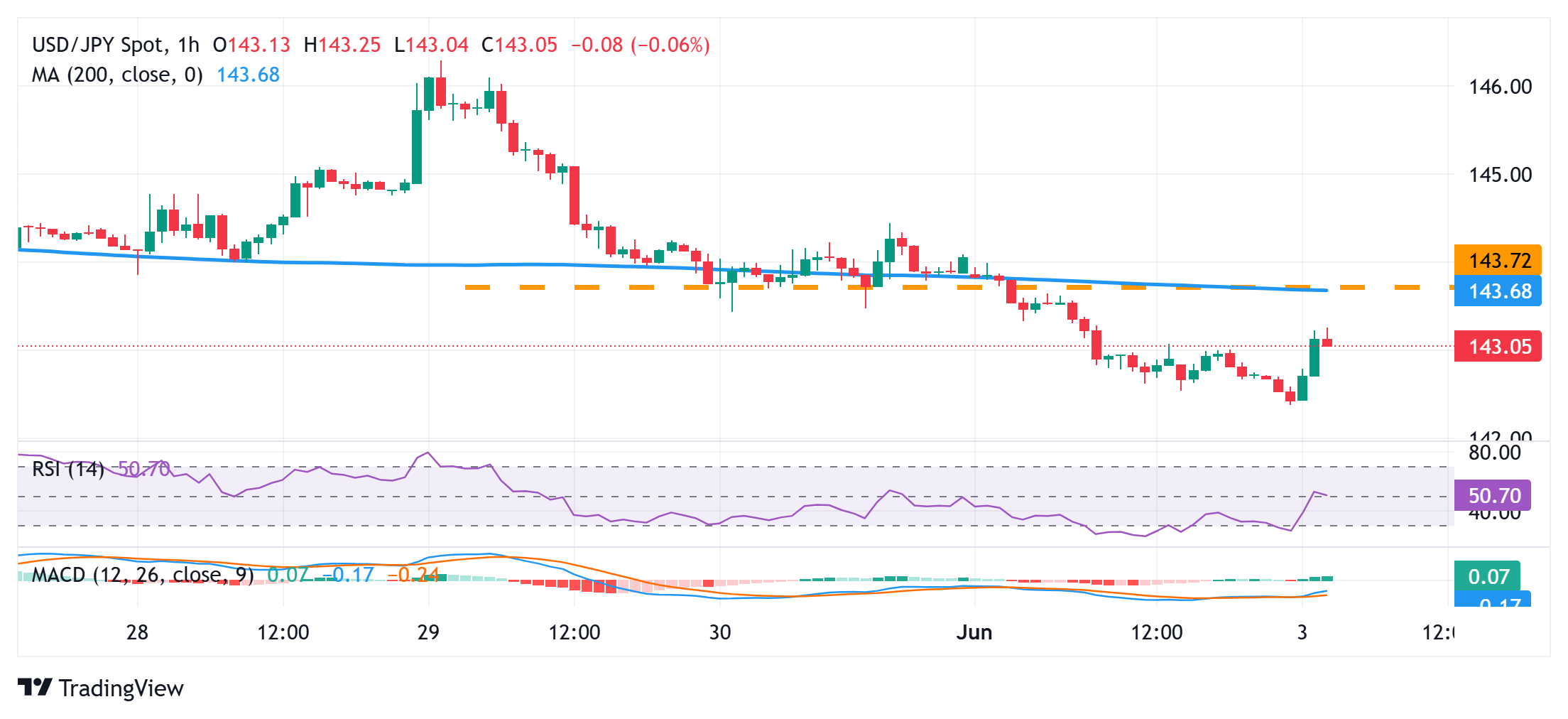
From a technical perspective, the overnight breakdown below the 143.65-143.60 horizontal support, which coincided with the 200-hour Simple Moving Average (SMA), was seen as a key trigger for the USD/JPY bears. The said area should now keep a lid on any further intraday move-up. A sustained strength beyond, however, might trigger a short-covering rally and lift spot prices to the 144.00 mark. The momentum could extend further, though it runs the risk of fizzling out near the 144.40-144.45 supply zone.
On the flip side, weakness back below the 143.00 mark could find some support near the Asian session low, around the 142.40-142.35 region. This is followed by the 142.10 area, or last week's swing low, below which the USD/JPY pair could resume its recent downfall from the May monthly swing high. Spot prices might then weaken to the next relevant support near the 141.60 area before eventually dropping to sub-141.00 levels.
Fed FAQs
Monetary policy in the US is shaped by the Federal Reserve (Fed). The Fed has two mandates: to achieve price stability and foster full employment. Its primary tool to achieve these goals is by adjusting interest rates. When prices are rising too quickly and inflation is above the Fed’s 2% target, it raises interest rates, increasing borrowing costs throughout the economy. This results in a stronger US Dollar (USD) as it makes the US a more attractive place for international investors to park their money. When inflation falls below 2% or the Unemployment Rate is too high, the Fed may lower interest rates to encourage borrowing, which weighs on the Greenback.
The Federal Reserve (Fed) holds eight policy meetings a year, where the Federal Open Market Committee (FOMC) assesses economic conditions and makes monetary policy decisions. The FOMC is attended by twelve Fed officials – the seven members of the Board of Governors, the president of the Federal Reserve Bank of New York, and four of the remaining eleven regional Reserve Bank presidents, who serve one-year terms on a rotating basis.
In extreme situations, the Federal Reserve may resort to a policy named Quantitative Easing (QE). QE is the process by which the Fed substantially increases the flow of credit in a stuck financial system. It is a non-standard policy measure used during crises or when inflation is extremely low. It was the Fed’s weapon of choice during the Great Financial Crisis in 2008. It involves the Fed printing more Dollars and using them to buy high grade bonds from financial institutions. QE usually weakens the US Dollar.
Quantitative tightening (QT) is the reverse process of QE, whereby the Federal Reserve stops buying bonds from financial institutions and does not reinvest the principal from the bonds it holds maturing, to purchase new bonds. It is usually positive for the value of the US Dollar.
Author

Haresh Menghani
FXStreet
Haresh Menghani is a detail-oriented professional with 10+ years of extensive experience in analysing the global financial markets.