Japanese Yen remains depressed; USD/JPY sits near nine-month top amid a firmer USD
- The Japanese Yen kicks off the new week on a softer note amid the BoJ rate-hike uncertainty.
- The JPY bulls seem rather unimpressed by Japan’s less-worse-than-expected Q3 GDP print.
- Reduced December Fed rate cut bets underpin the USD and lend support to the USD/JPY pair.

The Japanese Yen (JPY) sticks to its offered tone against a broadly firmer US Dollar (USD) through the early European session on Monday and remains close to a nine-month low touched last week. Government data released earlier today showed that Japan’s economy contracted in the July-September period for the first time in six quarters. This comes amid Japan's Prime Minister Sanae Takaichi’s fiscal stimulus plans and support for ultra-loose monetary policy, dampening bets for a Bank of Japan (BoJ) rate hike and undermining the JPY. The USD, on the other hand, benefits from reduced bets for another rate cut by the US Federal Reserve (Fed) in December and assists the USD/JPY pair in holding steady above the 154.45-154.50 supply zone.
The JPY bears, however, seem reluctant to place aggressive bets amid speculations that Japanese authorities might step into the markets to stem further weakness in the domestic currency. Apart from this, a weaker risk tone contributes to limiting losses for the safe-haven JPY. Furthermore, concerns about the weakening economic momentum on the back of the longest-ever US government shutdown could act as a headwind for the Greenback. This, in turn, warrants some caution before positioning for an extension of the USD/JPY pair's recent move up witnessed over the past month or so. Traders might also opt to wait for this week's release of FOMC meeting Minutes and the delayed US Nonfarm Payrolls (NFP) report for October.
Japanese Yen bears retain control amid diminishing odds for December BoJ rate hike and fiscal concerns
- The Cabinet Office reported this Monday that Japan's economy contracted by 0.4% in the July-September period, marking the first fall in six quarters. Furthermore, the Gross Domestic Product fell 1.8% year-on-year in the September quarter following a 2.3% rise in the previous quarter.
- The readings were less worse than consensus estimates, though pointed to a limited strength in the Japanese economy. This forced investors to pare their bets that the Bank of Japan will hike interest rates soon amid increasing political resistance and undermines the Japanese Yen.
- Japan's Prime Minister Sanae Takaichi’s administration is compiling a stimulus package to cushion the blow to households from rising living costs. Takaichi said last week that she would work on setting a new fiscal target extending through several years to allow more flexible spending.
- China and Japan exchanged sharp warnings after Takaichi’s remarks over the use of military force in any Taiwan conflict. In response, China threatened severe consequences, raising the risk of further escalation of tensions and the worsening diplomatic standoff between the two nations.
- This, in turn, is seen weighing on investors' sentiment and offering some support to the safe-haven JPY. Meanwhile, the recent decline in the JPY prompted some verbal intervention from Japanese authorities. This further holds back the JPY bears from placing fresh bets and limits losses.
- In fact, Japan's Finance Minister Satsuki Katayama said last week that she will be watching FX moves with a sense of urgency. Moreover, Japan's Economy Minister Minoru Kiuchi said on Friday that a weak JPY can push up CPI through import costs, warranting caution for the JPY bears.
- Meanwhile, a growing number of Federal Reserve policymakers signaled caution on further easing amid the lack of economic data. This tempers expectations for another interest rate cut by the US central bank in December, which lends some support to the US Dollar and the USD/JPY pair.
- The market attention now shifts to the delayed release of the closely-watched US Nonfarm Payrolls report on Thursday. Apart from this, FOMC meeting minutes and Fed speeches will be scrutinized for cues about the future rate-cut path, which should provide a fresh impetus to the buck.
USD/JPY sustained move above 155.00 should pave the way for further appreciation
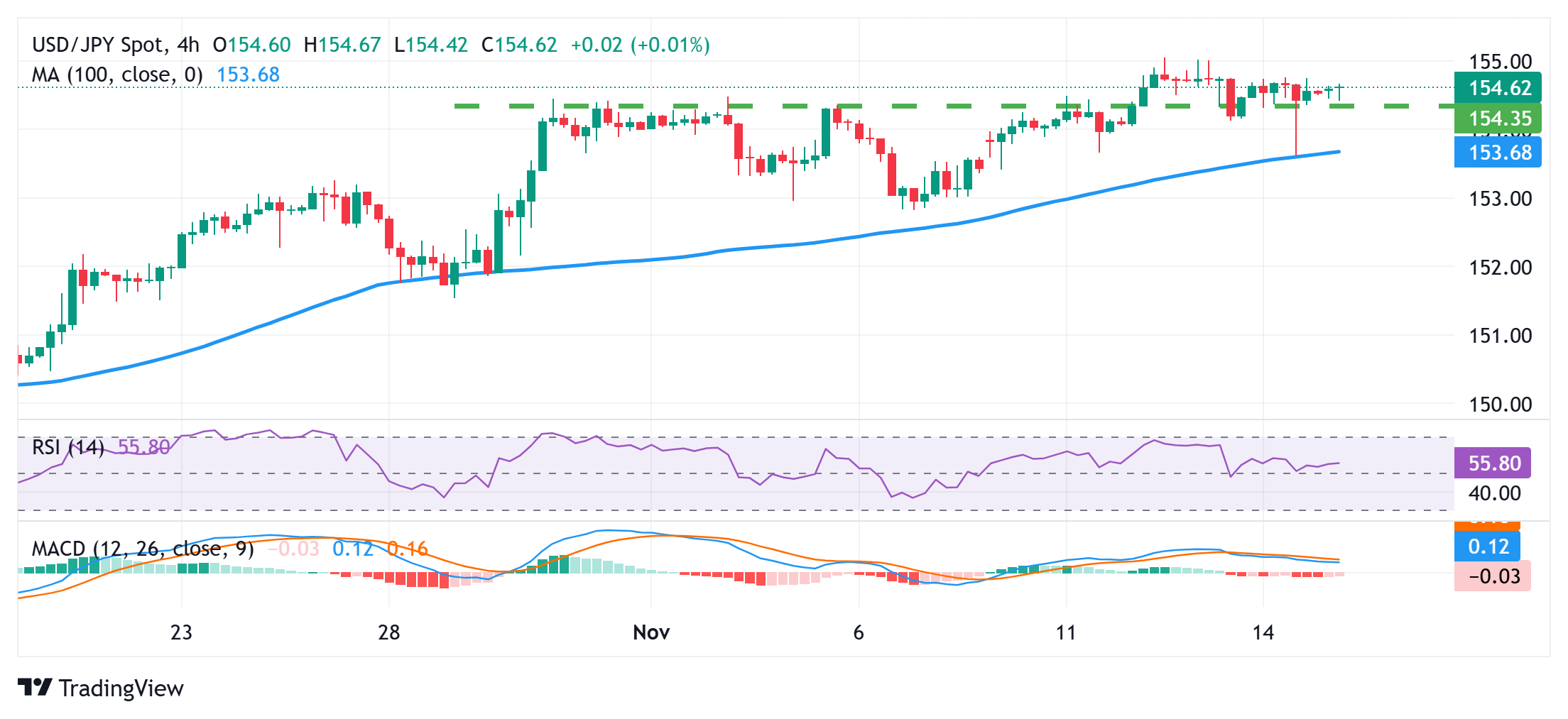
From a technical perspective, Friday's goodish rebound from the 153.60 support, representing the 100-period Simple Moving Average (SMA) on the 4-hour chart, and a close above the 154.45-154.50 hurdle favors the USD/JPY bulls. Moreover, oscillators on the daily chart are holding comfortably in positive territory and are still away from being in the overbought zone. Some follow-through buying and acceptance above the 155.00 psychological mark will reaffirm the constructive outlook and lift spot prices to the 155.60-155.65 intermediate barrier en route to the 156.00 round figure.
On the flip side, weakness below the 154.00 immediate support might continue to attract some buyers and find decent support near the 153.60-153.50 region, below which the USD/JPY pair could slide to the 153.00 round figure. The latter should act as a key pivotal point, which, if broken decisively, might shift the near-term bias in favor of bearish traders and drag spot prices to the next relevant support near the 152.15-152.10 area.
US Dollar FAQs
The US Dollar (USD) is the official currency of the United States of America, and the ‘de facto’ currency of a significant number of other countries where it is found in circulation alongside local notes. It is the most heavily traded currency in the world, accounting for over 88% of all global foreign exchange turnover, or an average of $6.6 trillion in transactions per day, according to data from 2022. Following the second world war, the USD took over from the British Pound as the world’s reserve currency. For most of its history, the US Dollar was backed by Gold, until the Bretton Woods Agreement in 1971 when the Gold Standard went away.
The most important single factor impacting on the value of the US Dollar is monetary policy, which is shaped by the Federal Reserve (Fed). The Fed has two mandates: to achieve price stability (control inflation) and foster full employment. Its primary tool to achieve these two goals is by adjusting interest rates. When prices are rising too quickly and inflation is above the Fed’s 2% target, the Fed will raise rates, which helps the USD value. When inflation falls below 2% or the Unemployment Rate is too high, the Fed may lower interest rates, which weighs on the Greenback.
In extreme situations, the Federal Reserve can also print more Dollars and enact quantitative easing (QE). QE is the process by which the Fed substantially increases the flow of credit in a stuck financial system. It is a non-standard policy measure used when credit has dried up because banks will not lend to each other (out of the fear of counterparty default). It is a last resort when simply lowering interest rates is unlikely to achieve the necessary result. It was the Fed’s weapon of choice to combat the credit crunch that occurred during the Great Financial Crisis in 2008. It involves the Fed printing more Dollars and using them to buy US government bonds predominantly from financial institutions. QE usually leads to a weaker US Dollar.
Quantitative tightening (QT) is the reverse process whereby the Federal Reserve stops buying bonds from financial institutions and does not reinvest the principal from the bonds it holds maturing in new purchases. It is usually positive for the US Dollar.
Author

Haresh Menghani
FXStreet
Haresh Menghani is a detail-oriented professional with 10+ years of extensive experience in analysing the global financial markets.

















