Japanese Yen sticks to negative bias; USD/JPY sits near eight-month top amid bullish USD
- The Japanese Yen continues to be undermined by the BoJ rate hike uncertainty.
- Receding safe-haven demand further weighs on the JPY amid a bullish US Dollar.
- The Fed’s hawkish tilt supports the USD despite the US government shutdown.

The Japanese Yen (JPY) retains its negative bias heading into the European session on Monday and languishes near its lowest level since February 14 against a bullish US Dollar (USD). Expectations that Japan's new Prime Minister Sanae Takaichi will pursue aggressive fiscal spending plans and resist policy tightening continue to fuel uncertainty over the likely timing of the next interest rate hike by the Bank of Japan (BoJ). This, along with the upbeat market mood, is seen as another factor undermining demand for the safe-haven JPY.
However, concerns about economic risks stemming from a prolonged US government shutdown and speculations that Japanese authorities could intervene to stem further weakness in the domestic currency could limit deeper JPY losses. The USD, on the other hand, is seen consolidating last week's strong gains to its highest level since early August amid the US Federal Reserve's (Fed) hawkish tilt. This, in turn, favors the USD/JPY bulls and backs the case for an extension of the pair's recent strong move up witnessed over the past three weeks or so.
Japanese Yen remains under selling pressure amid uncertainty over a BoJ rate hike this year
- The Bank of Japan held rates steady last Thursday despite two dissenting votes, with board members Naoki Tamura and Hajime Takata pushing for a hike to 0.75%. In the post-meeting press conference, BoJ Governor Kazuo Ueda said that there are no preset ideas about the timing of the next rate hike.
- Moreover, Japan's new Prime Minister, Sanae Takaichi, has a pro-stimulus stance, advocating for significant fiscal spending to tackle inflation and boost the economy. This reaffirms expectations that the BoJ could delay raising interest rates further and continues to undermine the Japanese Yen on Monday.
- Meanwhile, traders trimmed their bets for another interest rate cut by the US central bank in December following Federal Reserve Chair Jerome Powell's hawkish comments last Wednesday. This assists the US Dollar to stand firm near a three-month peak and further acts as a tailwind for the USD/JPY pair.
- US President Donald Trump again urged Republican senators to scrap the filibuster rule in the Senate as the US government shutdown enters Day 33 on Monday amid a deadlock in Congress. This, however, does little to dent the underlying bullish sentiment surrounding the USD or the currency pair.
- Trump said on Sunday that, for now, he is not considering a deal that would allow Ukraine to obtain long-range Tomahawk missiles for use against Russia. This, along with the optimism over the de-escalation of US-China trade tensions, undermines the JPY's safe-haven status and favors the USD/JPY bulls.
- Traders now look forward to the US economic docket – featuring the release of the ISM Manufacturing PMI. Apart from this, comments from influential FOMC members would play a key role in driving the USD demand and providing some impetus to the currency pair later during the North American session.
USD/JPY bulls have the upper hand while above the 153.25-153.30 resistance breakpoint
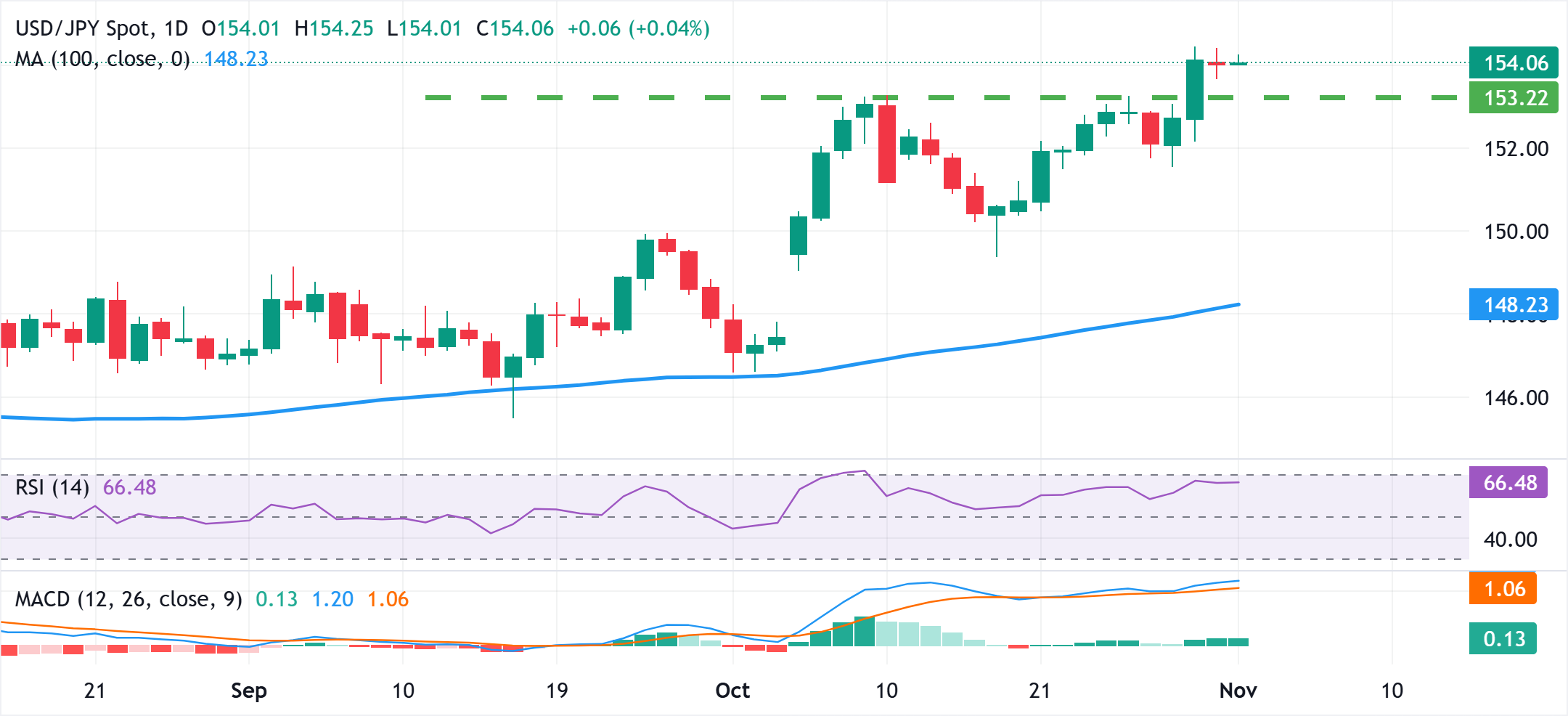
From a technical perspective, last week's breakout through the 153.25-153.30 hurdle, and a subsequent strength beyond the 154.00 mark, was seen as a key trigger for the USD/JPY bulls. Moreover, oscillators on the daily chart are holding comfortably in positive territory and are still away from being in the overbought zone. This, in turn, backs the case for a move towards the 154.75-154.80 intermediate hurdle en route to the 155.00 psychological mark.
On the flip side, any corrective pullback below the 154.00 mark is likely to find decent support near Friday's trough, around the 153.65 region. This is followed by the 153.30-153.25 resistance-turned-support and the 153.00 round figure, which, if broken decisively, might expose the 152.15 region. Some follow-through selling below the 152.00 mark would negate the near-term positive bias and drag the USD/JPY pair to the 151.55-151.50 area en route to the 151.10-151.00 key support.
Fed FAQs
Monetary policy in the US is shaped by the Federal Reserve (Fed). The Fed has two mandates: to achieve price stability and foster full employment. Its primary tool to achieve these goals is by adjusting interest rates. When prices are rising too quickly and inflation is above the Fed’s 2% target, it raises interest rates, increasing borrowing costs throughout the economy. This results in a stronger US Dollar (USD) as it makes the US a more attractive place for international investors to park their money. When inflation falls below 2% or the Unemployment Rate is too high, the Fed may lower interest rates to encourage borrowing, which weighs on the Greenback.
The Federal Reserve (Fed) holds eight policy meetings a year, where the Federal Open Market Committee (FOMC) assesses economic conditions and makes monetary policy decisions. The FOMC is attended by twelve Fed officials – the seven members of the Board of Governors, the president of the Federal Reserve Bank of New York, and four of the remaining eleven regional Reserve Bank presidents, who serve one-year terms on a rotating basis.
In extreme situations, the Federal Reserve may resort to a policy named Quantitative Easing (QE). QE is the process by which the Fed substantially increases the flow of credit in a stuck financial system. It is a non-standard policy measure used during crises or when inflation is extremely low. It was the Fed’s weapon of choice during the Great Financial Crisis in 2008. It involves the Fed printing more Dollars and using them to buy high grade bonds from financial institutions. QE usually weakens the US Dollar.
Quantitative tightening (QT) is the reverse process of QE, whereby the Federal Reserve stops buying bonds from financial institutions and does not reinvest the principal from the bonds it holds maturing, to purchase new bonds. It is usually positive for the value of the US Dollar.
Author

Haresh Menghani
FXStreet
Haresh Menghani is a detail-oriented professional with 10+ years of extensive experience in analysing the global financial markets.