Japanese Yen struggles to lure buyers amid tumbling JGB yields
- The Japanese Yen remains on the defensive amid a further steep decline in JGB yields.
- Bets that the BoJ will hike interest rates further should help limit any further JPY losses.
- Expectations for additional Fed rate cuts undermine the USD and cap the USD/JPY pair.

The Japanese Yen (JPY) trades with a mild negative bias against its American counterpart heading into the European session on Tuesday, though the downside seems cushioned. Bank of Japan (BoJ) Governor Kazuo Ueda's remarks last week, saying that the central bank stands ready to increase government bond buying if long-term interest rates rise sharply, leads to a further steep decline in the Japanese government bond (JGB) yields. This, in turn, is seen as a key factor undermining the JPY, which, along with a modest US Dollar (USD) uptick, acts as a tailwind for the USD/JPY pair.
Meanwhile, Japan's Services Producer Price Index (PPI) released earlier this Tuesday underscores the view that rising wages are persuading firms to pass on higher labour costs through price hikes. This comes on top of strong consumer inflation figures from Japan and reaffirms bets that the Bank of Japan (BoJ) will hike interest rates further, which, in turn, holds back the JPY bears from placing aggressive bets. Furthermore, expectations that the Federal Reserve (Fed) would cut rates further this year keep the USD bulls on the defensive and might further contribute to capping the USD/JPY pair.
Japanese Yen bulls remain on the back foot amid tumbling JGB yields
- Bank of Japan Governor Kazuo Ueda issued a mild warning last Friday and said that the central bank could increase bond buying if abnormal market moves trigger a sharp rise in yields.
- Ueda's remarks dragged the yield on the benchmark Japanese government bond away from its highest level since November 2009 and continue to weigh on the Japanese Yen this Tuesday.
- Some market players, however, expect that the 10-year JGB could rise to 1.5% in the coming weeks, with growing acceptance that the BoJ will hike rates further amid broadening inflation in Japan.
- The bets were lifted by Japan's strong consumer inflation figures released last week and the Services Producer Price Index (PPI), which rose 3.1% YoY in January and signaled persistent cost pressures.
- The recent downbeat US economic data raised doubts about consumer health and the growth outlook amid worries that US President Donald Trump's tariff plans could undermine domestic demand.
- The S&P Global's flash US PMIs pointed to a weaker expansion in overall business activity and the University of Michigan's US Consumer Sentiment Index dropped to a 15-month low in February.
- Federal Reserve officials, however, remain wary of future rate cuts. In fact, Chicago Fed President Austan Goolsbee said that the central bank needs more clarity on Trump's policies before going back to cut rates.
- This assists the US Dollar in building on the previous day's bounce from its lowest level since December 10 and continues to push the USD/JPY pair higher for the second successive day on Tuesday.
- Traders now look to the US macro data – Conference Board's Consumer Confidence Index and Richmond Manufacturing Index. This, along with Fed speaks, might influence the USD.
- The focus, however, will remain glued to the release of the US Personal Consumption Expenditure (PCE) Price Index on Friday, which could provide cues about the Fed's rate-cut path.
USD/JPY remains vulnerable while below 151.00-150.90 support breakpoint
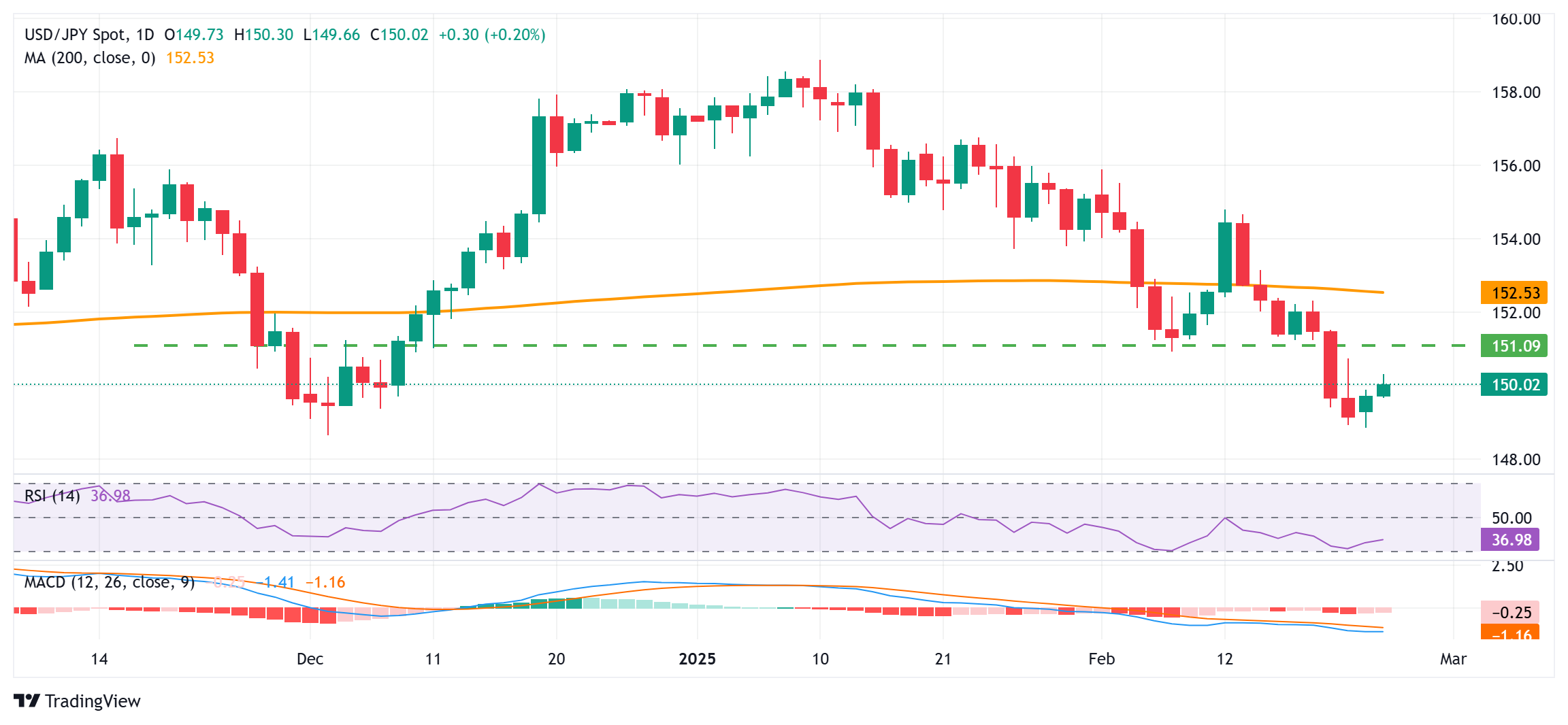
From a technical perspective, any subsequent move-up could attract fresh sellers and remain capped near the 150.90-151.00 horizontal support breakpoint. A sustained strength beyond, however, might trigger a short-covering rally and lift the USD/JPY pair towards the 151.40 intermediate hurdle en route to the 152.00 mark. The momentum could extend further, though it runs the risk of fizzling out rather quickly near the 152.65 area, representing the very important 200-day Simple Moving Average (SMA).
On the flip side, the 149.65-149.60 area, or the Asian session low now seems to protect the immediate downside ahead of the 149.30 region and the 149.00 round figure. Some follow-through selling below the 148.65 zone, or the lowest level since December 2024 touched on Monday, would be seen as a fresh trigger for bearish traders. Given that oscillators on the daily chart are holding deep in negative territory, the USD/JPY pair might then decline further towards the 148.00 mark en route to the 147.45 region before eventually dropping to the 147.00 round figure.
Japanese Yen FAQs
The Japanese Yen (JPY) is one of the world’s most traded currencies. Its value is broadly determined by the performance of the Japanese economy, but more specifically by the Bank of Japan’s policy, the differential between Japanese and US bond yields, or risk sentiment among traders, among other factors.
One of the Bank of Japan’s mandates is currency control, so its moves are key for the Yen. The BoJ has directly intervened in currency markets sometimes, generally to lower the value of the Yen, although it refrains from doing it often due to political concerns of its main trading partners. The BoJ ultra-loose monetary policy between 2013 and 2024 caused the Yen to depreciate against its main currency peers due to an increasing policy divergence between the Bank of Japan and other main central banks. More recently, the gradually unwinding of this ultra-loose policy has given some support to the Yen.
Over the last decade, the BoJ’s stance of sticking to ultra-loose monetary policy has led to a widening policy divergence with other central banks, particularly with the US Federal Reserve. This supported a widening of the differential between the 10-year US and Japanese bonds, which favored the US Dollar against the Japanese Yen. The BoJ decision in 2024 to gradually abandon the ultra-loose policy, coupled with interest-rate cuts in other major central banks, is narrowing this differential.
The Japanese Yen is often seen as a safe-haven investment. This means that in times of market stress, investors are more likely to put their money in the Japanese currency due to its supposed reliability and stability. Turbulent times are likely to strengthen the Yen’s value against other currencies seen as more risky to invest in.
Author

Haresh Menghani
FXStreet
Haresh Menghani is a detail-oriented professional with 10+ years of extensive experience in analysing the global financial markets.