Japanese Yen remains on the back foot; lacks bearish conviction amid relatively hawkish BoJ expectations
- The Japanese Yen struggles to lure buyers as trade optimism undermines safe-haven assets.
- A modest USD uptick lends additional support to USD/JPY, though the upside seems capped.
- The divergent BoJ-Fed policy expectations might continue to act as a headwind for the pair.

The Japanese Yen (JPY) extends its intraday consolidative price move through the early European session on Wednesday and is currently placed near a two-week low touched against its American counterpart the previous day. Data released earlier today showed that Japan's annual wholesale inflation slowed in May, taking some pressure off the Bank of Japan (BoJ) to raise interest rates. This, along with the optimism over a positive outcome from US-China trade talks, turns out to be key factors undermining the safe-haven JPY.
The JPY bears, however, seem reluctant to place aggressive bets as the markets are still pricing in the possibility of further policy normalization by the BoJ. In contrast, the Federal Reserve (Fed) is expected to lower borrowing costs further in 2025, which fails to assist the US Dollar (USD) to capitalize on its modest intraday gains and helps limit the downside for the lower-yielding JPY. Traders also seem reluctant to place directional bets around the USD/JPY pair and opt to wait for the release of the US consumer inflation figures.
Japanese Yen maintains its offered tone as traders scale back BoJ rate hike bets
- Data released this Wednesday showed that Japan's Corporate Goods Price Index (CGPI), which measures the price companies charge each other for their goods and services, rose 3.2% in May from a year earlier. The reading fell short of the median market forecast for a 3.5% gain.
- A Reuters poll indicated that a slight majority of economists expect that the Bank of Japan will forego another interest rate hike this year. Investors, however, seem convinced that the BOJ might push for tighter monetary conditions amid signs of broadening inflation in Japan.
- Investors turned cautious after a federal appeals court ruled that US President Donald Trump's “Liberation Day” tariffs on most trading partners could remain in effect while it reviewed a lower court decision to block them. The court, however, is yet to rule on whether the tariffs are permissible under an emergency economic powers act that Trump cited to justify them.
- China’s Vice Commerce Minister Li Chenggang told reporters that the Chinese and the US negotiators have agreed on a framework for trade after two days of talks in London. US Commerce Secretary Howard Lutnick said that the framework was the first step to eliminate the negativity, and the implementation plan should result in the resolution of rare earth and magnet issues.
- The optimism stemming from the positive outcome of the crucial US-China trade talks remains supportive of a generally upbeat tone in the equity markets. It undermines the safe-haven status of the JPY. Moreover, signs of easing tensions between the world's two largest economies assist the US Dollar to attract some buyers and further act as a tailwind for the USD/JPY pair.
- Traders pared their bets that the Federal Reserve will cut interest rates in the next few months following the release of the US Nonfarm Payrolls (NFP) report on Friday, which pointed to a resilient labor market. Traders, however, are still pricing in around 0.45% of easing by the year-end, marking a significant divergence in comparison to hawkish BoJ expectations.
- Traders now look forward to the release of the US Consumer Price Index (CPI), which is forecast to show a pickup that may reinforce the Fed’s wait-and-see stance toward further easing. Nevertheless, the crucial data will be scrutinized for cues about the Fed's rate-cut path, which, in turn, will influence the USD price dynamics and provide a fresh impetus.
USD/JPY bulls await move beyond the 145.30 hurdle before placing fresh bets
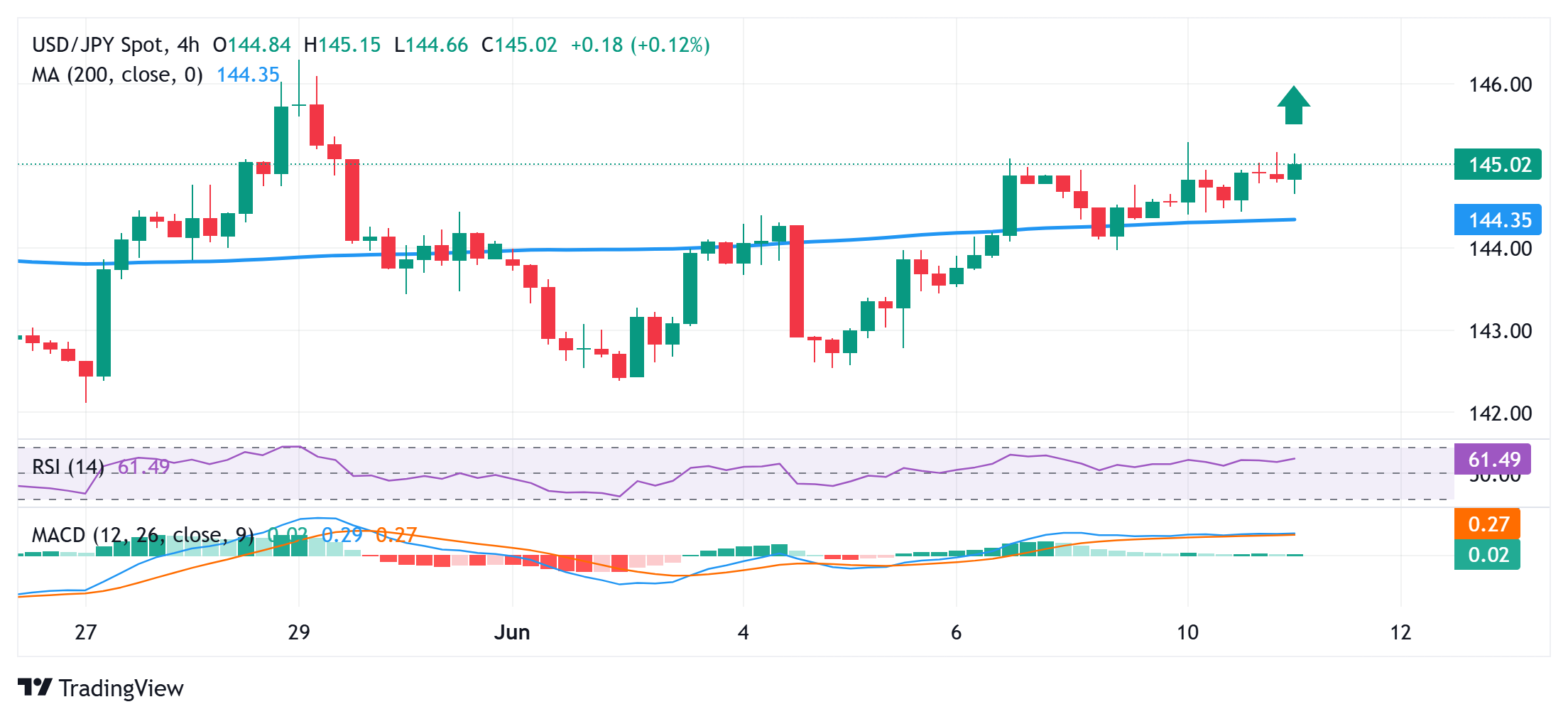
From a technical perspective, acceptance above the 100-period Simple Moving Average (SMA) and positive oscillators on daily/hourly charts favor the USD/JPY bulls. However, repeated failures to build on momentum beyond the 145.00 psychological mark make it prudent to wait for some follow-through buying beyond the 145.30 area, or a two-week top touched on Tuesday, before positioning for further gains. Spot prices might then surpass the 145.60-145.65 intermediate hurdle and aim to reclaim the 146.00 round figure before climbing further towards the 146.25-146.30 region, or May 29 swing high.
On the flip side, the 200-period SMA on the 4-hour chart, currently pegged near the 144.30 area, might now protect the immediate downside ahead of the 144.00 mark. A convincing break below the latter will negate the positive outlook and shift the near-term bias in favor of the USD/JPY bears. The subsequent decline could drag spot prices down to the 143.60-143.50 region en route to sub-143.00 levels.
US Dollar PRICE Today
The table below shows the percentage change of US Dollar (USD) against listed major currencies today. US Dollar was the strongest against the New Zealand Dollar.
| USD | EUR | GBP | JPY | CAD | AUD | NZD | CHF | |
|---|---|---|---|---|---|---|---|---|
| USD | 0.15% | 0.25% | 0.16% | 0.08% | 0.16% | 0.43% | 0.08% | |
| EUR | -0.15% | 0.09% | 0.03% | -0.09% | 0.00% | 0.23% | -0.07% | |
| GBP | -0.25% | -0.09% | -0.08% | -0.15% | -0.07% | 0.15% | -0.17% | |
| JPY | -0.16% | -0.03% | 0.08% | -0.21% | -0.01% | 0.23% | -0.13% | |
| CAD | -0.08% | 0.09% | 0.15% | 0.21% | 0.12% | 0.32% | -0.03% | |
| AUD | -0.16% | -0.00% | 0.07% | 0.01% | -0.12% | 0.22% | -0.09% | |
| NZD | -0.43% | -0.23% | -0.15% | -0.23% | -0.32% | -0.22% | -0.32% | |
| CHF | -0.08% | 0.07% | 0.17% | 0.13% | 0.03% | 0.09% | 0.32% |
The heat map shows percentage changes of major currencies against each other. The base currency is picked from the left column, while the quote currency is picked from the top row. For example, if you pick the US Dollar from the left column and move along the horizontal line to the Japanese Yen, the percentage change displayed in the box will represent USD (base)/JPY (quote).
Author

Haresh Menghani
FXStreet
Haresh Menghani is a detail-oriented professional with 10+ years of extensive experience in analysing the global financial markets.