Japanese Yen struggles to capitalize on intraday gains amid political uncertainty
- The Japanese Yen strengthened following some verbal intervention from Japanese authorities.
- The USD pulls back from an over two-month high and further exerts pressure on USD/JPY.
- Any meaningful JPY appreciation seems elusive amid political uncertainty and fiscal concerns.

The Japanese Yen (JPY) maintains its bid tone heading into the European session on Friday amid some verbal intervention from Japan's Finance Minister Kato. Moreover, bets for another interest rate hike by the Bank of Japan (BoJ) this year, along with the cautious market mood, continue to underpin the safe-haven JPY. Apart from this, a modest US Dollar (USD) downtick drags the USD/JPY pair away from its highest level since February 13, touched earlier today.
Meanwhile, reports suggest that Japan's Komeito party will leave the ruling coalition led by the Liberal Democratic Party (LDP). This could jeopardize the path for newly elected LDP chief Sanae Takaichi to become Japan's first female Prime Minister and adds a layer of uncertainty. Furthermore, expectations that Takaichi's expansive fiscal policies could further delay the BoJ's tightening plan keep a lid on any further JPY depreciation and limit losses for the USD/JPY pair.
Japanese Yen bulls lack conviction as domestic political turmoil offsets verbal intervention
- Public broadcaster NHK reported this Friday that Japan's Komeito party will leave the ruling coalition led by the Liberal Democratic Party (LDP). The report added that Komeito leader Tetsuo Saito informed LDP chief Sanae Takaichi of the decision to end a 26-year partnership at a meeting on Friday.
- This comes on top of growing concerns over Japan’s fiscal health and dimming hopes for an immediate interest rate hike by the Bank of Japan following Takaichi's surprise win at the LDP's leadership race last Saturday, which fueled speculations about more expansionary fiscal policy.
- Takaichi is seen as a supporter of the former Premier Shinzo Abe's economic policies, who advocated for heavy spending and monetary stimulus to support the Japanese economy. Takaichi is also expected to oppose any further policy tightening by the BoJ, which, in turn, has been a key factor behind the Japanese Yen's broad underperformance since the start of the current week.
- Meanwhile, inflation in Japan has stayed at or above the BoJ’s 2% target for more than three years, and the economy expanded for a fifth straight quarter in the three months through June. Moreover, Takaichi's economic advisors – such as Etsuro Honda and Takuji Aida – were quoted as saying that Japan's new PM would probably tolerate another rate hike either in December or in January.
- Furthermore, Takaichi said that she did not want to trigger excessive declines in the domestic currency. Moreover, Japan's Finance Minister Katsunobu Kato said on Friday that authorities will thoroughly monitor for excessive fluctuations and disorderly movements in the forex market. Kato added that it’s important for currencies to move in a stable manner, reflecting fundamentals.
- This, in turn, provides some respite to the JPY bulls during the Asian session on Friday. Apart from this, the cautious tone around the Asian equity markets assists the safe-haven JPY to recover slightly from its lowest level since February 13, touched against a retreating US Dollar during the Asian session this Friday.
- The USD Index (DXY), which tracks the Greenback against a basket of currencies, shot to over a two-month peak on Thursday amid the ongoing political turmoil in Japan and France. The USD bulls seem unaffected by rising bets for two more interest rate cuts by the US Federal Reserve this year and concerns that a prolonged US government shutdown could affect the economic performance.
- The government shutdown is now in its second week amid few signs of progress toward a deal to advance funding bills, with the Senate rejecting motions to advance competing bills for the seventh time on Thursday. The Senate will not hold any further votes, and the shutdown will extend until at least next week, when the upper chamber is expected to return on Tuesday.
- Friday's US economic docket features the release of the University of Michigan Consumer Sentiment Index, later during the North American session. Apart from this, comments from influential FOMC members would drive the USD and provide some impetus to the USD/JPY pair, which remains on track to register strong weekly gains and post its highest weekly close since late January.
USD/JPY bulls have the upper hand while above the 152.00 horizontal resistance breakpoint
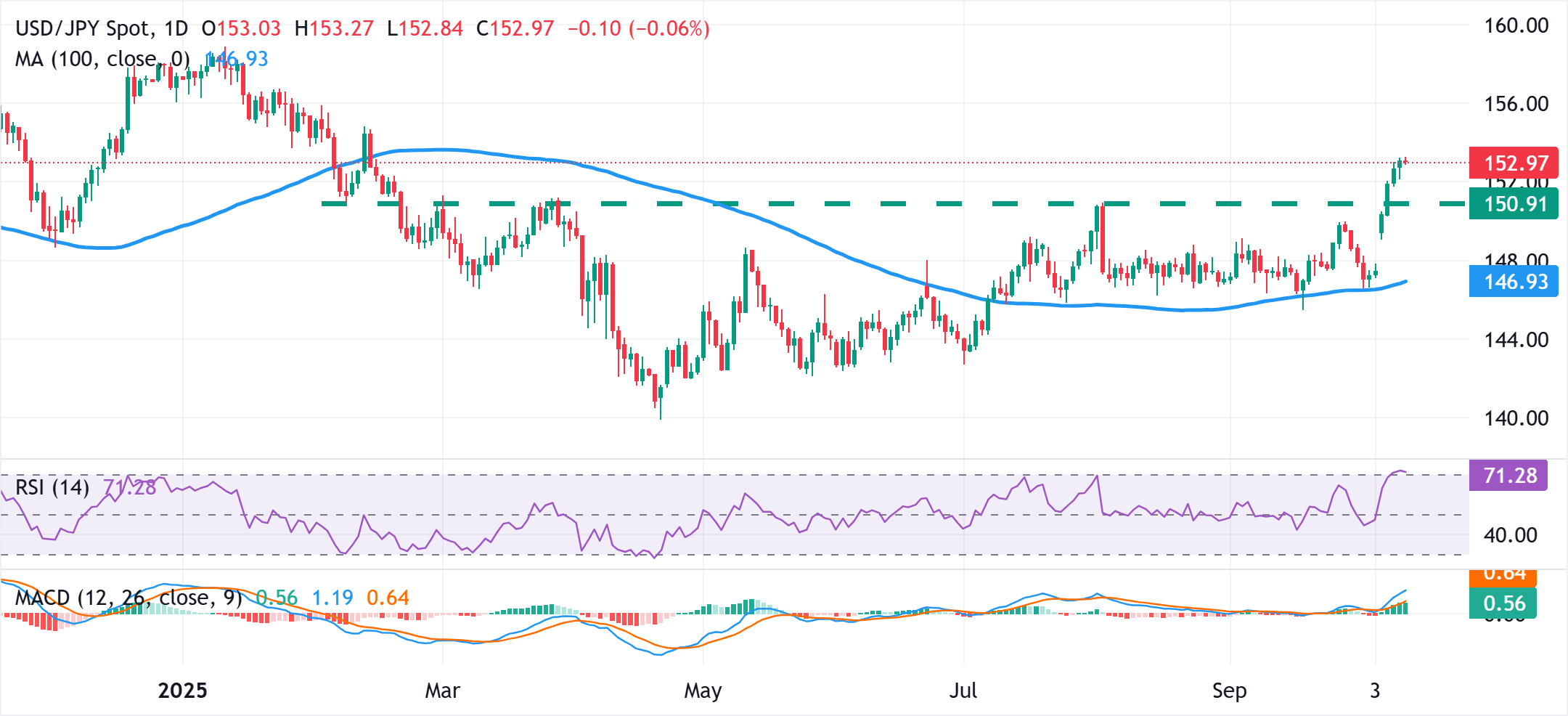
The overnight close above the 153.00 mark comes on top of the recent breakout through the 151.00 key hurdle and backs the case for further gains for the USD/JPY pair. However, the daily Relative Strength Index (RSI) is flashing slightly overbought conditions and holding back bulls from placing fresh bets. Nevertheless, the broader technical setup suggests that the path of least resistance for spot prices remains to the upside, and any corrective pullback might be seen as a buying opportunity near the 152.60-152.55 region. This should help limit the downside near the 152.00 round figure.
On the flip side, any further move up is likely to confront some resistance near the 153.70-153.75 region. This is followed by the 154.00 mark, above which the USD/JPY pair could accelerate the momentum towards the 154.70-154.80 zone (February 11 swing high) and reclaim the 155.00 psychological mark.
Japanese Yen FAQs
The Japanese Yen (JPY) is one of the world’s most traded currencies. Its value is broadly determined by the performance of the Japanese economy, but more specifically by the Bank of Japan’s policy, the differential between Japanese and US bond yields, or risk sentiment among traders, among other factors.
One of the Bank of Japan’s mandates is currency control, so its moves are key for the Yen. The BoJ has directly intervened in currency markets sometimes, generally to lower the value of the Yen, although it refrains from doing it often due to political concerns of its main trading partners. The BoJ ultra-loose monetary policy between 2013 and 2024 caused the Yen to depreciate against its main currency peers due to an increasing policy divergence between the Bank of Japan and other main central banks. More recently, the gradually unwinding of this ultra-loose policy has given some support to the Yen.
Over the last decade, the BoJ’s stance of sticking to ultra-loose monetary policy has led to a widening policy divergence with other central banks, particularly with the US Federal Reserve. This supported a widening of the differential between the 10-year US and Japanese bonds, which favored the US Dollar against the Japanese Yen. The BoJ decision in 2024 to gradually abandon the ultra-loose policy, coupled with interest-rate cuts in other major central banks, is narrowing this differential.
The Japanese Yen is often seen as a safe-haven investment. This means that in times of market stress, investors are more likely to put their money in the Japanese currency due to its supposed reliability and stability. Turbulent times are likely to strengthen the Yen’s value against other currencies seen as more risky to invest in.
Author

Haresh Menghani
FXStreet
Haresh Menghani is a detail-oriented professional with 10+ years of extensive experience in analysing the global financial markets.

















