Japanese Yen bulls retain control amid hawkish BoJ; USD/JPY seems vulnerable near 148.00
- The Japanese Yen attracts some dip-buyers despite a divided BoJ Summary of Opinions.
- Disappointing macro data and a positive risk tone also do little to undermine the JPY.
- The divergent BoJ-Fed policy expectations also act as a headwind for the USD/JPY pair.

The Japanese Yen (JPY) extends its intraday ascent through the early European session on Tuesday, which, along with sustained US Dollar (USD) selling bias, drags the USD/JPY pair to the 148.00 neighborhood in the last hour. Despite a divided Bank of Japan’s (BoJ) Summary of Opinions, investors seem convinced that the central bank will stick to its policy normalization path. This offsets the disappointing release of Industrial Production figures and Retail Sales data from Japan and acts as a tailwind for the JPY.
Apart from this, rising geopolitical tensions and concerns about the looming US government shutdown turn out to be another factor underpinning the safe-haven JPY. Meanwhile, the BoJ's hawkish tilt marks a significant divergence in comparison to the growing acceptance that the US Federal Reserve (Fed) will lower borrowing costs twice by the year-end. The latter keeps the USD depressed and benefits the lower-yielding JPY. This, in turn, suggests that the path of least resistance for the USD/JPY pair is to the downside.
Japanese Yen is underpinned by hawkish BoJ bets and safe-haven buying
- The Bank of Japan's Summary of Opinions from the September meeting, released earlier this Tuesday, showed increasing pressure from hawks to normalise policy. That said, dovish policymakers highlighted uncertainty over inflation dynamics and global grade uncertainties.
- On the economic data front, Retail Sales in Japan fell 1.1% year-on-year in August, marking their first decline since Feb 2022 and the biggest fall since August 2021. Moreover, the reading was well below market expectations of a 1% rise and a 0.4% rise recorded in the previous month.
- A separate government report showed that Japan's Industrial Production declined for the second consecutive month, by 1.2% in August compared to consensus estimates for a 0.7% contraction. The data suggested that businesses remained cautious amid persistent concerns about US tariffs.
- In the latest trade-related developments, the White House announced early Tuesday that US President Donald Trump signed a proclamation adjusting imports of timber, lumber, and derivative products into the US. Meanwhile, imports from the European Union and Japan were capped at 15%.
- Adding to this, domestic political uncertainty continues to fuel speculations that the BoJ will delay raising interest rates further, which fails to assist the Japanese Yen to build on a two-day-old move up against the US Dollar. Any meaningful depreciating move for the JPY, however, seems elusive.
- Traders are still pricing in the possibility of a 25-basis-point rate hike by the BoJ in October. In contrast, the Federal Reserve is expected to cut rates twice by the year-end. The latter should cap the USD amid the looming US government shutdown and offer support to the lower-yielding JPY.
USD/JPY seems vulnerable to weaken further to the 147.60-147.55 support
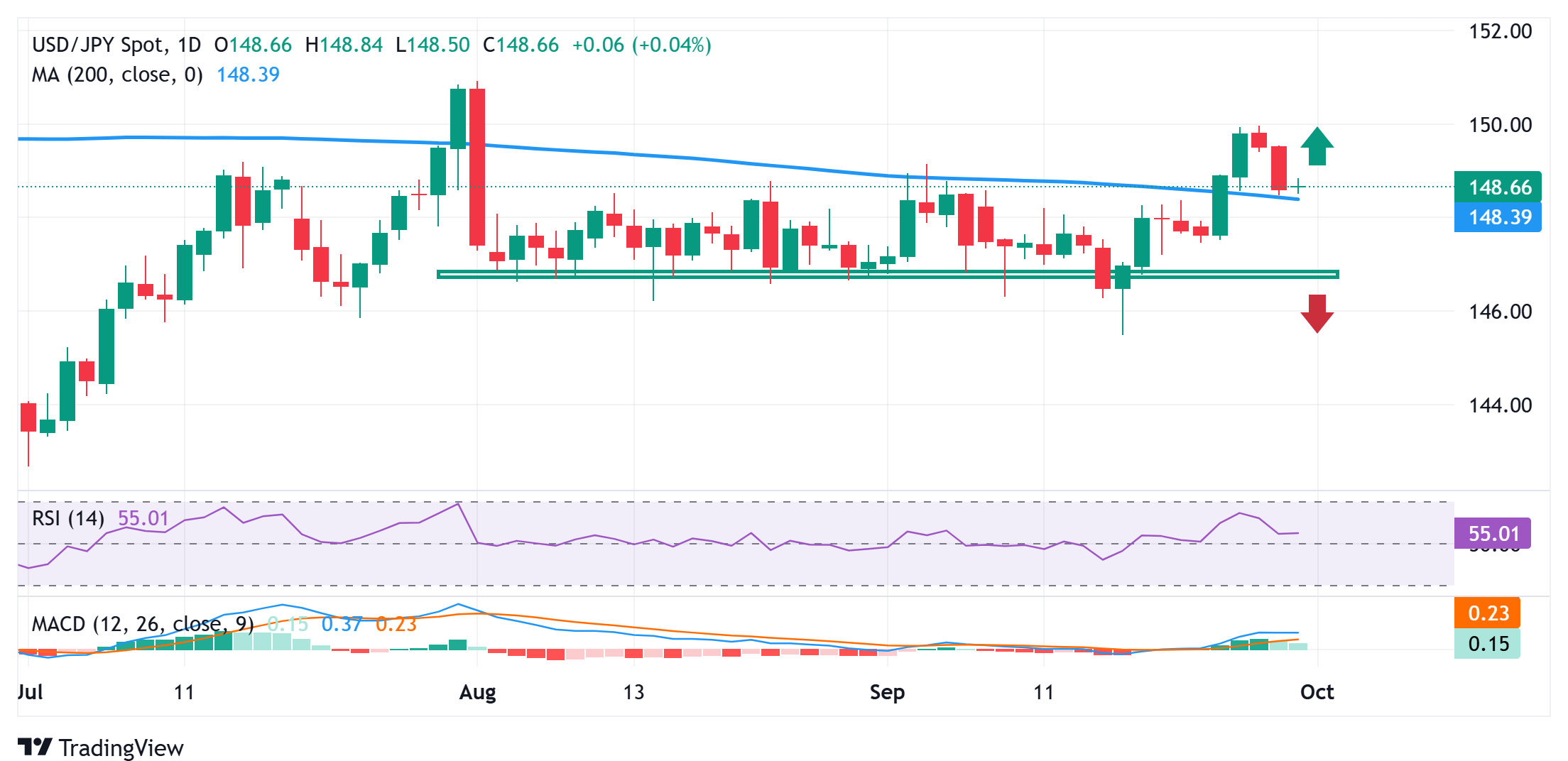
The USD/JPY pair finds some support and defends a technically significant 200-day Simple Moving Average (SMA). Adding to this, oscillators on the daily chart – though they have been losing traction – are holding in positive territory. This, in turn, favors bullish traders and backs the case for additional gains. Any further move up, however, is likely to confront a hurdle near the 149.00 mark. A sustained strength beyond will reaffirm the positive outlook and allow spot prices to make a fresh attempt to conquer the 150.00 psychological mark with some intermediate resistance near the 149.40-149.45 region.
On the flip side, weakness below the 200-day SMA, currently pegged near the 148.40 region, could pave the way for a slide towards the 148.00 round figure. Some follow-through selling will negate any near-term positive bias and make the USD/JPY pair vulnerable to accelerate the slide towards the 147.50 region en route to the 147.20-147.15 zone. This is followed by the 147.00 mark, which, if broken decisively, might shift the near-term bias in favor of bearish traders.
Fed FAQs
Monetary policy in the US is shaped by the Federal Reserve (Fed). The Fed has two mandates: to achieve price stability and foster full employment. Its primary tool to achieve these goals is by adjusting interest rates. When prices are rising too quickly and inflation is above the Fed’s 2% target, it raises interest rates, increasing borrowing costs throughout the economy. This results in a stronger US Dollar (USD) as it makes the US a more attractive place for international investors to park their money. When inflation falls below 2% or the Unemployment Rate is too high, the Fed may lower interest rates to encourage borrowing, which weighs on the Greenback.
The Federal Reserve (Fed) holds eight policy meetings a year, where the Federal Open Market Committee (FOMC) assesses economic conditions and makes monetary policy decisions. The FOMC is attended by twelve Fed officials – the seven members of the Board of Governors, the president of the Federal Reserve Bank of New York, and four of the remaining eleven regional Reserve Bank presidents, who serve one-year terms on a rotating basis.
In extreme situations, the Federal Reserve may resort to a policy named Quantitative Easing (QE). QE is the process by which the Fed substantially increases the flow of credit in a stuck financial system. It is a non-standard policy measure used during crises or when inflation is extremely low. It was the Fed’s weapon of choice during the Great Financial Crisis in 2008. It involves the Fed printing more Dollars and using them to buy high grade bonds from financial institutions. QE usually weakens the US Dollar.
Quantitative tightening (QT) is the reverse process of QE, whereby the Federal Reserve stops buying bonds from financial institutions and does not reinvest the principal from the bonds it holds maturing, to purchase new bonds. It is usually positive for the value of the US Dollar.
Author

Haresh Menghani
FXStreet
Haresh Menghani is a detail-oriented professional with 10+ years of extensive experience in analysing the global financial markets.
















