Japanese Yen remains subdued due to the potential for BoJ to delay rate hikes
- The Japanese Yen receives downward pressure as traders assess BoJ's policy outlook.
- BoJ Ueda indicated to evaluate market and economic conditions before making any policy adjustments, signaling no urgency for rate hikes.
- The US Dollar faces challenges due to rising dovish sentiment surrounding the Fed’s policy outlook.

The Japanese Yen (JPY) inches lower against the US Dollar (USD) on Wednesday as investors assess the Bank of Japan's (BoJ) monetary policy outlook. On Tuesday, BoJ Governor Kazuo Ueda indicated that the central bank has time to evaluate market and economic conditions before making any policy adjustments, signaling that there is no urgency to raise interest rates again.
BoJ Governor Kazuo Ueda also noted that Japan's real interest rate remains deeply negative, which is helping to stimulate the economy and drive up prices. Additionally, Finance Minister Shunichi Suzuki expressed his expectation that the Bank of Japan will take appropriate monetary policy actions while continuing to coordinate closely with the government.
Traders are now focused on the release of the BoJ Monetary Policy Meeting Minutes on Thursday, followed by Tokyo’s inflation data on Friday, to provide further guidance on the economic outlook and potential monetary policy moves.
The USD/JPY pair received downward pressure as the US Dollar struggled following weaker consumer confidence data from the United States (US) released on Tuesday, which added to dovish expectations for the Federal Reserve (Fed) for its upcoming monetary policy decision.
Daily Digest Market Movers: Japanese Yen remains subdued amid confusion over BoJ policy outlook
- Federal Reserve Governor Michelle Bowman stated on Tuesday that key inflation indicators are still "uncomfortably above" the 2% target, urging caution as the Fed moves forward with interest rate cuts. Despite this, she expressed a preference for a more conventional approach, advocating for a quarter percentage point reduction.
- US Consumer Confidence Index fell to 98.7 in September from a revised 105.6 in August. This figure registered the biggest decline since August 2021.
- The Jibun Bank Japan Composite Purchasing Managers Index (PMI) declined to 52.5 in September, down from a final reading of 52.9 in August, which was the highest in 15 months. Despite this decrease, it marks the eighth consecutive month of growth in private sector activity this year, primarily driven by the service sector. The Services PMI increased to 53.9 in September, up from a final 53.7 in the previous month.
- The S&P Global US Composite PMI grew at a slower rate in September, registering 54.4 compared to 54.6 in August. The Manufacturing PMI unexpectedly dropped to 47.0, indicating contraction, while the Services PMI expanded more than anticipated, reaching 55.4.
- Minneapolis Fed President Neel Kashkari said on Monday that he believes there should be and will be additional interest rate cuts in 2024. However, Kashkari expects future cuts to be smaller than the one from the September meeting, per Reuters.
- Chicago Fed President Austan Goolsbee noted, “Many more rate cuts are likely needed over the next year, rates need to come down significantly.” Additionally, Atlanta Fed President Raphael Bostic said Monday that the US economy is close to normal rates of inflation and unemployment and the central bank needs monetary policy to "normalize" as well, per Reuters.
- On Monday, Japan's new "top currency diplomat," Atsushi Mimura, stated in an interview with NHK that the Yen carry trades accumulated in the past have likely been mostly unwound. Mimura cautioned that if such trades were to increase again, it could lead to heightened market volatility. "We are always monitoring the markets to ensure that does not happen," he added.
Technical Analysis: USD/JPY remains near 143.50; aligns with the upper boundary of a descending channel
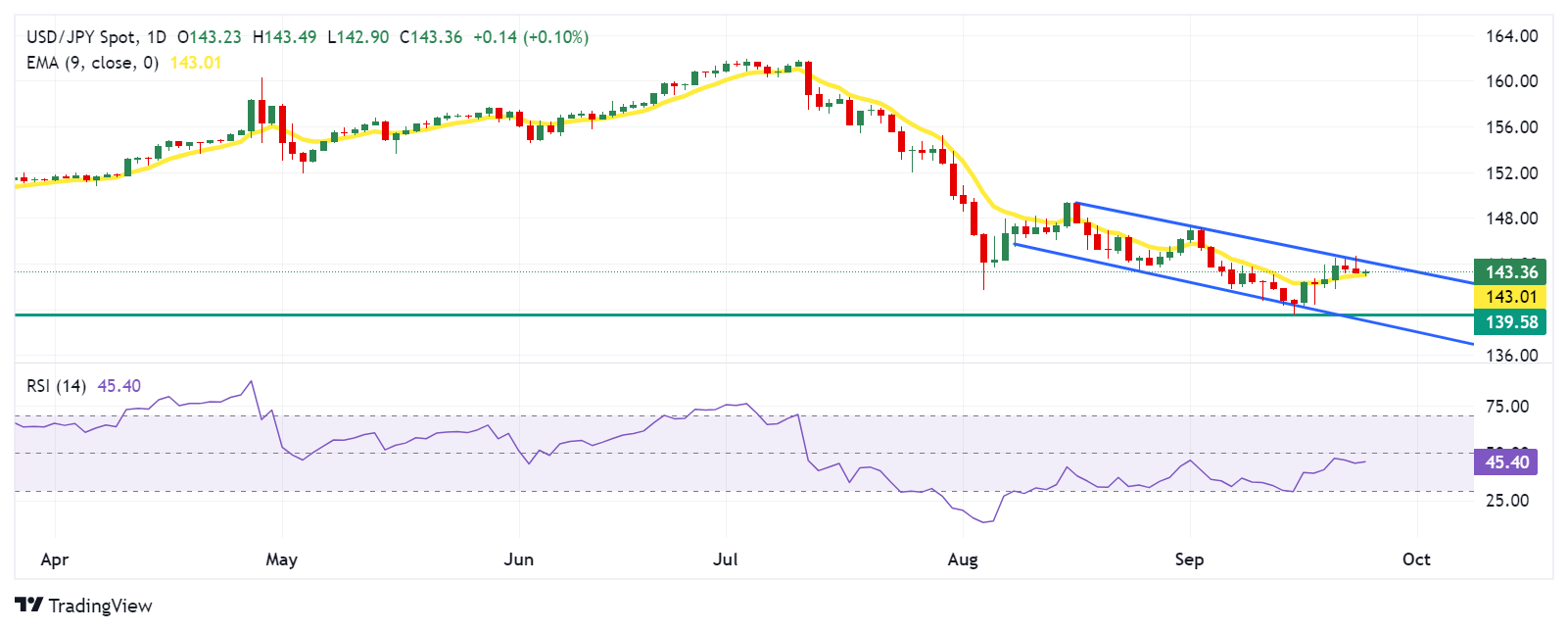
USD/JPY trades around 143.40 on Wednesday. Analysis of the daily chart shows that the pair is moving within a descending channel, indicating a bearish bias. Additionally, the 14-day Relative Strength Index (RSI) is slightly below the 50 level, confirming the bearish sentiment is in play.
On the downside, the USD/JPY pair is currently testing the nine-day EMA at the 143.03 level. A break below this support could prompt the pair to target the 139.58 region, the lowest point since June 2023.
The USD/JPY pair may test the immediate barrier at the upper boundary of the descending channel, around the 144.10 level. A breakout above this resistance could allow the USD/JPY pair to challenge the psychological barrier of 145.00.
USD/JPY: Daily Chart
Japanese Yen PRICE Today
The table below shows the percentage change of Japanese Yen (JPY) against listed major currencies today. Japanese Yen was the weakest against the Euro.
| USD | EUR | GBP | JPY | CAD | AUD | NZD | CHF | |
|---|---|---|---|---|---|---|---|---|
| USD | -0.08% | 0.21% | 0.45% | 0.02% | 0.22% | 0.33% | 0.13% | |
| EUR | 0.08% | 0.29% | 0.53% | 0.10% | 0.30% | 0.43% | 0.21% | |
| GBP | -0.21% | -0.29% | 0.21% | -0.19% | -0.00% | 0.10% | -0.08% | |
| JPY | -0.45% | -0.53% | -0.21% | -0.42% | -0.22% | -0.10% | -0.30% | |
| CAD | -0.02% | -0.10% | 0.19% | 0.42% | 0.20% | 0.32% | 0.11% | |
| AUD | -0.22% | -0.30% | 0.00% | 0.22% | -0.20% | 0.14% | -0.08% | |
| NZD | -0.33% | -0.43% | -0.10% | 0.10% | -0.32% | -0.14% | -0.22% | |
| CHF | -0.13% | -0.21% | 0.08% | 0.30% | -0.11% | 0.08% | 0.22% |
The heat map shows percentage changes of major currencies against each other. The base currency is picked from the left column, while the quote currency is picked from the top row. For example, if you pick the Japanese Yen from the left column and move along the horizontal line to the US Dollar, the percentage change displayed in the box will represent JPY (base)/USD (quote).
Japanese Yen FAQs
The Japanese Yen (JPY) is one of the world’s most traded currencies. Its value is broadly determined by the performance of the Japanese economy, but more specifically by the Bank of Japan’s policy, the differential between Japanese and US bond yields, or risk sentiment among traders, among other factors.
One of the Bank of Japan’s mandates is currency control, so its moves are key for the Yen. The BoJ has directly intervened in currency markets sometimes, generally to lower the value of the Yen, although it refrains from doing it often due to political concerns of its main trading partners. The current BoJ ultra-loose monetary policy, based on massive stimulus to the economy, has caused the Yen to depreciate against its main currency peers. This process has exacerbated more recently due to an increasing policy divergence between the Bank of Japan and other main central banks, which have opted to increase interest rates sharply to fight decades-high levels of inflation.
The BoJ’s stance of sticking to ultra-loose monetary policy has led to a widening policy divergence with other central banks, particularly with the US Federal Reserve. This supports a widening of the differential between the 10-year US and Japanese bonds, which favors the US Dollar against the Japanese Yen.
The Japanese Yen is often seen as a safe-haven investment. This means that in times of market stress, investors are more likely to put their money in the Japanese currency due to its supposed reliability and stability. Turbulent times are likely to strengthen the Yen’s value against other currencies seen as more risky to invest in.
Author

Akhtar Faruqui
FXStreet
Akhtar Faruqui is a Forex Analyst based in New Delhi, India. With a keen eye for market trends and a passion for dissecting complex financial dynamics, he is dedicated to delivering accurate and insightful Forex news and analysis.