Japanese Yen drops to fresh eight-month low against a broadly firmer USD
- The Japanese Yen attracts fresh sellers amid concerns about the fiscal outlook in Japan.
- Expectations that Takaichi's policies could delay BoJ rate hikes further weigh on the JPY.
- The Israel-Hamas peace deal contributes to driving flows away from the safe-haven JPY.

The Japanese Yen (JPY) meets with a fresh supply following an intraday uptick on Thursday and drops to its lowest level since February 13 against a broadly firmer US Dollar (USD) heading into the European session. Sanae Takaichi, who is expected to become Japan's first female Prime Minister, is a big supporter of aggressive government spending and is expected to oppose further policy tightening by the Bank of Japan (BoJ). This, in turn, has been a key factor exerting downward pressure on the JPY since the beginning of this week.
Meanwhile, the Israel-Hamas agreement on the first phase of the peace deal boosts the global risk sentiment and contributes to driving flows away from the safe-haven JPY. The USD, on the other hand, reverses an intraday dip and moves back closer to its highest level since late August, touched on Wednesday, which, in turn, pushes the USD/JPY pair beyond the 153.00 mark. This, to a larger extent, overshadows expectations for another BoJ rate hike this year and suggests that the path of least resistance for the JPY is to the downside.
Japanese Yen bears retain control amid bets that Takaichi's policies could delay BoJ rate hikes
- Japan's Finance Minister Katsunobu Kato said earlier this week that the government will be vigilant for volatile movements on the currency market, and it's important for currencies to move in a stable manner reflecting fundamentals.
- Sanae Takaichi's surprise win in the ruling Liberal Democratic Party's (LDP) leadership race last Saturday puts her on course to become the first female Prime Minister and fueled speculations about more expansionary fiscal policy.
- Traders are now pricing in a 26% chance that the Bank of Japan will raise interest rates at its next meeting on October 30, down from around 60% last Friday. This has been weighing on the Japanese Yen since the beginning of this week.
- Takaichi's economic advisors – Etsuro Honda and Takuji Aida – were quoted as saying that the new PM would probably tolerate another interest rate hike either in December or in January, though the path beyond that remains unclear.
- Moreover, inflation in Japan has stayed at or above the BoJ’s 2% target for more than three years, and the economy expanded for a fifth straight quarter in the three months through June, keeping hopes alive for another BoJ hike this year.
- Minutes from the Federal Reserve’s September meeting released on Wednesday indicated near unanimity among participants to lower interest rates amid concern about labour market risks and a more balanced inflation outlook.
- Policymakers, however, remained split on whether there should be one or two more rate reductions before the end of this year. Nevertheless, the overall tone was cautious and pointed to a continued easing bias.
- In fact, the CME Group's FedWatch Tool indicates that traders are still pricing in a greater possibility of 25-basis-point rate cut at each of the two remaining policy meetings this year, in October and in December.
- US President Donald Trump said on Wednesday that Israel and Hamas have agreed to the first phase of his 20-point peace plan to pause fighting and release at least some hostages and prisoners, undermining safe-haven assets.
- Traders now look forward to Fed Chair Jerome Powell's speech for more cues about the future rate-cut path. This, in turn, will influence the US Dollar price dynamics and provide some meaningful impetus to the USD/JPY pair.
USD/JPY could climb further towards 153.70-153.75 intermediate hurdle en route to 154.00
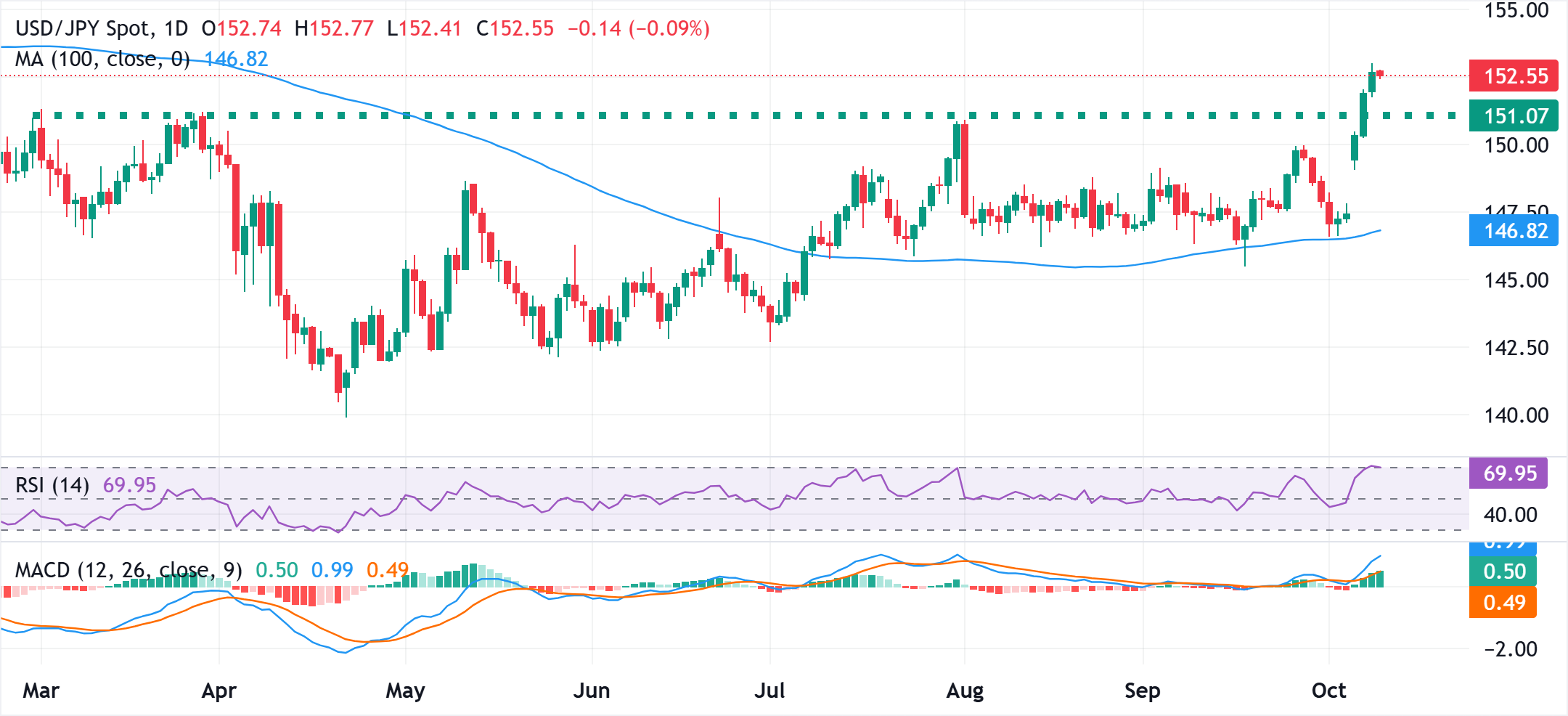
The daily Relative Strength Index (RSI) remains close to the overbought zone and holds back traders from placing fresh bullish bets around the USD/JPY pair. Any subsequent pullback, however, is likely to attract fresh buyers and remain cushioned near the 152.00 round figure. This is followed by the overnight swing low, around the 151.70 region, which, if broken, might prompt some technical selling and drag spot prices to the 151.00 strong horizontal resistance breakpoint.
On the flip side, the 153.00 round figure, or a multi-month peak touched on Wednesday, now seems to act as an immediate hurdle. A sustained strength beyond the said handle will reaffirm the positive outlook and lift the USD/JPY pair to the next relevant hurdle, near the 153.70-153.75 region, before bulls eventually aim to reclaim the 154.00 mark for the first time since February 12.
Japanese Yen FAQs
The Japanese Yen (JPY) is one of the world’s most traded currencies. Its value is broadly determined by the performance of the Japanese economy, but more specifically by the Bank of Japan’s policy, the differential between Japanese and US bond yields, or risk sentiment among traders, among other factors.
One of the Bank of Japan’s mandates is currency control, so its moves are key for the Yen. The BoJ has directly intervened in currency markets sometimes, generally to lower the value of the Yen, although it refrains from doing it often due to political concerns of its main trading partners. The BoJ ultra-loose monetary policy between 2013 and 2024 caused the Yen to depreciate against its main currency peers due to an increasing policy divergence between the Bank of Japan and other main central banks. More recently, the gradually unwinding of this ultra-loose policy has given some support to the Yen.
Over the last decade, the BoJ’s stance of sticking to ultra-loose monetary policy has led to a widening policy divergence with other central banks, particularly with the US Federal Reserve. This supported a widening of the differential between the 10-year US and Japanese bonds, which favored the US Dollar against the Japanese Yen. The BoJ decision in 2024 to gradually abandon the ultra-loose policy, coupled with interest-rate cuts in other major central banks, is narrowing this differential.
The Japanese Yen is often seen as a safe-haven investment. This means that in times of market stress, investors are more likely to put their money in the Japanese currency due to its supposed reliability and stability. Turbulent times are likely to strengthen the Yen’s value against other currencies seen as more risky to invest in.
Author

Haresh Menghani
FXStreet
Haresh Menghani is a detail-oriented professional with 10+ years of extensive experience in analysing the global financial markets.

















