Japanese Yen might struggle to lure buyers as change in Japan's leadership fuels BoJ uncertainty
- The Japanese Yen remains on the defensive amid delayed BoJ rate hike bets.
- The selling bias remains unabated after Japan's lower house voted for Takaichi.
- Dovish Fed expectations act as a headwind for the USD and the USD/JPY pair.

The Japanese Yen (JPY) trims a part of its heavy intraday losses that followed a key parliamentary vote, which confirms Sanae Takaichi to become Japan's first female Prime Minister. Market participants have been speculating that Takaichi would announce more expansionary policy in Japan, which could allow the Bank of Japan (BoJ) to further delay raising interest rates and is seen weighing on the JPY. Apart from this, a generally positive tone around the equity markets turns out to be another that undermine the JPY's safe-haven status.
That said, Takaichi would still need cooperation from other opposition groups to pass any legislation as the coalition remains short of a simple majority. Moreover, investors seem convinced that the BoJ will stick to its policy normalization path, which marks a significant divergence in comparison to bets that the US Federal Reserve (Fed) will cut rates two more times this year. The resultant narrowing of the Japan-US rate differential supports the lower-yielding JPY. Moreover, dovish Fed expectations cap gains for the USD and the USD/JPY pair.
Japanese Yen remains depressed as traders assess domestic political landscape
- The ruling Liberal Democratic Party and Japan Innovation Party, known as Ishin, agreed to form a coalition Monday. Sanae Takaichi created history, becoming Japan's first female PM after securing majority votes from both the Lower and Upper Houses of parliament.
- The development fuels speculations about more expansionary policy in Japan, which could allow the Bank of Japan to delay raising interest rates further. This, in turn, fails to assist the Japanese Yen to attract any meaningful buyers during the Asian session.
- The coalition holds a combined tally of 231 in the lower house, short of the 233 needed for a simple majority, suggesting that the government would need cooperation from other parties to pass any legislation. This keeps a lid on the so-called "Takaichi" trade.
- Inflation in Japan remains at or above the BoJ’s 2% target for more than three years, and the economy grew for a fifth straight quarter through June. Moreover, BoJ Board Member Hajime Takata said on Monday that Japan has roughly achieved the price target.
- This follows BoJ Deputy Governor Shinichi Uchida's remarks on Friday, reiterating that the central bank will continue raising rates if economic and price developments move in line with its forecasts. This keeps hopes alive for an imminent rate hike this year.
- In contrast, the CME Group's FedWatch Tool indicates that traders have fully priced in a 25-basis-points rate cut at each of the US Federal Reserve's policy meetings in October and in December. This could undermine the US Dollar and cap the USD/JPY pair.
- The Senate on Monday voted against reopening the US government for the 11th time, extending the shutdown to a third week as Democrats and Republicans remain at odds and unable to resolve the deadlock. This, in turn, contributes to capping the buck.
- US President Donald Trump set the tone for his upcoming meeting with China's President Xi Jinping. Trump said that the two countries would strike a fantastic deal and warned that failure to reach an agreement could see China face potential tariffs of 155%.
- On the geopolitical front, Ukrainian drones struck major gas processing plants in southern Russia. Trump said on Sunday that the Donbas region of Ukraine should be cut up, leaving most of it in Russian hands, to end a war that has dragged on for nearly four years.
USD/JPY bulls might now wait for a move beyond the 151.75 confluence before placing fresh bets
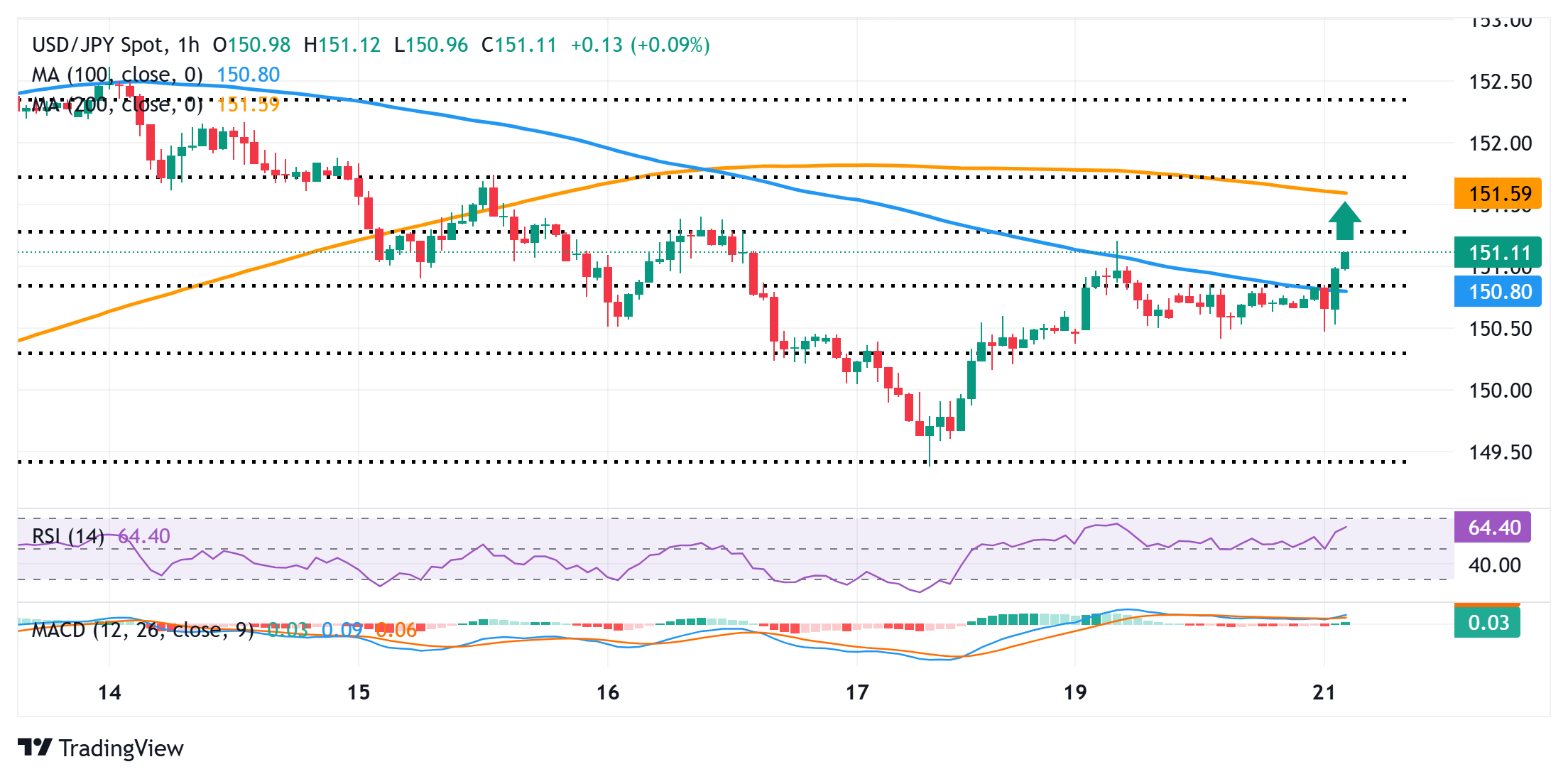
The emergence of some dip-buying and a move back above the 151.00 mark favors the USD/JPY bulls. Adding to this, positive oscillators on 1-hour/daily charts back the case for a further appreciating move towards the 151.75 confluence – comprising the 61.8% Fibonacci retracement level of the recent decline from the monthly peak and the 200-hour Simple Moving Average (SMA). A sustained move beyond the latter should allow the USD/JPY pair to surpass the 152.00 mark and climb further towards the next relevant hurdle near the 152.25 supply zone en route to the 153.00 mark.
On the flip side, the 150.50-150.45 region, or the Asian session trough, might continue to act as an immediate support ahead of the 150.25 zone, or the 23.6% Fibo. retracement level and the 150.00 psychological mark. A convincing break below the latter might expose the 149.40-149.35 area, or a nearly two-week low touched on Friday. The USD/JPY pair could extend the fall further towards the 149.00 round figure before eventually dropping to the 148.45-148.40 strong horizontal resistance-turned-support.
Fed FAQs
Monetary policy in the US is shaped by the Federal Reserve (Fed). The Fed has two mandates: to achieve price stability and foster full employment. Its primary tool to achieve these goals is by adjusting interest rates. When prices are rising too quickly and inflation is above the Fed’s 2% target, it raises interest rates, increasing borrowing costs throughout the economy. This results in a stronger US Dollar (USD) as it makes the US a more attractive place for international investors to park their money. When inflation falls below 2% or the Unemployment Rate is too high, the Fed may lower interest rates to encourage borrowing, which weighs on the Greenback.
The Federal Reserve (Fed) holds eight policy meetings a year, where the Federal Open Market Committee (FOMC) assesses economic conditions and makes monetary policy decisions. The FOMC is attended by twelve Fed officials – the seven members of the Board of Governors, the president of the Federal Reserve Bank of New York, and four of the remaining eleven regional Reserve Bank presidents, who serve one-year terms on a rotating basis.
In extreme situations, the Federal Reserve may resort to a policy named Quantitative Easing (QE). QE is the process by which the Fed substantially increases the flow of credit in a stuck financial system. It is a non-standard policy measure used during crises or when inflation is extremely low. It was the Fed’s weapon of choice during the Great Financial Crisis in 2008. It involves the Fed printing more Dollars and using them to buy high grade bonds from financial institutions. QE usually weakens the US Dollar.
Quantitative tightening (QT) is the reverse process of QE, whereby the Federal Reserve stops buying bonds from financial institutions and does not reinvest the principal from the bonds it holds maturing, to purchase new bonds. It is usually positive for the value of the US Dollar.
Author

Haresh Menghani
FXStreet
Haresh Menghani is a detail-oriented professional with 10+ years of extensive experience in analysing the global financial markets.