Japanese Yen remains depressed amid political uncertainty, receding safe-haven demand
- The Japanese Yen drifts lower for the second straight day against a recovering USD.
- Receding safe-haven demand undermines the JPY amid domestic political uncertainty.
- The divergent BoJ-Fed outlooks could support the lower-yielding JPY and cap USD/JPY.

The Japanese Yen (JPY) maintains its offered tone heading into the European session on Friday, though the downside potential seems limited amid hawkish Bank of Japan (BoJ) expectations. Investors seem convinced that the BoJ will stick to its policy normalization path and hike interest rates later this month. This marks a significant divergence in comparison to bets that the US Federal Reserve (Fed) will lower borrowing costs twice this year. The resultant narrowing US-Japan rate differential, in turn, could offer some support to the lower-yielding JPY.
Meanwhile, government data showed earlier today that the Unemployment Rate in Japan rose more than expected, to 2.6% in August. This, along with a positive risk tone and domestic political uncertainty, continues to undermine the safe-haven JPY. Apart from this, a further US Dollar (USD) recovery from a one-week low touched on Thursday turns out to be another factor that assists the USD/JPY pair to build on the previous day's bounce from the 100-day Simple Moving Average (SMA) support, around the 146.60-146.55 region, or a two-week low.
Japanese Yen sticks to negative bias amid political uncertainty, positive risk tone
- Government data showed this Friday that Japan's Unemployment Rate rose to 2.6% in August, compared to 2.3% in the previous month and consensus estimates for a reading of 2.4%.
- This comes ahead of the Liberal Democratic Party leadership election on Saturday, October 4th, and undermines the Japanese Yen during the Asian session amid the positive risk tone.
- The new Prime Minister will influence the trajectory of Japan's fiscal policy, which could further determine the Bank of Japan's policy stance and drive demand for the JPY in the near term.
- Traders have largely priced in Koizumi's victory. If Takaichi wins, it becomes a positive surprise, and the stock market could surge, said Kazuaki Shimada, Chief Strategist at IwaiCosmo Securities.
- Asian markets tracked Wall Street's another session of record highs on Wednesday amid expectations that the US government shutdown would have a limited impact on the economy.
- US Treasury Secretary Scott Bessent warned that the shutdown could hurt the economy more than those in the past, with potential hits to the GDP, growth, and the labor market.
- Bank of Japan Governor Kazuo Ueda said that the central bank must maintain an accommodative monetary environment to offset various uncertainties in Japan’s economic outlook.
- Ueda, however, reiterated that the BoJ will raise interest rates if the economy and prices move in line with forecasts, keeping hopes alive for an imminent rate hike later this month.
- In contrast, traders have fully priced in a rate cut by the Federal Reserve in October and see around a 90% probability of another rate reduction at the December FOMC meeting.
- Dallas Fed President Lorie Logan noted that inflation is running above target and that payroll gains have declined markedly. Logan sees risks on both sides of the Fed's mandate.
- The US Dollar struggles to build on the overnight bounce from a one-week low and might cap the USD/JPY pair, which seems poised to end the week on a downbeat note.
- Important US macro data scheduled at the beginning of a new month, including the Nonfarm Payrolls (NFP) report, could be delayed amid the US government shutdown.
USD/JPY might struggle to build on strength beyond 148.00; 200-day SMA holds the key
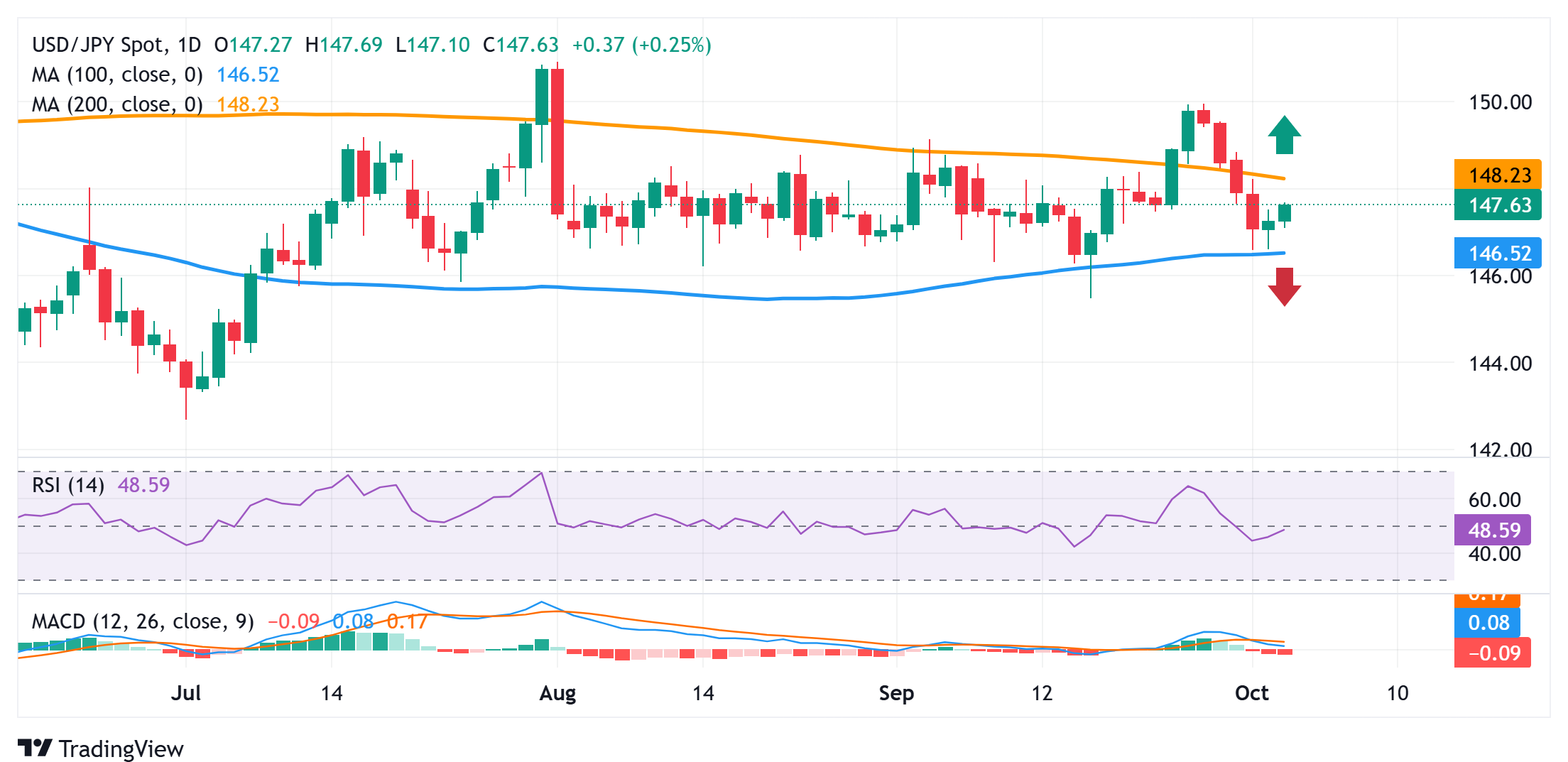
The USD/JPY pair has been showing resilience below the 147.00 mark and bounced off the 100-day Simple Moving Average (SMA) support near the 146.60-146.55 region for the second straight day on Thursday. The subsequent move up favors bullish traders. That said, oscillators on the daily chart have just started gaining negative traction, which, in turn, backs the case for the emergence of some selling near the 148.00 mark.
This is followed by a technically significant 200-day SMA, around the 148.35 zone, which, if cleared, might trigger a short-covering move. The USD/JPY pair might then climb to the 149.00 mark en route to the 149.35-149.40 region before making a fresh attempt to conquer the 150.00 psychological mark.
On the flip side, the 147.00 mark could protect the immediate downside ahead of the 146.60-146.55 pivotal support. Some follow-through selling has the potential to drag the USD/JPY pair to the 146.00 mark. The downward trajectory could extend further towards the September swing low, around the 145.50-145.45 region, en route to the 145.00 psychological mark.
Fed FAQs
Monetary policy in the US is shaped by the Federal Reserve (Fed). The Fed has two mandates: to achieve price stability and foster full employment. Its primary tool to achieve these goals is by adjusting interest rates. When prices are rising too quickly and inflation is above the Fed’s 2% target, it raises interest rates, increasing borrowing costs throughout the economy. This results in a stronger US Dollar (USD) as it makes the US a more attractive place for international investors to park their money. When inflation falls below 2% or the Unemployment Rate is too high, the Fed may lower interest rates to encourage borrowing, which weighs on the Greenback.
The Federal Reserve (Fed) holds eight policy meetings a year, where the Federal Open Market Committee (FOMC) assesses economic conditions and makes monetary policy decisions. The FOMC is attended by twelve Fed officials – the seven members of the Board of Governors, the president of the Federal Reserve Bank of New York, and four of the remaining eleven regional Reserve Bank presidents, who serve one-year terms on a rotating basis.
In extreme situations, the Federal Reserve may resort to a policy named Quantitative Easing (QE). QE is the process by which the Fed substantially increases the flow of credit in a stuck financial system. It is a non-standard policy measure used during crises or when inflation is extremely low. It was the Fed’s weapon of choice during the Great Financial Crisis in 2008. It involves the Fed printing more Dollars and using them to buy high grade bonds from financial institutions. QE usually weakens the US Dollar.
Quantitative tightening (QT) is the reverse process of QE, whereby the Federal Reserve stops buying bonds from financial institutions and does not reinvest the principal from the bonds it holds maturing, to purchase new bonds. It is usually positive for the value of the US Dollar.
Author

Haresh Menghani
FXStreet
Haresh Menghani is a detail-oriented professional with 10+ years of extensive experience in analysing the global financial markets.

















