Japanese Yen bears lack conviction ahead of this week's central bank event risks
- The Japanese Yen kicks off the new week on a weaker note amid a positive risk tone.
- Hawkish BoJ expectations and rising trade tensions limit losses for the safe-haven JPY.
- Traders also seem reluctant ahead of the crucial BoJ and Fed decisions later this week.


The Japanese Yen (JPY) remains on the defensive against its American counterpart heading into the European session, though the downside remains cushioned. The global risk sentiment gets a minor lift in reaction to fresh stimulus measures announced by China over the weekend, which, in turn, is seen undermining the safe-haven JPY. However, the growing acceptance that the Bank of Japan (BoJ) will hike interest rates further holds back the JPY bears from placing aggressive bets.
Apart from this, persistent worries about the potential economic fallout from US President Donald Trump's trade tariffs and geopolitical risks help limit further losses. Investors also seem reluctant and opt to wait for this week's key central bank event risks – the BoJ policy decision and the outcome of a two-day FOMC meeting on Wednesday. This, in turn, warrants some caution before positioning for an extension of the USD/JPY pair's recent recovery from a multi-month low.
Japanese Yen remains depressed as positive risk tone undermines safe-haven assets
- China’s State Council announced a special action plan on Sunday aimed at stimulating domestic consumption and introduced measures to increase household incomes. Adding to this, China’s Shenzhen eased its housing provident fund loan policies to stimulate the property market and clear the overhang. This, in turn, boosts investors' confidence and undermines the safe-haven Japanese Yen during the Asian session on Monday.
- The results of Japan's annual spring labor negotiations, which concluded on Friday, showed that companies offered an average wage hike above 5% at least for the second year running to help workers cope with inflation and address labour shortages. Higher wages are expected to boost consumer spending and contribute to rising inflation, which gives the Bank of Japan a fresh reason to keep raising interest rates.
- Meanwhile, traders continue to ramp up their bets that the Federal Reserve will have to lower interest rates several times this year amid the rising possibility of an economic downturn on the back of US President Donald Trump's trade tariffs. The expectations were reaffirmed by the University of Michigan Surveys on Friday, which showed that the Consumer Sentiment Index plunged to a nearly 2-1/2-year low in March.
- This comes on top of softer US inflation figures released last week and signs of a cooling labor market, suggesting that the US central bank could resume its policy-easing cycle in June. Moreover, market participants are currently pricing in the possibility of two more 25 basis points Fed rate cut moves each at the July and October monetary policy meetings, which keeps the US Dollar depressed near a multi-month low.
- Houthi leader Abdul Malik al-Houthi said on Sunday that his militants would target US ships in the Red Sea as long as the US continues its attacks on Yemen. This comes a day after deadly US airstrikes, which the Houthi-run health ministry said killed at least 53 people. In response, the US defense secretary said on Sunday that the US will continue attacking Yemen's Houthis until they stop attacks on shipping.
- According to Palestinian media, an Israeli drone attack on Saturday in northern Gaza killed at least nine people, including three journalists. Israel’s military said that its forces have intervened to thwart threats by terrorists approaching its troops or planting bombs since the January 19 ceasefire took effect. The Israeli military said that six men – identified as members of the armed wings of Hamas – were killed in the strike.
- Traders now look forward to the US economic docket – featuring the release of monthly Retail Sales and the Empire State Manufacturing Index – for some impetus later during the North American session. The focus, however, will remain glued to the crucial BoJ decision on Wednesday. This, along with the outcomes of a two-day FOMC meeting, should provide a fresh directional impetus to the USD/JPY pair.
USD/JPY needs to surpass last week's high, around 149.20 for bulls to retain control
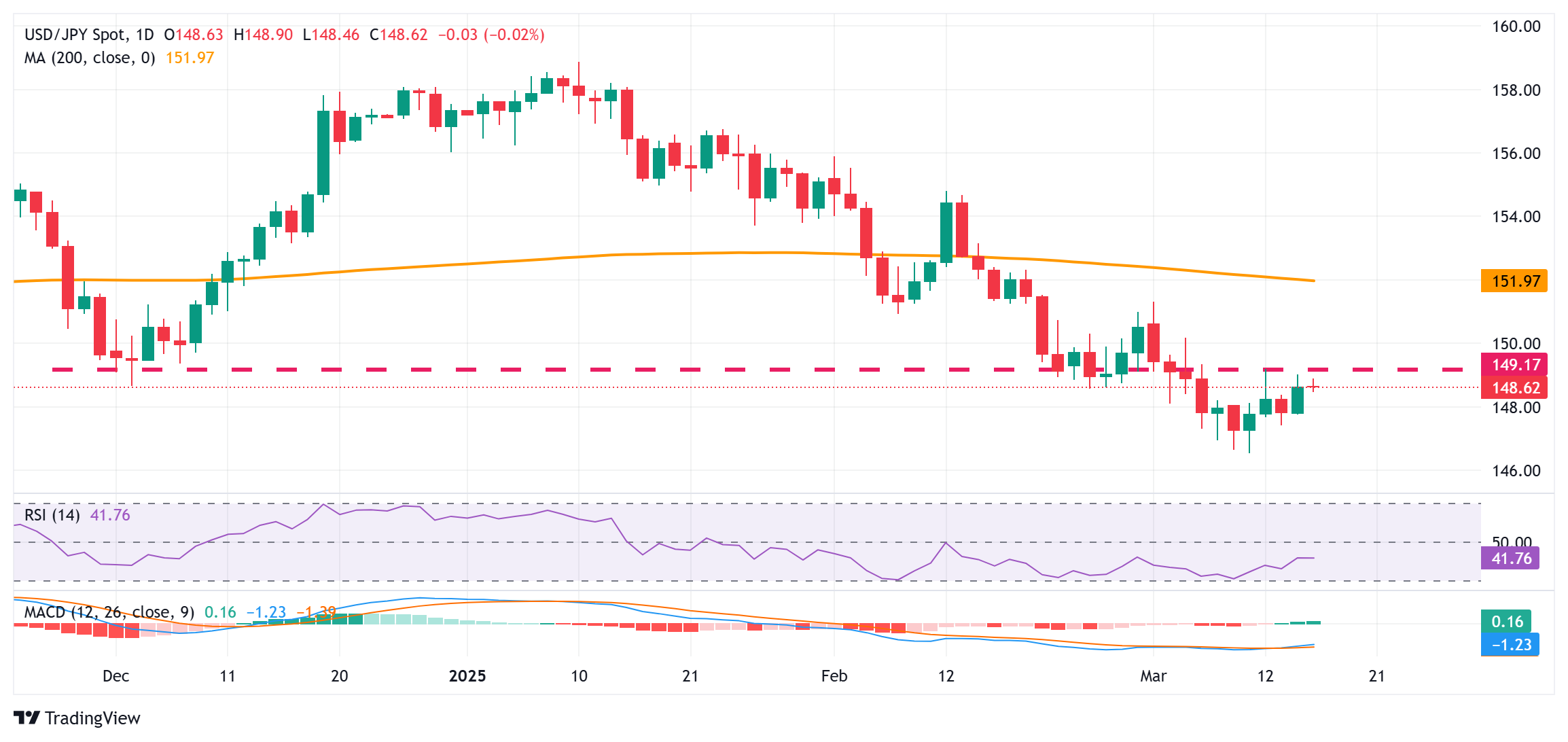
From a technical perspective, the recent repeated failures to find acceptance above the 149.00 mark and negative oscillators on the daily chart favor bearish traders. However, a sustained strength beyond the said handle, leading to a subsequent break through last week's swing high around the 149.20 area, might trigger a short-covering rally and lift the USD/JPY pair to the 150.00 psychological mark. The momentum could extend further towards the 150.65-150.70 zone en route to the 151.00 mark and the monthly peak, around the 151.30 region.
On the flip side, the 148.25 area might protect the immediate downside ahead of the 148.00 mark. Some follow-through selling below the 147.75-147.70 horizontal zone could make the USD/JPY pair vulnerable to accelerate the fall towards the 147.00 mark before eventually dropping to the 146.55-146.50 region or the lowest level since October touched last week. A convincing break below the latter will be seen as a fresh trigger for bears and pave the way for further losses.
Economic Indicator
BoJ Interest Rate Decision
The Bank of Japan (BoJ) announces its interest rate decision after each of the Bank’s eight scheduled annual meetings. Generally, if the BoJ is hawkish about the inflationary outlook of the economy and raises interest rates it is bullish for the Japanese Yen (JPY). Likewise, if the BoJ has a dovish view on the Japanese economy and keeps interest rates unchanged, or cuts them, it is usually bearish for JPY.
Read more.Next release: Wed Mar 19, 2025 03:00
Frequency: Irregular
Consensus: 0.5%
Previous: 0.5%
Source: Bank of Japan
Author
Haresh Menghani
FXStreet
Haresh Menghani is a detail-oriented professional with 10+ years of extensive experience in analysing the global financial markets.