Japanese Yen climbs to one-week top against weaker USD amid divergent BoJ-Fed expectations
- The Japanese Yen attracts some buyers amid expectations for an imminent BoJ rate hike.
- Fed rate cut bets undermine the USD and weigh on USD/JPY ahead of central bank events.
- Political and BoJ, along with a positive risk tone, might cap gains for the safe-haven JPY.


The Japanese Yen (JPY) spikes to a one-week high and remains on track to appreciate further against a broadly weaker US Dollar (USD) amid the divergent Bank of Japan (BoJ)-Federal Reserve (Fed) policy expectations. Investors seem convinced that the BoJ will stick to its policy normalization path, while the US central bank will resume its rate-cutting cycle this week. This, in turn, is seen as a key factor driving flows towards the lower-yielding JPY and exerting downward pressure on the USD/JPY pair.
Meanwhile, the recent political developments in Japan could give the BoJ reasons to delay rate hikes. This, along with a positive risk tone, might keep a lid on any further appreciating move for the safe-haven JPY. Traders might also refrain from placing aggressive bets and opt to wait for this week's key central bank events. The Fed is scheduled to announce its policy decision on Wednesday ahead of the two-day BoJ meeting starting Thursday, which will provide a fresh impetus to the USD/JPY pair.
Japanese Yen is underpinned by BoJ rate hike bets, bearish USD
- The Japanese Yen has been struggling for a firm near-term direction over the past week or so and oscillating in a range against its American counterpart amid ambiguity over the Bank of Japan rate hike decision. Japanese Prime Minister Shigeru Ishiba's resignation added a layer of uncertainty in the markets and could give the BoJ more reasons to go slow on interest rate hikes.
- Japan's farm minister and the chief government spokesperson, Shinjiro Koizumi, on Tuesday announced his candidacy to lead the ruling Liberal Democratic Party (LDP) and replace the outgoing Prime Minister Shigeru Ishiba.
- Meanwhile, the US-Japan trade deal has removed some risks to domestic growth. The BoJ sees the development paving the way for steady progress toward the inflation target. Moreover, a tight labor market and optimistic economic outlook keep the door open for an imminent BoJ interest rate hike by the end of this year and offer some support to the JPY.
- Moreover, the current market pricing points to a nearly two full 25-basis-point rate hikes by July next year, which, in turn, warrants some caution before placing aggressive JPY bearish bets. Traders might also opt to wait on the sidelines ahead of the latest BoJ monetary policy update on Friday. This, along with a bearish US Dollar, should cap the USD/JPY pair.
- The USD Index (DXY), which tracks the Greenback against a basket of currencies, languishes near its lowest level since July 24 amid rising bets for a more aggressive policy easing by the US Federal Reserve. Traders ramped up their bets for three interest rate cuts by the Fed this year after the recent US macroeconomic data pointed to signs of a softening labor market.
- The US Senate voted to confirm Stephen Miran – one of US President Donald Trump’s top economic advisers – to join the Fed's powerful Board of Governors. Miran will now be voting on this week's interest rate decision. A federal appeals court ruled that Trump cannot fire Fed Governor Lisa Cook, who can participate in the pivotal two-day meeting starting Tuesday.
- On the geopolitical front, Trump said on Monday that a face-to-face meeting between Ukrainian President Volodymyr Zelenskyy and his Russian counterpart, Vladimir Putin, is difficult. This comes amid the intensifying Russia-Ukraine war and brewing Middle East tensions, which could further benefit the safe-haven JPY ahead of the key central bank events.
- Tuesday's US economic docket features the release of US monthly Retail Sales figures and Industrial Production data later during the North American session. The immediate market reaction is more likely to be muted as traders might refrain from placing aggressive directional bets and opt to wait for more cues about the central banks' policy outlook.
USD/JPY bears could aim trading range support near 146.30-146.20
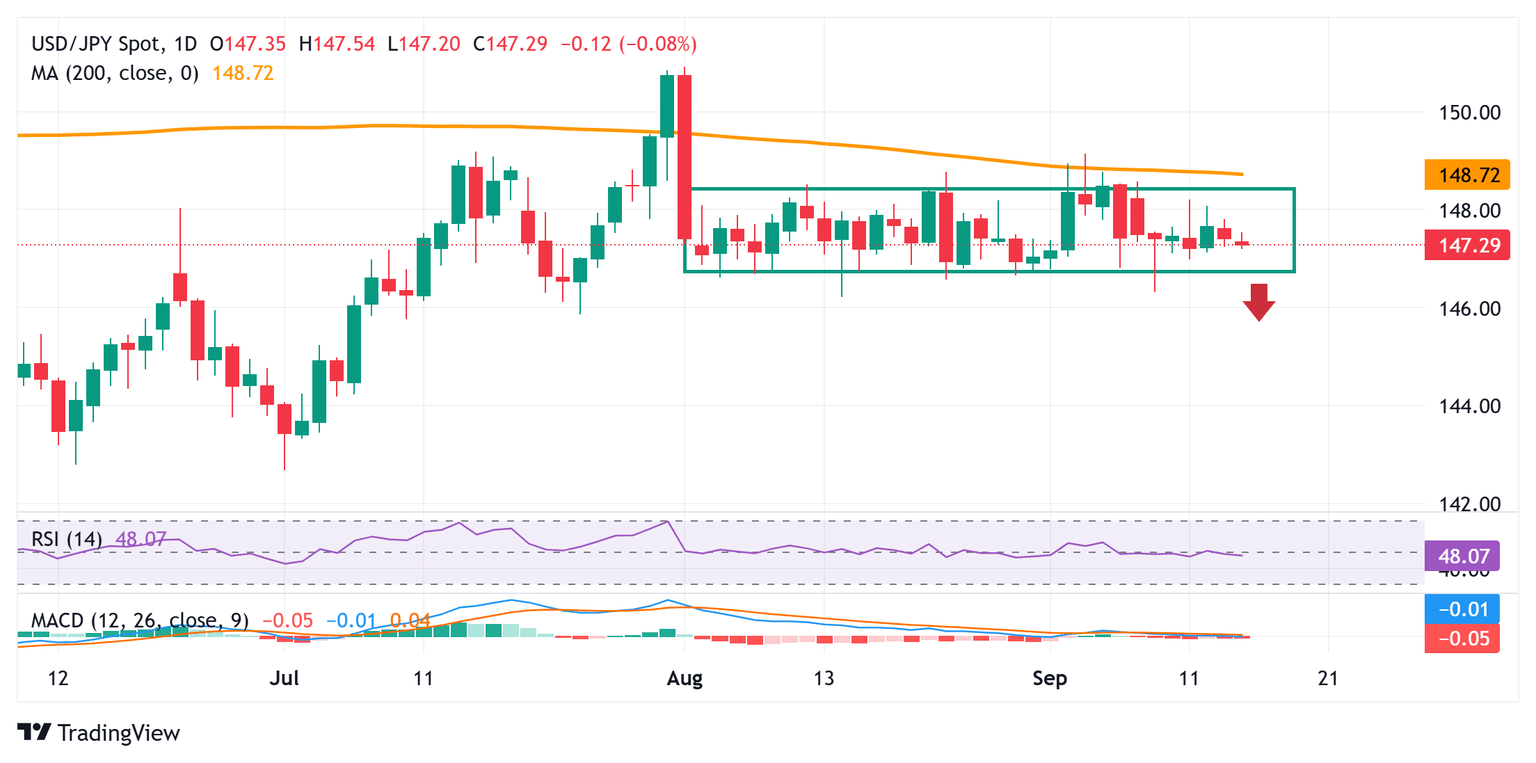
The range-bound price action might be seen as a consolidation phase before the next leg of a directional move. Meanwhile, the recent repeated failures near a technically significant 200-day Simple Moving Average (SMA) suggest that the path of least resistance for the USD/JPY pair is to the downside. That said, it will still be prudent to wait for some follow-through selling and acceptance below the 147.00 mark before positioning for further losses amid neutral oscillators on the daily chart. Spot prices might then accelerate the fall towards the 146.30-146.20 horizontal support. This is closely followed by the 146.00 round figure, below which the downward trajectory could extend further towards the 145.35 intermediate support en route to the 145.00 psychological mark.
On the flip side, any positive move up is likely to confront an immediate hurdle near the 148.00 round figure, above which a bout of short-covering could lift the USD/JPY pair to the 200-day Simple Moving Average (SMA) barrier, currently pegged near the 148.75 zone. Some follow-through buying, leading to a subsequent strength beyond the 149.00 mark and the monthly swing high, around the 149.15 region, would negate the negative outlook and shift the near-term bias in favor of bullish traders.
Fed FAQs
Monetary policy in the US is shaped by the Federal Reserve (Fed). The Fed has two mandates: to achieve price stability and foster full employment. Its primary tool to achieve these goals is by adjusting interest rates. When prices are rising too quickly and inflation is above the Fed’s 2% target, it raises interest rates, increasing borrowing costs throughout the economy. This results in a stronger US Dollar (USD) as it makes the US a more attractive place for international investors to park their money. When inflation falls below 2% or the Unemployment Rate is too high, the Fed may lower interest rates to encourage borrowing, which weighs on the Greenback.
The Federal Reserve (Fed) holds eight policy meetings a year, where the Federal Open Market Committee (FOMC) assesses economic conditions and makes monetary policy decisions. The FOMC is attended by twelve Fed officials – the seven members of the Board of Governors, the president of the Federal Reserve Bank of New York, and four of the remaining eleven regional Reserve Bank presidents, who serve one-year terms on a rotating basis.
In extreme situations, the Federal Reserve may resort to a policy named Quantitative Easing (QE). QE is the process by which the Fed substantially increases the flow of credit in a stuck financial system. It is a non-standard policy measure used during crises or when inflation is extremely low. It was the Fed’s weapon of choice during the Great Financial Crisis in 2008. It involves the Fed printing more Dollars and using them to buy high grade bonds from financial institutions. QE usually weakens the US Dollar.
Quantitative tightening (QT) is the reverse process of QE, whereby the Federal Reserve stops buying bonds from financial institutions and does not reinvest the principal from the bonds it holds maturing, to purchase new bonds. It is usually positive for the value of the US Dollar.
Author
Haresh Menghani
FXStreet
Haresh Menghani is a detail-oriented professional with 10+ years of extensive experience in analysing the global financial markets.