Japanese Yen retains bullish bias as USD weakness offsets political uncertainty
- The Japanese Yen attracts buyers for the second straight day against a broadly weaker USD.
- Sustained safe-haven buying and the divergent BoJ-Fed expectations lend support to the JPY.
- Domestic political uncertainty might hold back the JPY bulls from placing aggressive bets.

The Japanese Yen (JPY) maintains its bid tone against a broadly weaker US Dollar (USD), with the USD/JPY pair flirting with the 151.00 mark, or a one-week low, heading into the European session on Wednesday. Shifting US-China trade dynamics, along with rising geopolitical tensions and concerns about a prolonged US government shutdown, continue to underpin demand for traditional safe-haven assets, including the JPY. Moreover, the recent comments from Finance Minister Katsunobu Kato fueled speculations about a possible government intervention, which turns out to be another factor supporting the JPY.
However, the growing acceptance that the recent political development in Japan could put pressure on the Bank of Japan (BoJ) to delay interest rate hikes further, which might hold back the JPY bulls from placing fresh bets. However, rising bets that the US Federal Reserve (Fed) will lower borrowing costs two more times this year drags the USD away from its highest level since early August, touched last week. This, in turn, backs the case for a further depreciating move for the USD/JPY pair, though a sustained break and acceptance below the 151.00 round-figure mark is needed to reaffirm the near-term negative outlook.
Japanese Yen sticks to gains amid sustained safe-haven buying, intervention fears
- Tensions over trade tariffs heated up on Tuesday after China announced new special port fees for US ships arriving in Chinese ports. This comes on top of China's enhanced restrictions on the export of rare earths and US President Donald Trump's threat to raise tariffs on Chinese goods to 100%.
- Furthermore, Trump threatened to terminate trade with China in cooking oil and other products in response to China’s decision not to purchase US soybeans. This sparks concerns about a further escalation of the trade war between the world's two largest economies and benefits safe-haven assets.
- Media reports suggest that Trump was considering sending the US-made Tomahawk long-range cruise missiles to Ukraine to pressure Russian President Vladimir Putin into negotiations. This keeps geopolitical risks in play and benefits the Japanese Yen during the Asian session on Wednesday.
- The latest vote to pass a Republican-backed stopgap funding bill to end the partial federal government shutdown fell short of the votes needed for passage in the Senate on Tuesday. This means that the shutdown, which started on October 1, will extend into a third week, with no resolution in sight.
- The long-standing Liberal Democratic Party (LDP)–Komeito coalition came to an abrupt end last week. The breakup, in turn, means the newly elected LDP leader, Sanae Takaichi, would need support from other parties to confirm her as Japan’s first female Prime Minister and for her key policies.
- Meanwhile, Kyodo news agency reported on Wednesday that Japan's parliamentary scheduling committee could not agree on holding a vote to select the next Prime Minister on October 21.
- This might create a challenge for the Bank of Japan to hike interest rates and could act as a headwind for the JPY. However, traders are still pricing in the possibility of a further BoJ policy tightening this year. This marks a significant divergence in comparison to dovish Federal Reserve expectations.
- The CME Group's FedWatch Tool indicates that traders have fully priced in that the US central bank will lower borrowing costs by a 25-basis-point in October and see a 90% chance for another rate reduction in December. This exerts pressure on the US Dollar and drags the USD/JPY pair lower.
USD/JPY could accelerate the fall once the 151.00 mark is broken decisively
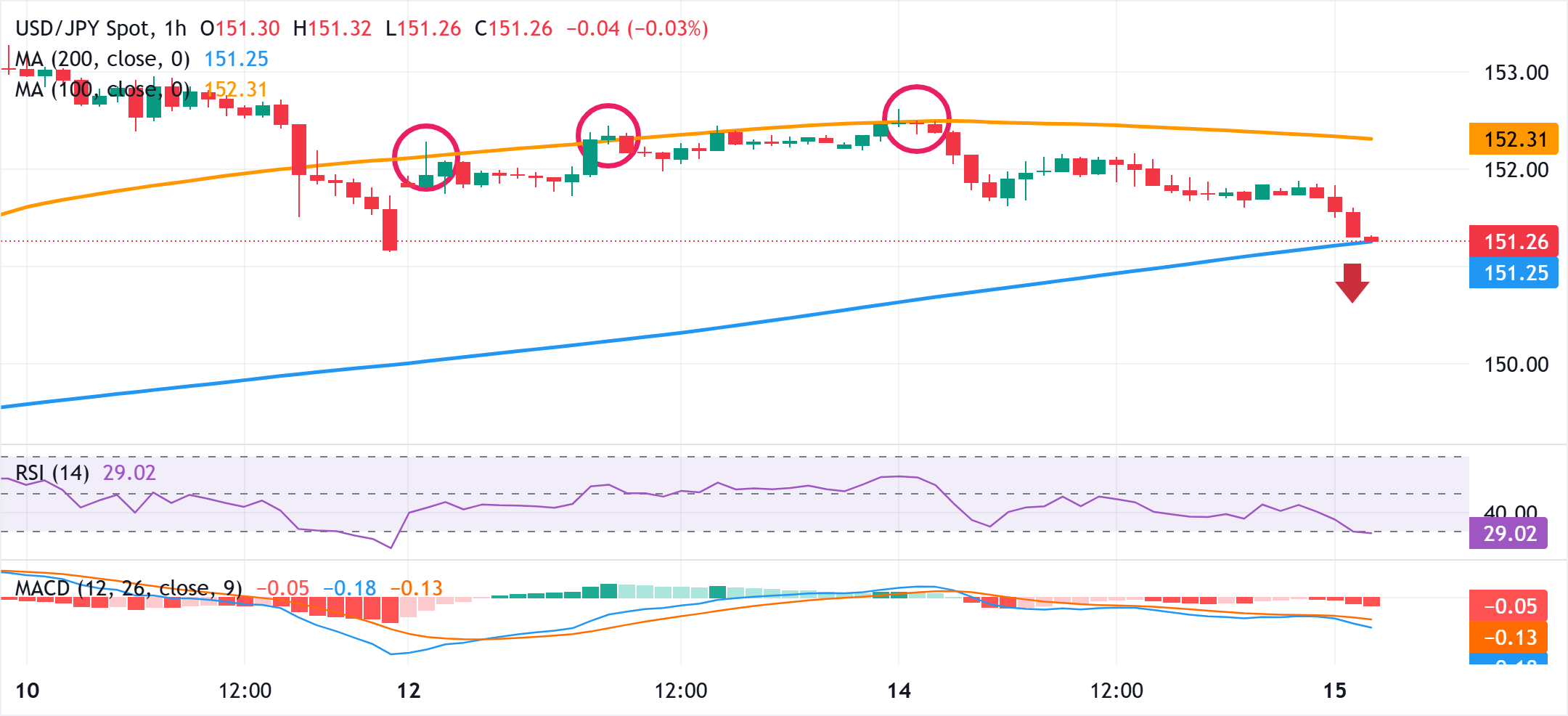
This week's repeated failures to rise above the 100-hour SMA and the subsequent decline below the 200-hour SMA, around the 151.20-151.15 region, could be seen as a key trigger for the USD/JPY bears. A sustained break and acceptance below the 151.00 mark will reaffirm the negative outlook and drag spot prices to the 150.70 intermediate support en route to the 150.00 psychological mark.
On the flip side, any intraday recovery beyond the 151.65-151.70 region might now confront an immediate hurdle near the 152.00 round figure. A further move up is likely to attract some sellers near the 152.25 area and remain capped near the 152.65-152.70 region. A sustained strength above the latter could shift the bias in favor of bullish traders and lift the USD/JPY pair beyond the 153.00 mark, towards retesting the eighth-month high, around the 153.25-153.30 region, touched last Friday.
US Dollar Price Today
The table below shows the percentage change of US Dollar (USD) against listed major currencies today. US Dollar was the strongest against the New Zealand Dollar.
| USD | EUR | GBP | JPY | CAD | AUD | NZD | CHF | |
|---|---|---|---|---|---|---|---|---|
| USD | -0.14% | -0.34% | -0.48% | -0.08% | -0.53% | 0.00% | -0.19% | |
| EUR | 0.14% | -0.15% | -0.35% | 0.04% | -0.36% | 0.09% | -0.05% | |
| GBP | 0.34% | 0.15% | -0.20% | 0.23% | -0.21% | 0.24% | 0.15% | |
| JPY | 0.48% | 0.35% | 0.20% | 0.37% | -0.06% | 0.32% | 0.38% | |
| CAD | 0.08% | -0.04% | -0.23% | -0.37% | -0.46% | 0.01% | -0.08% | |
| AUD | 0.53% | 0.36% | 0.21% | 0.06% | 0.46% | 0.45% | 0.36% | |
| NZD | -0.01% | -0.09% | -0.24% | -0.32% | -0.01% | -0.45% | -0.09% | |
| CHF | 0.19% | 0.05% | -0.15% | -0.38% | 0.08% | -0.36% | 0.09% |
The heat map shows percentage changes of major currencies against each other. The base currency is picked from the left column, while the quote currency is picked from the top row. For example, if you pick the US Dollar from the left column and move along the horizontal line to the Japanese Yen, the percentage change displayed in the box will represent USD (base)/JPY (quote).
Author

Haresh Menghani
FXStreet
Haresh Menghani is a detail-oriented professional with 10+ years of extensive experience in analysing the global financial markets.

















