Japanese Yen holds gains as Reuters poll suggests a BoJ rate hike by March 2026
- Japanese Yen gained as the trade deficit narrowed in September.
- A Reuters poll suggested that nearly 96% expect the BoJ to deliver a 25 basis point rate hike by the end of March 2026.
- The US Dollar may struggle amid concerns over a prolonged federal government shutdown.

The Japanese Yen (JPY) maintains its position against the US Dollar (USD) on Wednesday after three days of losses. The USD/JPY pair depreciated as the JPY gained ground following the release of Japan’s Merchandise Trade Balance Total data.
Japan’s Ministry of Finance reported a trade deficit of JPY 234.6 billion in September, narrowing slightly from August’s deficit of JPY 242.8 billion (revised from -242.5) but falling short of market expectations for a JPY 22.0 billion surplus.
Japan’s Exports rose 4.2% year-on-year, the first increase since April, though slightly below the projected 4.6% gain. Meanwhile, Imports jumped 3.3% to an eight-month high, marking their first rise in three months and exceeding forecasts for a modest 0.6% increase.
A Reuters poll suggested that 64 of 67 economists (nearly 96%) expect the Bank of Japan (BoJ) policy rate to be at 0.75% by the end of March 2026. 45 of 75 economists (60%) expect BoJ to raise rates by 25 bps this quarter.
The JPY faced challenges after dovish Sanae Takaichi was elected as Japan’s first female Prime Minister on Tuesday. Takaichi vowed to strengthen the nation’s economy and defense capabilities, as well as enhance relations with the US. Her victory came after the ruling Liberal Democratic Party (LDP) allied with the Japan Innovation Party and reportedly signed an agreement over the weekend to form a coalition government.
US Dollar struggles amid a prolonged federal government shutdown
- The US Dollar Index (DXY), which measures the value of the US Dollar (USD) against six major currencies, is edging lower after registering gains in the previous session and trading around 98.90 at the time of writing. The Greenback may come under pressure amid concerns over a prolonged federal government shutdown and potential delays in key US economic data releases, including Nonfarm Payrolls (NFP), adding uncertainty for financial markets and the Federal Reserve (Fed).
- The CME FedWatch Tool indicates that markets are now pricing in nearly a 99% chance of a Fed rate cut in October and a 98% possibility of another reduction in December.
- The US government shutdown has entered its fourth week as the Senate on Monday failed for the 11th time to advance a House-passed measure to fund the government and end the ongoing shutdown. The 50-43 vote fell mostly along party lines. This marks the third-longest funding lapse in modern history.
- St. Louis Fed President Alberto Musalem spoke at the Institute of International Finance Annual Membership Meeting in Washington, DC, on Friday that he could support a path with another rate cut if more risks to jobs emerge and inflation is contained. Musalem added that the Fed should not be on a preset course and follow a balanced approach.
- US Federal Reserve (Fed) Governor Christopher Waller stated on Thursday that he supports another interest rate cut at this month’s upcoming policy meeting. Meanwhile, the Fed’s newest governor, Stephen Miran, reiterated his call for a more aggressive rate-cut trajectory for 2025 than that favored by his colleagues.
- Federal Reserve Chair Jerome Powell stated last week that the central bank is on track to deliver another quarter-point interest-rate reduction later this month, even as a government shutdown significantly reduces its read on the economy. Powell highlighted the low pace of hiring and noted that it may weaken further.
USD/JPY remains close to 152.00 due to persistent bullish bias
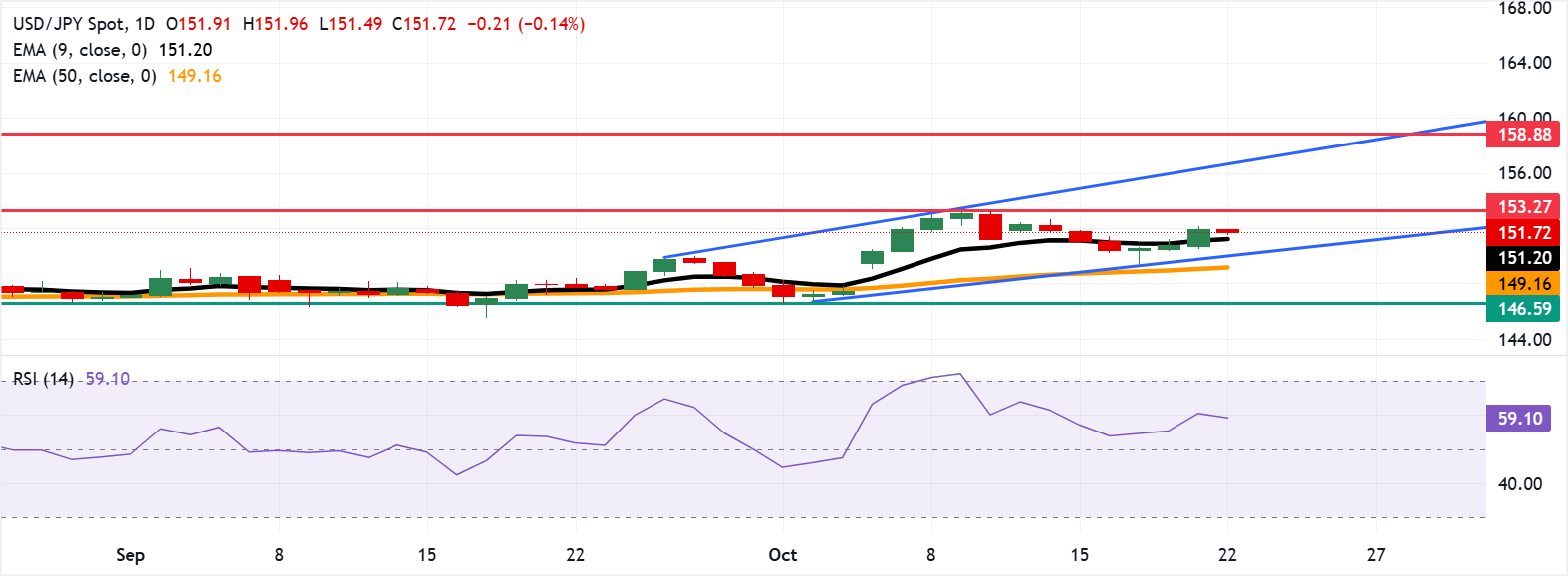
The Japanese Yen gains ground against the US Dollar, with the USD/JPY pair trading lower at around 151.70 on Wednesday. The technical analysis of the daily chart suggests an ongoing bullish bias as the pair remains within the ascending channel pattern.
On the upside, the initial barrier lies at the eight-month high of 153.27, which was recorded on October 10. A break above this level would support the pair to explore the region around the upper boundary of the ascending channel at 156.90.
The immediate support appears at the nine-day Exponential Moving Average (EMA) of 151.20. A break below this level would weaken the short-term price momentum and prompt the USD/JPY pair to test the ascending channel’s lower boundary around 150.00, followed by the 50-day EMA at 149.16. Further declines would cause the emergence of the bearish bias and put downward pressure on the pair to navigate the area around the monthly low of 146.59.
USD/JPY: Daily Chart
Japanese Yen Price Today
The table below shows the percentage change of Japanese Yen (JPY) against listed major currencies today. Japanese Yen was the strongest against the British Pound.
| USD | EUR | GBP | JPY | CAD | AUD | NZD | CHF | |
|---|---|---|---|---|---|---|---|---|
| USD | -0.10% | 0.17% | -0.05% | -0.21% | -0.31% | -0.32% | -0.12% | |
| EUR | 0.10% | 0.25% | 0.04% | -0.11% | -0.22% | -0.17% | -0.02% | |
| GBP | -0.17% | -0.25% | -0.20% | -0.37% | -0.47% | -0.45% | -0.28% | |
| JPY | 0.05% | -0.04% | 0.20% | -0.15% | -0.25% | -0.24% | -0.04% | |
| CAD | 0.21% | 0.11% | 0.37% | 0.15% | -0.11% | -0.09% | 0.09% | |
| AUD | 0.31% | 0.22% | 0.47% | 0.25% | 0.11% | 0.02% | 0.20% | |
| NZD | 0.32% | 0.17% | 0.45% | 0.24% | 0.09% | -0.02% | 0.18% | |
| CHF | 0.12% | 0.02% | 0.28% | 0.04% | -0.09% | -0.20% | -0.18% |
The heat map shows percentage changes of major currencies against each other. The base currency is picked from the left column, while the quote currency is picked from the top row. For example, if you pick the Japanese Yen from the left column and move along the horizontal line to the US Dollar, the percentage change displayed in the box will represent JPY (base)/USD (quote).
Japanese Yen FAQs
The Japanese Yen (JPY) is one of the world’s most traded currencies. Its value is broadly determined by the performance of the Japanese economy, but more specifically by the Bank of Japan’s policy, the differential between Japanese and US bond yields, or risk sentiment among traders, among other factors.
One of the Bank of Japan’s mandates is currency control, so its moves are key for the Yen. The BoJ has directly intervened in currency markets sometimes, generally to lower the value of the Yen, although it refrains from doing it often due to political concerns of its main trading partners. The BoJ ultra-loose monetary policy between 2013 and 2024 caused the Yen to depreciate against its main currency peers due to an increasing policy divergence between the Bank of Japan and other main central banks. More recently, the gradually unwinding of this ultra-loose policy has given some support to the Yen.
Over the last decade, the BoJ’s stance of sticking to ultra-loose monetary policy has led to a widening policy divergence with other central banks, particularly with the US Federal Reserve. This supported a widening of the differential between the 10-year US and Japanese bonds, which favored the US Dollar against the Japanese Yen. The BoJ decision in 2024 to gradually abandon the ultra-loose policy, coupled with interest-rate cuts in other major central banks, is narrowing this differential.
The Japanese Yen is often seen as a safe-haven investment. This means that in times of market stress, investors are more likely to put their money in the Japanese currency due to its supposed reliability and stability. Turbulent times are likely to strengthen the Yen’s value against other currencies seen as more risky to invest in.
Author

Akhtar Faruqui
FXStreet
Akhtar Faruqui is a Forex Analyst based in New Delhi, India. With a keen eye for market trends and a passion for dissecting complex financial dynamics, he is dedicated to delivering accurate and insightful Forex news and analysis.

















