Japanese Yen extends losses despite a hawkish sentiment surrounding BoJ
- The Japanese Yen declined despite positive economic data on Monday.
- Japan’s Manufacturing PMI posted a 49.8 reading for August, against the previous 49.5.
- The latest US Personal Consumption Expenditures Index data diminish the odds of an aggressive Fed rate cut in September.

The Japanese Yen (JPY) loses ground against the US Dollar (USD) after the release of July's US Personal Consumption Expenditures (PCE) Index data, which led traders to scale back expectations of an aggressive Federal Reserve rate cut in September.
According to the CME FedWatch Tool, markets are fully anticipating at least a 25 basis point (bps) rate cut by the Fed at its September meeting. Traders are now likely to focus on the upcoming US employment figures, including the Nonfarm Payrolls (NFP) for August, to gain further insights into the potential size and pace of Fed rate cuts.
On Monday, Japanese companies reported a 7.4% increase in Capital Spending for the second quarter. Additionally, the country’s Manufacturing PMI for August was revised upward to 49.8 from 49.5, indicating a trend toward stabilization. On Friday, a rise in Tokyo inflation reinforced the Bank of Japan's (BoJ) hawkish monetary policy stance, boosting the JPY and capping gains in the USD/JPY pair.
Daily Digest Market Movers: Japanese Yen falls due to a hawkish BoJ
- The US Bureau of Economic Analysis reported on Friday that the headline Personal Consumption Expenditures (PCE) Price Index increased by 2.5% year-over-year in July, matching the previous reading of 2.5% but falling short of the estimated 2.6%. Meanwhile, the core PCE, which excludes volatile food and energy prices, rose by 2.6% year-over-year in July, consistent with the prior figure of 2.6% but slightly below the consensus forecast of 2.7%.
- Tokyo's Consumer Price Index (CPI) increased to 2.6% year-on-year in August, up from 2.2% in July. Core CPI also rose to 1.6% YoY in August, compared to the previous 1.5%. Additionally, Japan’s Unemployment Rate unexpectedly climbed to 2.7% in July, up from both the market estimate and June's 2.5%, marking the highest jobless rate since August 2023.
- Federal Reserve Atlanta President Raphael Bostic, a prominent hawk on the FOMC, indicated last week that it might be "time to move" on rate cuts due to further cooling inflation and a higher-than-expected unemployment rate. FXStreet’s FedTracker, which gauges the tone of Fed officials’ speeches on a dovish-to-hawkish scale from 0 to 10 using a custom AI model, rated Bostic’s words as neutral with a score of 5.6.
- The US Gross Domestic Product (GDP) grew at an annualized rate of 3.0% in the second quarter, exceeding both the expected and previous growth rate of 2.8%. Additionally, Initial Jobless Claims showed that the number of people filing for unemployment benefits fell to 231,000 for the week ending August 23, down from the previous 233,000 and slightly below the expected 232,000.
- Japan’s Finance Minister Shunichi Suzuki stated last week that foreign exchange rates are influenced by a variety of factors, including monetary policies, interest rate differentials, geopolitical risks, and market sentiment. Suzuki added that it is difficult to predict how these factors will impact FX rates.
Technical Analysis: USD/JPY holds ground around 146.00
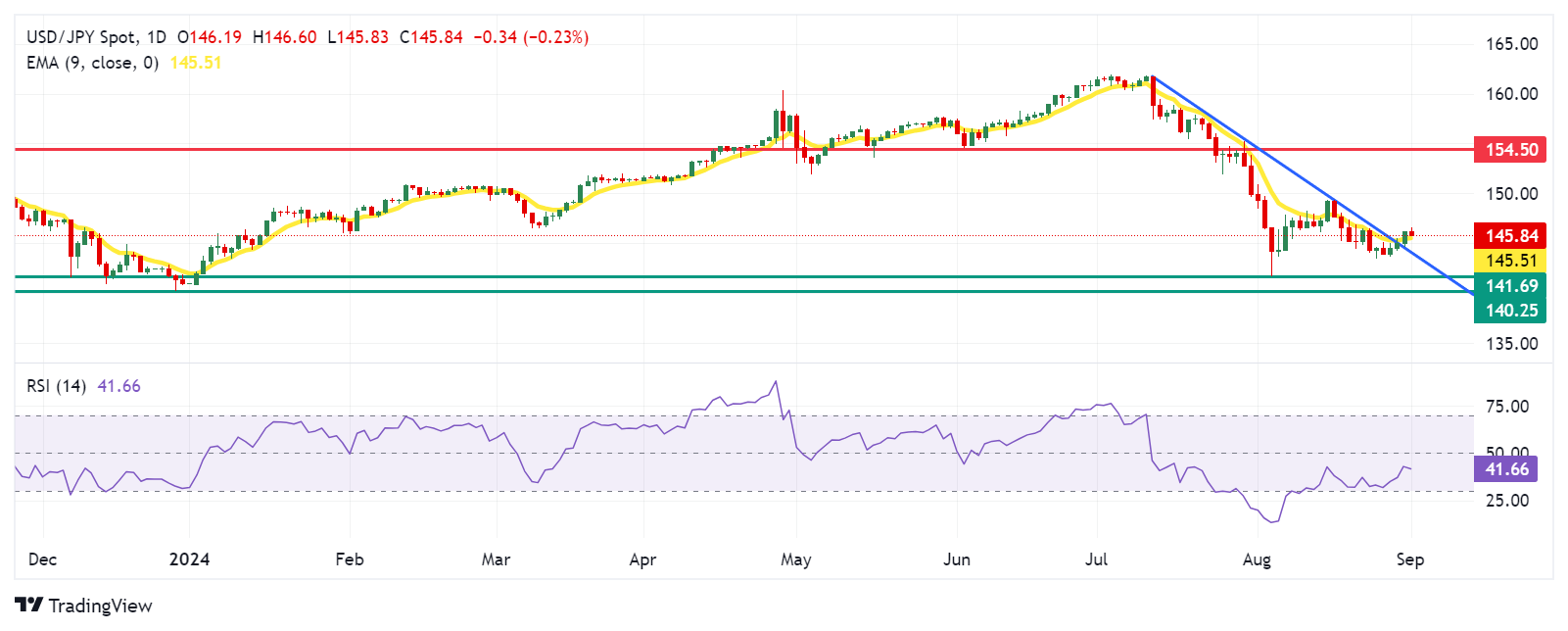
USD/JPY trades around 146.00 on Monday. Daily chart analysis shows the pair is situated above the downtrend line, suggesting a diminishing bearish bias. However, the 14-day Relative Strength Index (RSI) remains below 50, indicating that the bearish trend is still in effect.
In terms of support, the USD/JPY pair might first test the nine-day Exponential Moving Average (EMA) at around 145.53, followed by the downtrend line near 144.00. If the pair falls below this level, it could move toward the seven-month low of 141.69, recorded on August 5, and subsequently find support around 140.25.
On the upside, the USD/JPY pair might approach the psychological level of 150.00 level. A break above this level could lead the pair to navigate the area around the 154.50 level, which has shifted from support to resistance.
USD/JPY: Daily Chart
Japanese Yen PRICE Today
The table below shows the percentage change of Japanese Yen (JPY) against listed major currencies today. Japanese Yen was the weakest against the Australian Dollar.
| USD | EUR | GBP | JPY | CAD | AUD | NZD | CHF | |
|---|---|---|---|---|---|---|---|---|
| USD | -0.16% | -0.04% | 0.21% | 0.06% | -0.18% | 0.26% | -0.01% | |
| EUR | 0.16% | 0.14% | 0.34% | 0.19% | -0.02% | 0.41% | 0.13% | |
| GBP | 0.04% | -0.14% | 0.19% | 0.04% | -0.18% | 0.30% | -0.03% | |
| JPY | -0.21% | -0.34% | -0.19% | -0.21% | -0.36% | 0.18% | -0.29% | |
| CAD | -0.06% | -0.19% | -0.04% | 0.21% | -0.20% | 0.21% | -0.07% | |
| AUD | 0.18% | 0.02% | 0.18% | 0.36% | 0.20% | 0.42% | 0.15% | |
| NZD | -0.26% | -0.41% | -0.30% | -0.18% | -0.21% | -0.42% | -0.28% | |
| CHF | 0.01% | -0.13% | 0.03% | 0.29% | 0.07% | -0.15% | 0.28% |
The heat map shows percentage changes of major currencies against each other. The base currency is picked from the left column, while the quote currency is picked from the top row. For example, if you pick the Japanese Yen from the left column and move along the horizontal line to the US Dollar, the percentage change displayed in the box will represent JPY (base)/USD (quote).
Author

Akhtar Faruqui
FXStreet
Akhtar Faruqui is a Forex Analyst based in New Delhi, India. With a keen eye for market trends and a passion for dissecting complex financial dynamics, he is dedicated to delivering accurate and insightful Forex news and analysis.