Japan FX Today: The JPY between political uncertainties and BoJ expectations
The Japanese Yen (JPY) is up against the US Dollar (USD) on Friday, with the USD/JPY pair edging lower and trading at around 147.25 following the publication of US employment figures.
The Japanese currency rallied slightly, benefiting from a weaker USD, but it remains trapped in a climate of uncertainty.
Investors are looking ahead to Monday's internal vote of the Liberal Democratic Party (LDP), which could pave the way for a new leadership contest and threaten the position of Prime Minister Shigeru Ishiba.
Meanwhile, markets continue to scrutinize signals from the Bank of Japan (BoJ), as rising wages and stubborn inflation maintain expectations of monetary tightening before the end of the year.
USD/JPY Technical analysis: Trapped in a range amid growing uncertainty
The USD/JPY pair falls sharply following the publication of the US Nonfarm Payrolls (NFP) report on Friday, which showed only 22,000 new jobs created in August, compared with the 75,000 expected, and down sharply from the 79,000 created in July.
As a result, the currency pair continues its uncertain evolution in a wide horizontal range between 146.50 and 149.00, in place since the beginning of August.
Despite the spike in volatility that followed the US employment report, no clear trend seems yet to be emerging for USD/JPY in the short term.
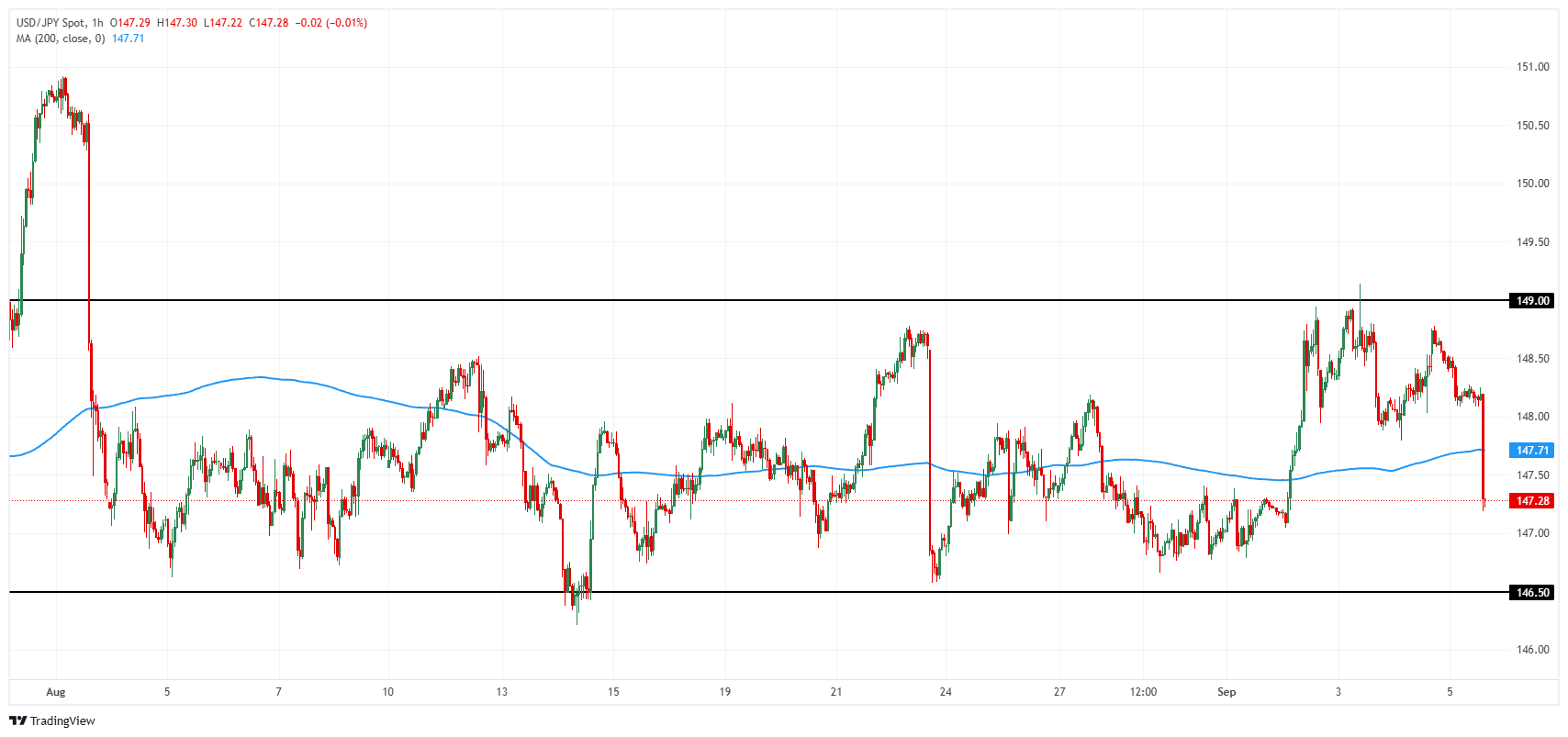
USD/JPY 1-hour chart. Source: FXStreet
In this context, traders will be keeping an eye on the next catalyst, which will be the internal vote of the Liberal Democratic Party (LDP) scheduled for Monday.
Japanese Yen Price Today
The table below shows the percentage change of Japanese Yen (JPY) against listed major currencies today. Japanese Yen was the strongest against the US Dollar.
| USD | EUR | GBP | JPY | CAD | AUD | NZD | CHF | |
|---|---|---|---|---|---|---|---|---|
| USD | -0.74% | -0.77% | -0.79% | -0.10% | -1.11% | -1.13% | -0.89% | |
| EUR | 0.74% | -0.01% | -0.16% | 0.64% | -0.28% | -0.37% | -0.15% | |
| GBP | 0.77% | 0.01% | -0.10% | 0.65% | -0.25% | -0.37% | -0.10% | |
| JPY | 0.79% | 0.16% | 0.10% | 0.78% | -0.23% | -0.28% | 0.09% | |
| CAD | 0.10% | -0.64% | -0.65% | -0.78% | -0.96% | -1.03% | -0.77% | |
| AUD | 1.11% | 0.28% | 0.25% | 0.23% | 0.96% | -0.12% | 0.16% | |
| NZD | 1.13% | 0.37% | 0.37% | 0.28% | 1.03% | 0.12% | 0.27% | |
| CHF | 0.89% | 0.15% | 0.10% | -0.09% | 0.77% | -0.16% | -0.27% |
The heat map shows percentage changes of major currencies against each other. The base currency is picked from the left column, while the quote currency is picked from the top row. For example, if you pick the Japanese Yen from the left column and move along the horizontal line to the US Dollar, the percentage change displayed in the box will represent JPY (base)/USD (quote).
Solid fundamentals, but a cluttered political calendar
On the economic front, the latest Japanese data argue in favor of a gradual normalization of monetary policy. Nominal wages rose by 4.1% year-on-year in July - their strongest acceleration in seven months - while real wages moved back into positive territory for the first time this year (+0.5%).
"Wage gains in excess of 4% are becoming more regular, confirming the strongest period since the early 1990s," observes Derek Halpenny, analyst at MUFG.
This momentum, coupled with still robust household consumption, is fuelling speculation that the Bank of Japan could raise interest rates as early as October.
However, the market remains cautious. BBH points out that only 50% of swap contracts anticipate an increase of 25 basis points between now and the end of 2025, and are counting on a limited tightening to 1.25% over the next three years.
"The BoJ is unlikely to raise rates beyond what the market is already pricing in, which limits the Yen's upside potential," BBH's report points out.
Political risks: The spectre of new LDP leadership
However, the equation is clouded by the political context. Following an electoral setback in July, several key LDP figures have resigned, and speculation is rife that Prime Minister Ishiba will leave office early.
According to Rabobank, "until political uncertainties are resolved, USD/JPY could remain in a holding pattern". Jane Foley, the bank's currency strategist, anticipates a move "into the 145-150 zone within three months" if interest rate hike expectations persist.
An internal LDP election as early as September would pave the way for more populist candidates, such as Sanae Takaichi, who has made no secret of her hostility to the cycle of interest rate hikes.
"She has already described the BoJ's interest rate hikes as 'stupid'," point out Rabobank analysts, which could heighten doubts about the central bank's independence.
International context: Partial appeasement with Washington
On the international front, US President Donald Trump's signature of a trade agreement with Tokyo, reducing US tariffs on Japanese cars from 27.5% to 15%, has brought respite to Japanese automakers.
But profits for the Japanese Yen remain limited, with investors favoring caution in the face of domestic political turbulence.
JPY is caught between two forces
In short, the Japanese Yen finds itself caught between favorable macro fundamentals - wage growth, persistent inflation - and major political uncertainty, which weighs on the visibility of monetary policy.
Frances Cheung and Christopher Wong of OCBC believe that "the risk of an early LDP election could temporarily weaken the Japanese Yen, but this pressure should ease once political order is restored".
Author

Ghiles Guezout
FXStreet
Ghiles Guezout is a Market Analyst with a strong background in stock market investments, trading, and cryptocurrencies. He combines fundamental and technical analysis skills to identify market opportunities.