Is the Apple getting rotten?


Key points
-
Apple's fundamental issues – China and AI: Apple faces challenges in China with weak iPhone demand, a strong buy-local movement, and tariff risks. Its AI capabilities have not met expectations, with delays in key markets like China.
-
High valuations and low earnings expectations: Apple's valuation at 30x forward earnings is high compared to the S&P 500 average or the historical average. Analysts expect weak Q4 2024 earnings, with continued struggles in Q1 2025, particularly with iPhone demand.
-
Strategies to diversify: Long-term investors should evaluate their allocation and consider trimming if Apple exceeds 10–15% of your equity holdings. Consider diversifying with complementary stocks like Microsoft and Alphabet, or ETFs for broader exposure. Hedging strategies to guard against downside volatility ahead of earnings could also be considered.
Apple has long been a favourite among investors, but recent developments have raised questions about its resilience in a changing macroeconomic and competitive landscape. From concerns about iPhone demand in China to doubts about innovation, valuation, and earnings momentum, here’s what’s driving the conversation.
A high price tag
At a valuation of 30x forward earnings, Apple is trading well above the S&P 500’s average multiple and above its 5-year average multiple at 26x. This premium pricing suggests that investors expect robust growth and consistent innovation. Yet, Apple’s revenue and earnings are not growing as fast as the broader market, making its high valuation harder to justify.
China headwinds are rising
Apple is facing multiple headwinds in its second-largest market, China:
-
Weak demand: Reports suggest iPhone shipments fell 18% year-over-year in China last quarter, with Huawei capturing much of the lost market share.
-
Buy local movement: As nationalism intensifies, Chinese consumers are gravitating toward domestic brands like Huawei and Xiaomi.
-
Tariff risks: The new Trump administration has brought tariff risks back on the investors’ radar, and Apple is highly exposed to that risk. Ongoing geopolitical tensions could lead to the iPhone maker getting caught between US tariffs on Chinese imports or even the retaliatory tariffs from China. This brings uncertainty and a risk of higher production costs.
Lagging on AI and innovation
Apple’s long-awaited AI capabilities, introduced with the iPhone 16, haven’t lived up to the hype. Analysts note that U.S. consumers find little utility in smartphone AI, and the rollout of AI features has been delayed in key markets like China. Without a clear innovation driver, Apple risks falling behind tech leaders like Nvidia (NVDA) and Microsoft (MSFT) in capturing the AI opportunity.
The bright spot: Services
Apple’s services segment, which includes subscriptions and digital payments, continues to grow as a percentage of revenue. Importantly, these offerings boast higher margins than hardware sales, providing some cushion against the weaker iPhone demand.
Earnings: A potential bruise
Apple’s Q4 2024 earnings, scheduled for January 30, could serve as a pivotal moment for the stock. Analysts expect weak results relative to the rest of the “Magnificent 7” tech giants, a trend that could extend into the March quarter of 2025. For Q4, Apple’s expected earnings growth at 7.8% trails the group, with its revenue hurt by soft iPhone demand and slower global growth.
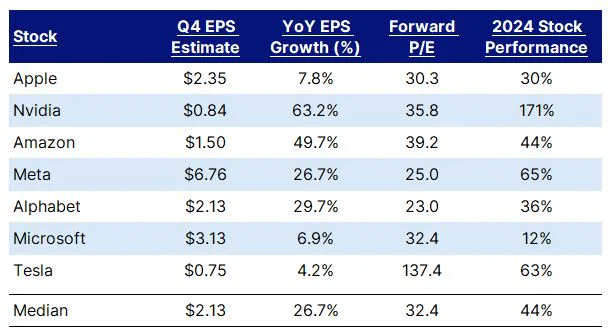
Source: Bloomberg, Saxo
Additionally, early indications for Q1 2025 suggest the company will continue to struggle. Reports highlight that iPhone demand remains tepid, and analysts expect disappointing guidance for the coming quarters. Without a strong performance, Apple risks extending its 11% year-to-date decline.
What to do if you hold Apple
For long-term investors holding Apple, here’s a simple action plan:
-
Evaluate your allocation: If Apple exceeds 10–15% of your equity holdings, consider trimming to manage concentration risk.
-
Diversify with complementary stocks: Reallocate to other growth stocks like Microsoft, Alphabet that have a better risk-adjusted profile. Other blue-chip stocks or defensive dividend stocks like Johnson & Johnson (JNJ) could also be considered.
-
Consider ETFs: Broader exposure through ETFs like those tracking the NASDAQ 100 index or the S&P 500 index reduces single-stock risk while keeping Apple exposure. ETFs like iShares S&P 500 Info Technology Sector ETF or the Global X Robotics & Artificial Intelligence ETF could also be considered for diversified technology and AI exposure.
-
Use hedging strategies: Sell covered calls or buy protective puts to guard against downside volatility ahead of earnings.
Read the original analysis: Is the Apple getting rotten?
Author
Saxo Research Team
Saxo Bank
Saxo is an award-winning investment firm trusted by 1,200,000+ clients worldwide. Saxo provides the leading online trading platform connecting investors and traders to global financial markets.

















