Is Tesla stock headed for $270?
- Tesla has lost over $147 billion in market cap in the past three sessions.
- Tariffs and trade war talk could hurt Tesla more than many other stocks.
- Demand for Tesla vehicles in January took a major hit, although Model Y Juniper may be at fault.
- Cratering TSLA stock price might not discover support until the 200-day moving average.

It’s only Tuesday, and yet Tesla (TSLA) stock is already down 9.2% this week. In fact, if you include Friday, in just the last three sessions TSLA shares have given up 12.2% or $147 billion in market cap.
Despite being a member of the Trump administration, or maybe because of it, CEO Elon Musk’s pioneering electric vehicle (EV) concern is at the receiving end of a flurry of headlines and trends shaped like daggers.
Last Friday, the China Passenger Car Association reported that taken together, Model Y and Model 3 vehicles produced in China had seen shipments fall 12% YoY and 33% MoM. Deliveries in China have now dropped for four months straight.
Australia as well saw Tesla deliveries plunge 33% YoY in January. January sales plunged by nearly 60% in Germany, and Sweden, Norway, Denmark, and the Netherlands all witnessed annual declines above 40%.
Overall, Tesla revenue grew 1% in 2024 after witnessing 19% revenue growth in 2023. So what gives? Is this just a cyclical downturn in the market or something more?
Are Elon Musk’s politics hurting Tesla sales?
Even analysts are starting to wonder whether Elon’s closeness to President Donald Trump has become a disadvantage. EVs are purchased by people of all political stripes now that they are part of the mainstream auto market, but Musk’s high profile as the top donor to President Trump’s campaign and now as the leader of Trump’s Department of Government Efficiency (or DOGE for short) has made him a more divisive figure.
Oppenheimer analyst Colin Rusch didn’t hold back: “We also believe CEO Musk's political activity has fans in certain circles, but that his public life risks alienating consumers and employees as the Trump administration tests the limits of its power.”
An Economist/YouGov poll released over the weekend reports that the share of Republican voters who favor Musk having a large influence in the Trump administration, which he currently does, has fallen by 18 percentage points from 47% to 29% since the election.
Musk’s DOGE unit has attempted to shut down the United States Agency for International Development (USAID) and taken control of the US Treasury’s critical payment system in just the first three weeks of the new administration. Multiple federal judges have already shown skepticism that these actions are lawful by attempting to block or delay them.
Internationally, Trump has now threatened to acquire Greenland, Canada, Panama and Gaza, which might also reflect poorly on the world’s richest man and his close relationship to the US leader.
Some industry observers think his strong opinions on German politics and immigration might also deter certain customers from favoring Tesla.
Is it the tariffs or the Model Y?
One theory is that demand has fallen since consumers were holding out for the revamped Model Y.

Model Y Juniper / Tesla.com
The Model Y is Tesla’s most popular vehicle, and Tesla waited until mid-January to showcase the revamped vehicle on its Chinese website. Most deliveries won’t begin until May, but some analysts think the revamp has led to dwindling demand as it was teased nearly a year earlier.
The Model Y Juniper is a sleeker crossover than its predecessor and offers a number of upgrades to the interior.
But Tesla’s share price was already falling well before the inauguration on January 20. A major piece of the puzzle would necessarily be worries over Trump’s lurch toward tariffs. Though he postponed 25% levies on Canada and Mexico, Trump has placed an additional 10% tariff on goods from China and this week has levied a 25% tax on all aluminum and steel imports.
Nations from Canada to the European Union have begun responding with their own levies on US goods to the point that it seems a general trade war has begun. Since their vehicles are made all over the world and, of course, use steel, Tesla is thought to be particularly vulnerable to tariffs.
Tesla relies extensively on a global component market wherein a significant portion of its parts are sourced from China. Tesla CFO Vaibhav Taneja recently acknowledged that the carmaker remains "very reliant on parts from across the world for all our businesses."
Tesla stock forecast
Momentum has fallen off such a cliff with TSLA stock that the Relative Strength Index (RSI) is now trending at 28. It's the first time since April 2024 that this has happened. Bulls shouldn't take heart since it doesn't mean that a bottom is in.
Tuesday's price action saw Tesla stock descend below the 100-day Simple Moving Average (SMA) for the first time since October of last year. What's happening is that Tesla is divorcing itself from the euphoria following Trump's win in early November. All of the rally is now headed for the dustbin. Traders will notice that TSLA shares didn't even pause on the way down at $360, which was a note resistance level on the way up.
There is really only one point of interest on the daily chart: $270. That level acted as resistance in both July and October of 2024 in the run-up to the election. Coincidentally, it is also where the 200-day SMA currently finds itself. As the only support level in sight, tentative buyers should wait until $270 at the very least, especially knowing that the first trade war in years could have a massive downward pressure on stock prices.
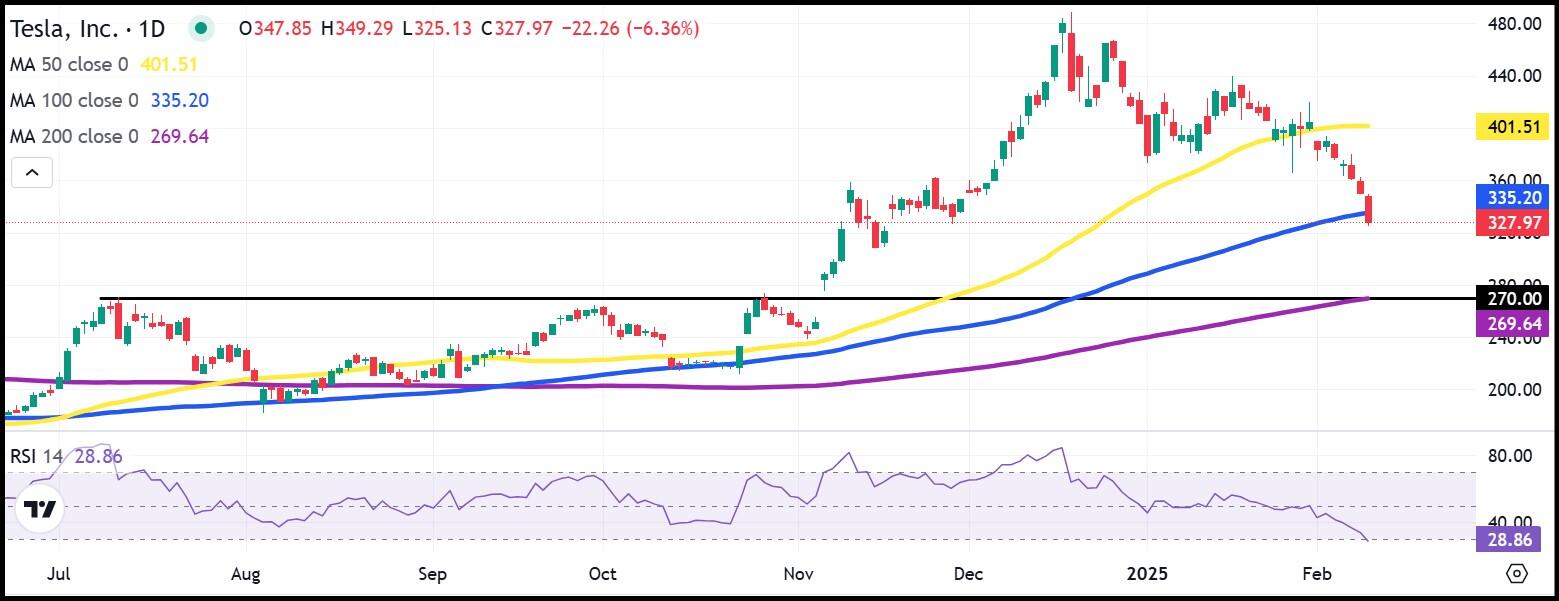
TSLA daily stock chart
Author

Clay Webster
FXStreet
Clay Webster grew up in the US outside Buffalo, New York and Lancaster, Pennsylvania. He began investing after college following the 2008 financial crisis.

















