Indian Rupee takes a hit as US-Iran deadlock boost oil prices
- The Indian Rupee tumbles against the US Dollar as oil prices jump amid US-Iran resolution uncertainty.
- Iran wants the recognition of its authority near the Strait of Hormuz.
- Indian PM Modi urges citizens to reduce fuel consumption, avoid foreign travel, and non-essential gold purchases.

The Indian Rupee (INR) starts the week on a negative note against the US Dollar (USD), with the USD/INR pair rising almost 1% to near 95.32. The pair gains significantly as the Indian Rupee faces the heat of a big jump in the oil price, following comments from United States (US) President Trump, in a post on Truth Social, that Iran’s response to Washington’s peace proposal is “totally unacceptable”.
As of writing, the WTI Oil price is up a little over 5% to near $96.40. Currencies from economies, such as India, which rely heavily on oil imports to meet their energy needs, tend to underperform in a high oil price environment. Higher oil prices have also resulted in a sharp increase in the US Dollar, cementing hopes that the Federal Reserve (Fed) will keep interest rates at their current levels by the year-end.
During the press time, the US Dollar Index (DXY), which gauges the Greenback’s value against six major currencies, trades 0.3% higher to near 98.10.
Meanwhile, a report from Reuters has shown that the Reserve Bank of India (RBA) has stepped in to support the Indian Rupee amid the US-Iran deadlock, which could open room for further losses later in the session.
Trump rejects Iran's counterproposal
According to a social post from US President Trump, he dismissed Iran’s response to the US one-page memorandum of understanding (MoU), calling it “totally unacceptable”, as Tehran wants the recognition of its authority near the Strait of Hormuz, a scenario that will allow Iran to collect taxes from ships passing through that passage, CNN reported.
Along with Iran’s sovereignty over the Strait of Hormuz, it wants the US to compensate for war damages, the release of frozen Iranian assets and the lifting of sanctions.
US President Trump’s dismissal of Iran’s response has dashed hopes of a near-term resolution between the US and Iran.
Indian PM Modi appeals to reduce fuel consumption
The impact of higher oil prices appears to be starting to hurt the Indian economy, with Indian Prime Minister (PM) Narendra Modi urging the general public to reduce fuel consumption, avoid unnecessary foreign travel, and non-essential gold purchases for a year, all aimed at conserving India’s forex reserves.
The worsening of India’s trade balance condition due to a significant depreciation in the Indian Rupee amid higher oil prices has raised fears of high inflation expectations, a scenario that will limit households’ spending power and discourage the Reserve Bank of India (RBI) rate-setting committee from reducing interest rates further.
FIIs remain net sellers amid absence of US-Iran negotiations breakthrough
Foreign Institutional Investors (FII) continue to pare their stake in the Indian stock market as oil prices remain higher amid the absence of a breakthrough in US-Iran negotiations. So far in May, Foreign Institutional Investors (FIIs) have remained net sellers in four of five trading days and have offloaded their stake worth Rs. 11,072.35 crore.
Technical Analysis: USD/INR aims to revisit all-time high of 95.50
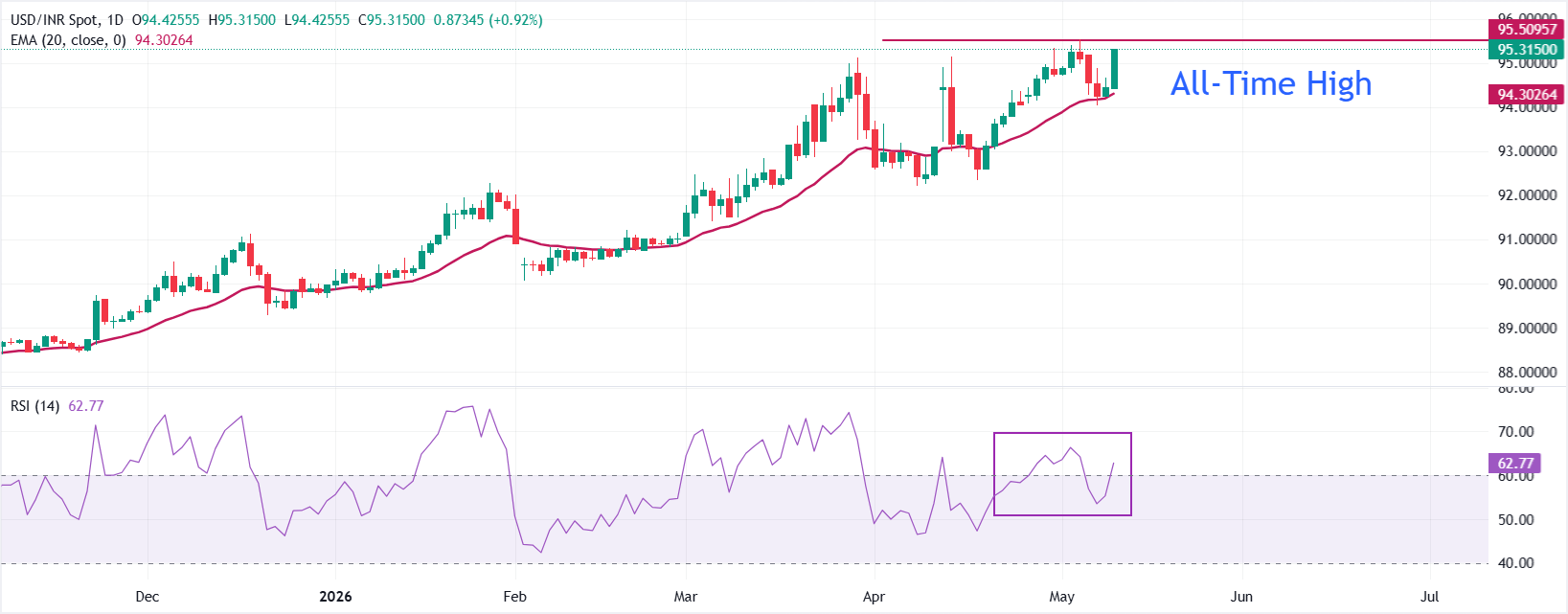
USD/INR trades firmly at around 95.32 at the press time. The pair extends its advance above the 20-day exponential moving average (EMA) at 94.30, reinforcing a bullish near-term tone. The positive slope of the 20-day EMA suggests underlying trend support, while the Relative Strength Index (RSI) around 63 stays in bullish territory without yet signaling overbought conditions, hinting that upside momentum remains constructive.
On the downside, initial support is seen at the 20-day EMA near 94.30, where a pullback could find buyers on a first test. A daily close back below that level would weaken the immediate bullish structure and open room for a deeper correction toward 94.00. Looking up, the pair aims to revisit the all-time high of 95.50 posted on May 5. Above that, the pair will enter uncharted territory and will likely jump towards 96.00
(The technical analysis of this story was written with the help of an AI tool.)
Author

Sagar Dua
FXStreet
Sagar Dua is associated with the financial markets from his college days. Along with pursuing post-graduation in Commerce in 2014, he started his markets training with chart analysis.