USD/INR firms up above 86.00 after softer Empire State reading
- The Indian Rupee recovers after two days of losses, tracking a weaker US Dollar Index.
- Fresh trade data and easing wholesale inflation support INR sentiment.
- USD/INR holds steady above 86.00 after briefly dipping to 85.83 on softer Empire State Manufacturing Index.
- RBI intervention expectations anchor the Rupee despite Middle East hostilities.

The Indian Rupee (INR) strengthens against the US Dollar (USD) on Monday, halting a two-day losing streak as the US Dollar Index (DXY) slips lower and fresh trade data boosts sentiment. A narrower trade gap has offered the Rupee some support, helping it recover alongside a softer Greenback and steady risk appetite in global markets.
The USD/INR pair extends its intraday decline to trade around 86.05 during the American session, slipping nearly 0.50% from the day’s high of 86.36. A weaker Greenback, improved domestic trade data, and softer global crude oil prices following Friday’s rally are lending support to the Rupee, although traders remain cautious ahead of key US economic releases this week.
While the ongoing Iran–Israel conflict has so far had limited direct impact on India, policymakers remain vigilant to any potential fallout, given the region’s importance for India’s energy security. New Delhi has maintained a neutral diplomatic stance, urging de-escalation while actively monitoring supply routes to ensure adequate Crude reserves.
This measured approach, along with the Reserve Bank of India’s (RBI) readiness to curb excess currency volatility, has helped cushion the Rupee from sharper swings, although a sudden flare-up could still push Oil prices higher and rekindle inflationary pressure.
Market Movers: Rupee Steadies on Data; Fed and Middle East Tensions Keep Traders Alert
- India’s trade deficit stood at $21.88 billion in May 2025, little changed from $23.8 billion a year ago, highlighting steady trade flows compared to fluctuations seen in other Asian economies. Imports dipped by 1.7% to $60.61 billion, helped by softer energy prices, while exports slipped 2.2% to $38.73 billion. Notably, shipments to the United States rose to $17.25 billion since April, up from $14.17 billion a year earlier, suggesting that recent US tariff moves have had a limited impact on India’s trade.
- India’s wholesale price inflation cooled to 0.39% in May 2025, marking its lowest level since March 2024 and coming in below market expectations for a slight decline to 0.80%. Softer food prices, especially a sharp drop in vegetable costs, helped ease headline inflation. Manufacturing price growth also slowed, reflecting milder cost increases for items like paper, food products, and plastics. Meanwhile, fuel and power prices continued to fall, led by lower petrol and diesel rates. On a monthly basis, wholesale prices dipped slightly by 0.06%, extending April’s modest decline.
- The Reserve Bank of India has signalled its willingness to smooth out excessive Rupee volatility through intervention if required. This backstop continues to support the currency, even as traders keep an eye on global risk trends.
- The Reserve Bank of India (RBI) on Monday released draft guidelines for Rupee Interest Rate Derivatives, aiming to update the current regulatory framework in line with evolving market conditions and related developments. The proposed changes are expected to enhance transparency and efficiency in the domestic interest rate derivatives market. In its statement, the Reserve Bank of India noted that a comprehensive review of the existing Interest Rate Derivatives (IRD) guidelines has been carried out. The draft directions — titled Draft Master Direction: Reserve Bank of India (Rupee Interest Rate Derivatives) Directions, 2025.
- The US Dollar Index (DXY) slipped to as low as 97.68 following the weaker-than-expected Empire State Manufacturing Index but quickly reversed course to trade near 97.94 at the time of writing. Traders dialed back some risk-off positioning while keeping a close eye on fresh developments in the Israel–Iran conflict. Sentiment improved further after reports indicated that Iran is open to resuming talks over its nuclear program. According to The Wall Street Journal, Tehran has signaled to Arab officials its willingness to return to negotiations, on the condition that the United States refrains from participating in ongoing attacks.
- Fresh data from the New York Federal Reserve showed that the Empire State Manufacturing Index plunged to -16.0 in June from -9.2 in May, well below market expectations of -5.5. This marks the weakest print since March’s two-year low of -20.0, pointing to a deeper contraction in regional factory activity and adding to concerns about slowing US economic momentum.
- Traders are turning their attention to the Fed’s midweek meeting, where policymakers are widely expected to hold rates steady. Market players will parse the updated economic projections and Fed Chairman Powell’s remarks for hints on when rate cuts might begin.
Technical analysis: USD/INR tests triangle breakout, but momentum fades
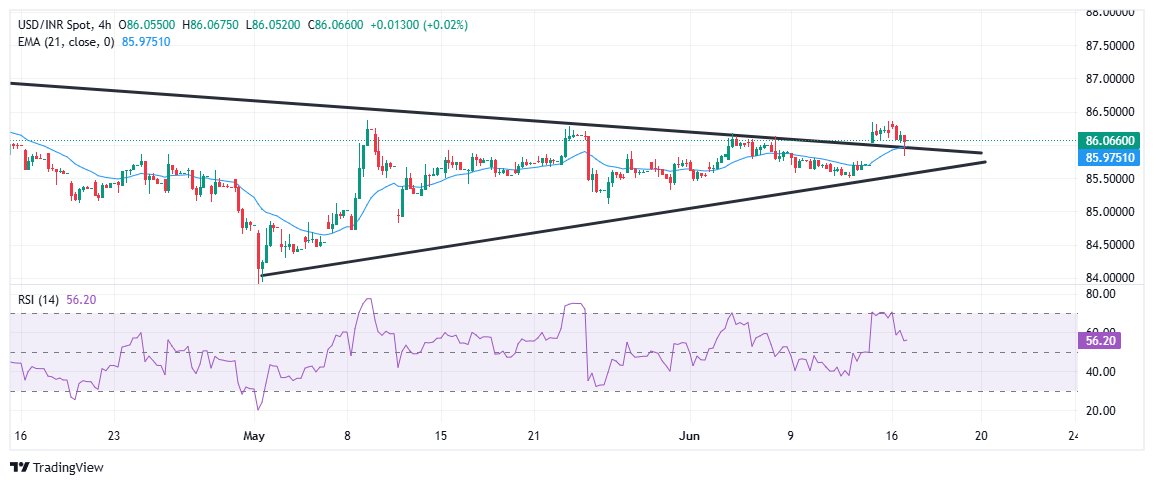
The USD/INR pair has recently broken out of a multi-week symmetrical triangle pattern on the 4-hour chart, signaling a potential shift in short-term bias. However, after reaching near 86.50, prices are struggling to sustain momentum above the upper trendline. The pair is currently hovering near 86.05, modestly above the 21-period Exponential Moving Average (EMA) at 85.97, suggesting that buyers still have a slight advantage as long as prices hold above this moving average support.
The 14-period Relative Strength Index (RSI) stands around 59, indicating mild bullish momentum but not yet in overbought territory. A sustained move above the recent high near 86.50 could confirm a stronger bullish breakout, potentially exposing the psychological 87.00 level. On the flip side, a drop back below the EMA and a retest of the former triangle resistance-turned-support near 85.90–85.80 could attract fresh selling, dragging the pair toward the lower ascending trendline near 85.50.
RBI FAQs
The role of the Reserve Bank of India (RBI), in its own words, is "..to maintain price stability while keeping in mind the objective of growth.” This involves maintaining the inflation rate at a stable 4% level primarily using the tool of interest rates. The RBI also maintains the exchange rate at a level that will not cause excess volatility and problems for exporters and importers, since India’s economy is heavily reliant on foreign trade, especially Oil.
The RBI formally meets at six bi-monthly meetings a year to discuss its monetary policy and, if necessary, adjust interest rates. When inflation is too high (above its 4% target), the RBI will normally raise interest rates to deter borrowing and spending, which can support the Rupee (INR). If inflation falls too far below target, the RBI might cut rates to encourage more lending, which can be negative for INR.
Due to the importance of trade to the economy, the Reserve Bank of India (RBI) actively intervenes in FX markets to maintain the exchange rate within a limited range. It does this to ensure Indian importers and exporters are not exposed to unnecessary currency risk during periods of FX volatility. The RBI buys and sells Rupees in the spot market at key levels, and uses derivatives to hedge its positions.
Author

Vishal Chaturvedi
FXStreet
I am a macro-focused research analyst with over four years of experience covering forex and commodities market. I enjoy breaking down complex economic trends and turning them into clear, actionable insights that help traders stay ahead of the curve.