Indian Rupee extends last week’s outperformance into the new week
- The Indian Rupee gains against the US Dollar at the start of the week.
- Sell-off in US AI-related stocks continues to weigh on the US Dollar.
- The RBI announces that it will infuse up to 1 trillion rupees through variable rate repo operation.
The Indian Rupee (INR) extends its positive momentum after last week’s outperformance against the US Dollar (USD) on Monday. The USD/INR pair declines to near 94.80 as continuous sell-off in United States (US) Artificial Intelligence (AI)-related stocks is keeping the US Dollar under pressure.
As of writing, the US Dollar Index (DXY), which gauges the Greenback’s value against six major currencies, is almost flat at around 101.80, but is close to its over two-week low of 101.57 posted on Friday.
Dollar softens as AI debt jitters reshape safe-haven dynamics
Analysts at ING argue that the latest moves in foreign exchange offer “a preview of how currencies will perform during a big AI correction.” They note that, rather than rallying as a traditional safe haven, “those currencies most linked to AI chip shipments, such as the Taiwanese dollar and the Korean won,” coming under the heaviest pressure. ING adds that investors are likely to “keep an eye on the debt of the big AI issuers today, and any further sell-off could weigh on the dollar.”
The ongoing weakness in the US Dollar amid correction in AI stocks has forced market experts to reprice US Dollar’s outlook.
Strategists at Scotiabank highlight that the US Dollar’s recent downturn has gathered momentum, describing DXY price action as “clearly bearish with an acceleration of the bearish reversal from Wednesday’s local peak.” They note that “the break below 102 is extending,” adding that they “see little in terms of support ahead of 101,” underscoring the vulnerability of the index as it grinds lower toward that next technical floor.
Meanwhile, the Indian Rupee continues to gain strength from Reserve Bank of India’s (RBI) liquidity infusions and new measures announced this month.
According to a Reuters report, the Indian central bank will conduct a seven-day variable rate repo operation to infuse liquidity on Monday, the Reserve Bank of India said. The RBI will infuse up to 1 trillion rupees ($10.53 billion) through the operation, which traders said is aimed at helping lenders tide over tax outflows amid tighter daily cash reserve requirements.
This month, the RBI announced various measures to curb the US Dollar’s demand, which led to a sharp rally in the Indian currency last week.
Analysts at Societe Generale said in a note that these measures include “the reintroduction of a dedicated oil import window, tighter restrictions on corporate hedging, limits on uncovered FX transactions, a ban on rebooking cancelled derivatives, and fresh open market operation (OMO) bond sales,” underscoring the central bank’s determination to stabilise the currency through both FX-market tools and balance-sheet operations.
USD/INR Technical Analysis
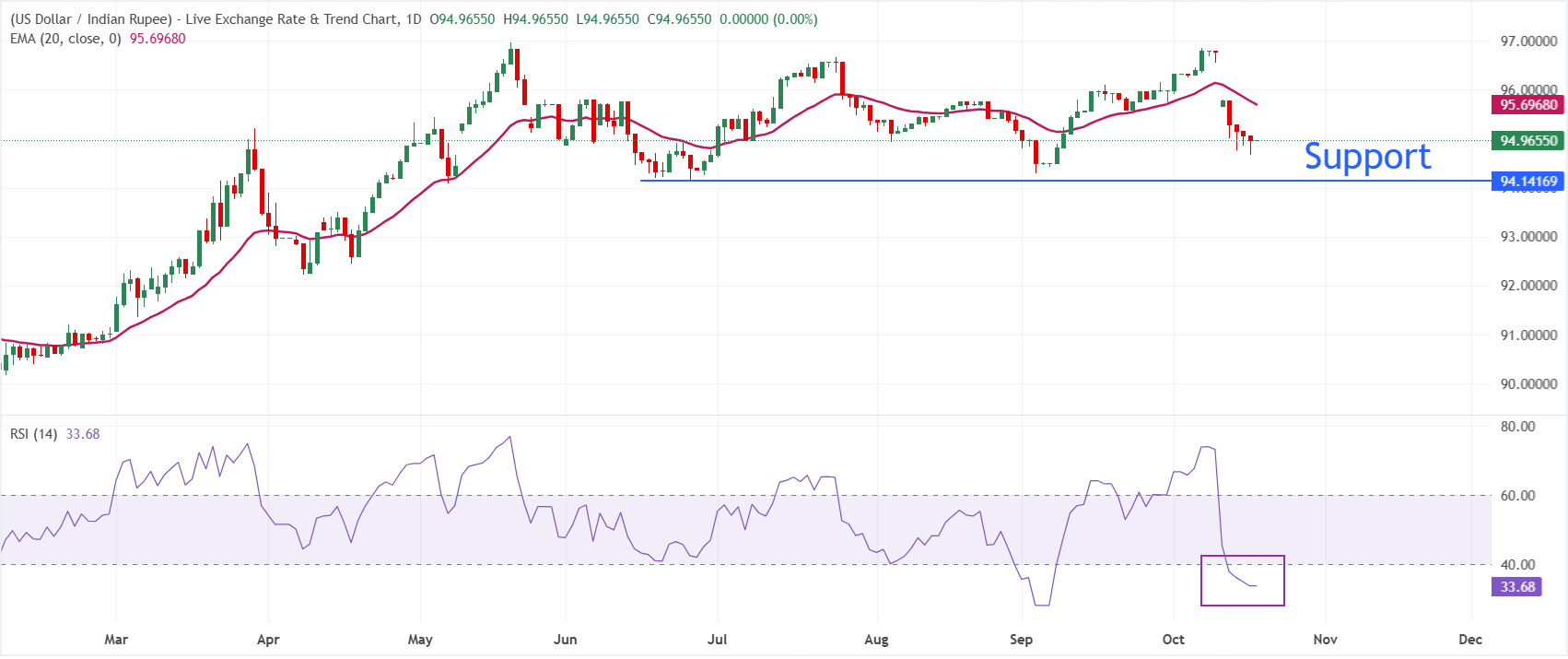
In the daily chart, USD/INR trades at 94.9655, extending a bearish tone as spot holds below the 20-period exponential moving average (EMA) at 95.6968, which now acts as the first meaningful topside barrier. The Relative Strength Index (RSI) sits near 34 in negative territory, hinting that downside momentum persists but is approaching oversold conditions that could slow the recent decline rather than reverse it outright.
On the topside, immediate resistance is located at the 20-day EMA around 95.70, and sellers are likely to defend this level while it caps corrective rebounds. With no nearby technical supports derived from moving averages or Fibonacci levels beneath current price in this dataset, the pair remains vulnerable to further slippage, and any recovery would need a sustained break above the 20-day EMA to ease the current bearish pressure.
(The technical analysis of this story was written with the help of an AI tool. Know more.)
Indian Rupee FAQs
The Indian Rupee (INR) is one of the most sensitive currencies to external factors. The price of Crude Oil (the country is highly dependent on imported Oil), the value of the US Dollar – most trade is conducted in USD – and the level of foreign investment, are all influential. Direct intervention by the Reserve Bank of India (RBI) in FX markets to keep the exchange rate stable, as well as the level of interest rates set by the RBI, are further major influencing factors on the Rupee.
The Reserve Bank of India (RBI) actively intervenes in forex markets to maintain a stable exchange rate, to help facilitate trade. In addition, the RBI tries to maintain the inflation rate at its 4% target by adjusting interest rates. Higher interest rates usually strengthen the Rupee. This is due to the role of the ‘carry trade’ in which investors borrow in countries with lower interest rates so as to place their money in countries’ offering relatively higher interest rates and profit from the difference.
Macroeconomic factors that influence the value of the Rupee include inflation, interest rates, the economic growth rate (GDP), the balance of trade, and inflows from foreign investment. A higher growth rate can lead to more overseas investment, pushing up demand for the Rupee. A less negative balance of trade will eventually lead to a stronger Rupee. Higher interest rates, especially real rates (interest rates less inflation) are also positive for the Rupee. A risk-on environment can lead to greater inflows of Foreign Direct and Indirect Investment (FDI and FII), which also benefit the Rupee.
Higher inflation, particularly, if it is comparatively higher than India’s peers, is generally negative for the currency as it reflects devaluation through oversupply. Inflation also increases the cost of exports, leading to more Rupees being sold to purchase foreign imports, which is Rupee-negative. At the same time, higher inflation usually leads to the Reserve Bank of India (RBI) raising interest rates and this can be positive for the Rupee, due to increased demand from international investors. The opposite effect is true of lower inflation.
Author

Sagar Dua
FXStreet
Sagar Dua is associated with the financial markets from his college days. Along with pursuing post-graduation in Commerce in 2014, he started his markets training with chart analysis.