Indian Rupee holds early ground as traders dial down hawkish Fed bets
- The Indian Rupee rebounds against the US Dollar as hawkish Fed bets ease.
- US headline and core CPI growth cooled faster than expected in June.
- Oil price rally halts while US-Iran military aggression continues.
The Indian Rupee (INR) gains ground against the US Dollar (USD) on Wednesday after rising significantly in the last three trading days. The USD/INR pair drops to near 96.11 as the US Dollar comes under selling pressure, with traders repricing Federal Reserve (Fed) interest rate expectations following the release of the softer-than-expected United States (US) Consumer Price Index (CPI) data for June.
At press time, the US Dollar Index (DXY), which gauges the Greenback’s value against six major currencies, trades 0.15% lower to near 100.80.
Hawkish Fed bets ease
On Tuesday, the US CPI report for June showed that the headline inflation cooled down at a faster-than-expected pace to 3.5% Year-on-Year (YoY) from 4.2% in May. In the same period, the core CPI – which excludes volatile food and energy items – grew at a moderate pace of 2.6% YoY against 2.8% estimates and the previous reading of 2.9%.
Signs of decelerating price pressures have eased fears of Federal Reserve (Fed) interest rate hikes in the near term.
According to the CME FedWatch tool, the odds of the Fed raising interest rates at the policy meeting this month have eased to 16.6% from 41.7% recorded on Monday.
Meanwhile, Fed Chairman Kevin Warsh has reiterated the need to bring price stability in his testimony before Congress on Tuesday. Warsh said in his prepared remarks, “The Fed has no tolerance for persistently elevated inflation.” "If we get policy right - and we will- the inflation surge of the last five years will be a thing of the past," Warsh added.
Oil price rally hits pause
Over-a-week-long rally in oil prices appears to have paused for a while as US President Donald Trump has rolled back the idea of charging a 20% toll fee from cargo ships transiting through the Strait of Hormuz, a vital passage to almost 20% of global energy supply.
However, the continued aggression between the US and Iran will keep the energy supply disrupted, a scenario that is favorable for the oil price.
FIIs dump Indian shares again
Foreign Institutional Investors (FIIs) turned out to be net sellers in the Indian stock market for the second consecutive trading day on Tuesday, paring their stake worth Rs. 739.69 crore. FIIs also sold shares worth Rs. 3,062.27 crore.
Technical Analysis: USD/INR sees more upside to near 97.10
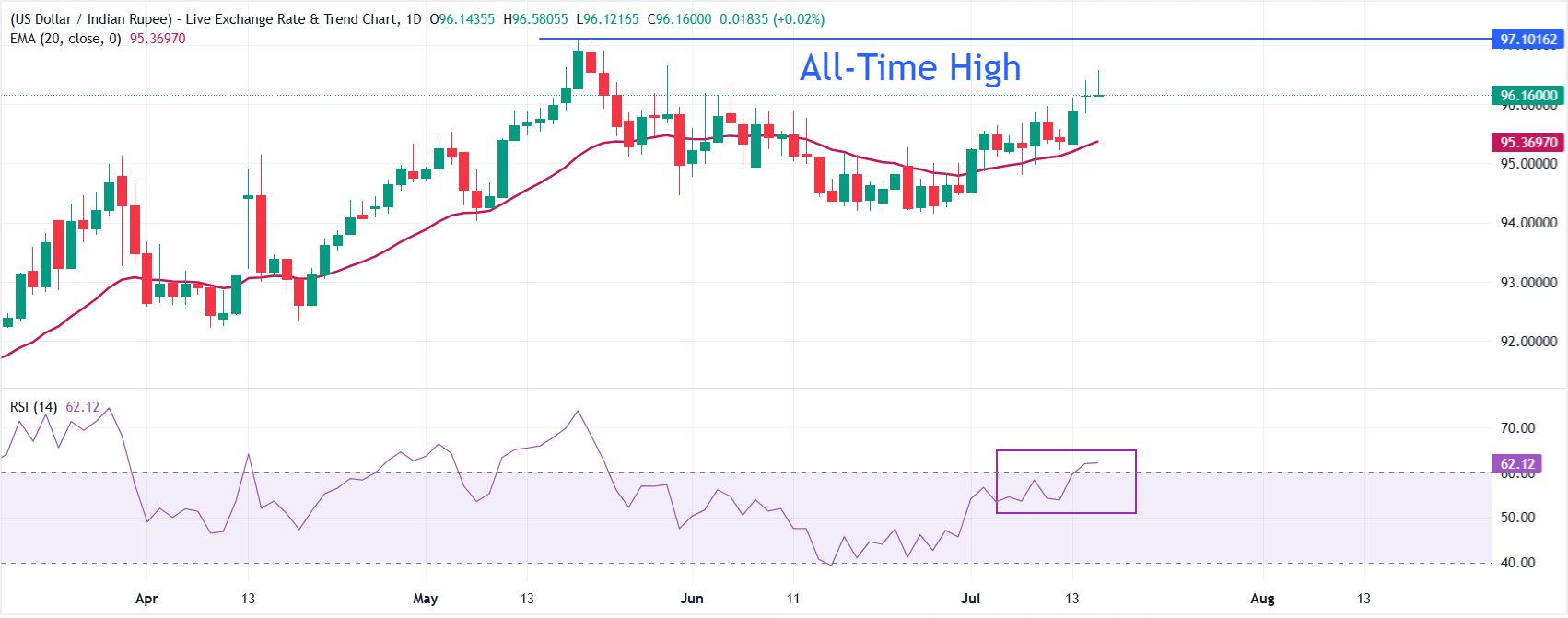
USD/INR trades subduedly at around 96.15 at press time. However, the near-term bias of the pair remains bullish as it holds above the 20-day Exponential Moving Average (EMA), which is at 95.37.
The positive slope of the EMA hints at a constructive underlying trend, while the Relative Strength Index (RSI) at 62.1 stays in bullish territory without yet reaching overbought, suggesting buyers still have room to press the move higher.
On the downside, immediate support is seen at the 20-day EMA at 95.37, where dip-buying interest could emerge if a corrective pullback unfolds. Looking up, the pair aims to revisit the all-time high at 97.10.
(The technical analysis of this story was written with the help of an AI tool. Know more.)
Inflation FAQs
Inflation measures the rise in the price of a representative basket of goods and services. Headline inflation is usually expressed as a percentage change on a month-on-month (MoM) and year-on-year (YoY) basis. Core inflation excludes more volatile elements such as food and fuel which can fluctuate because of geopolitical and seasonal factors. Core inflation is the figure economists focus on and is the level targeted by central banks, which are mandated to keep inflation at a manageable level, usually around 2%.
The Consumer Price Index (CPI) measures the change in prices of a basket of goods and services over a period of time. It is usually expressed as a percentage change on a month-on-month (MoM) and year-on-year (YoY) basis. Core CPI is the figure targeted by central banks as it excludes volatile food and fuel inputs. When Core CPI rises above 2% it usually results in higher interest rates and vice versa when it falls below 2%. Since higher interest rates are positive for a currency, higher inflation usually results in a stronger currency. The opposite is true when inflation falls.
Although it may seem counter-intuitive, high inflation in a country pushes up the value of its currency and vice versa for lower inflation. This is because the central bank will normally raise interest rates to combat the higher inflation, which attract more global capital inflows from investors looking for a lucrative place to park their money.
Formerly, Gold was the asset investors turned to in times of high inflation because it preserved its value, and whilst investors will often still buy Gold for its safe-haven properties in times of extreme market turmoil, this is not the case most of the time. This is because when inflation is high, central banks will put up interest rates to combat it. Higher interest rates are negative for Gold because they increase the opportunity-cost of holding Gold vis-a-vis an interest-bearing asset or placing the money in a cash deposit account. On the flipside, lower inflation tends to be positive for Gold as it brings interest rates down, making the bright metal a more viable investment alternative.
Author

Sagar Dua
FXStreet
Sagar Dua is associated with the financial markets from his college days. Along with pursuing post-graduation in Commerce in 2014, he started his markets training with chart analysis.