Improved jobs picture fails to impress stock market as non-AI tech flails
- Nonfarm Payrolls for January rise to 130K, above 70K consensus.
- US equity indices unimpressed as earnings take toll on non-AI tech.
- Software continues to feel the burn of competition with AI.
- Market pushes next interest rate cut out to July.

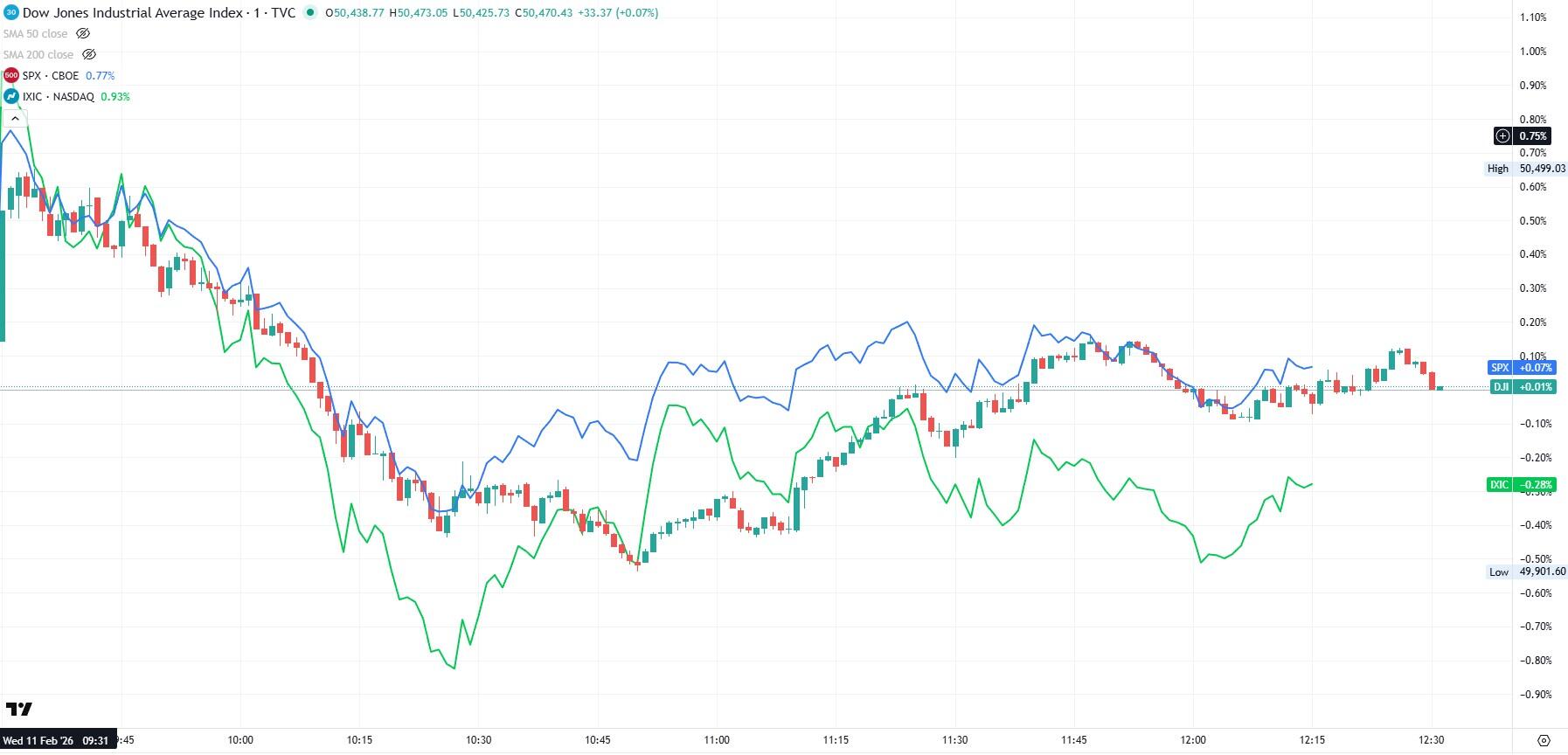
The uniformly positive news on the US jobs front on Wednesday was not mirrored by equity exuberance. Although the January US Nonfarm Payrolls of 130K arrived nearly double the 70K consensus, US stocks climbed down from their initial rally rather quickly. By lunchtime, the NASDAQ Composite had lost a quarter percentage point, while the Dow Jones and S&P 500 were largely flat.
While the employment picture improved dramatically in January from December's 48K revised figure, and the Unemployment Rate fell by a tenth of a point to 4.3%, investors sensed that a better labor market meant that interest rate cuts were farther away. Indeed, the CME's interest rate bets showed that investors had pushed the next rate cut from June to July. This tendency grew stronger after Jeffrey Schmid, the President of the Federal Reserve Bank of Kansas City, suggested that restrictive monetary policy was appropriate as inflation approaches 3%.
However, plenty of non-AI tech or tech-adjacent stocks plunged on earnings results. These included Robinhood Markets (HOOD), Shopify (SHOP), Lyft (LYFT), Astera Labs (ALAB) and Unity Software (U).
Non-AI tech returns to sell-off mode
The same extreme multiple downgrade that the market presented to Adobe (ADBE) last year is starting to take hold across the software sector in 2026. John Zito, co-president of Apollo Asset Management, told CNBC on Wednesday morning that the software segment is entering a "violent" technology cycle. While software companies are likely to continue adding customers, Zito said that companies are widely expected to fight back against the current pricing paradigm since AI is now allowing companies to build their own software in-house.
A small startup called Altruist released a tax-strategy tool that sent money management stocks reeling early this week. Last week, saw the release of tools from Anthropic that threaten white-collar jobs in the legal and financial services space. Newly released AI models from OpenAI and others are beginning to build themselves, something that wasn't thought possible even a year ago.
This wave of AI breakthroughs is leading many on Wall Street to question the durability of software companies and others that are not AI-centric.
Astera Labs (ALAB) dropped 20% on Wednesday after earnings that had analysts deriding future gross margins, partially due to its new partnership with Amazon (AMZN). Unity Software (U), a maker of video game platforms, fell 30% on its revenue guidance.
Robinhood Markets (HOOD) fell 13% on its quarterly revenue miss.
Centrus Energy (LEU) fell 19% following a broad quarterly consensus miss.
Shopify (SHOP) stock plunged 13% after its Q1 free cash flow guidance came in at "low to mid-teens" compared with the 17% margin expected by Wall Street.
Author

Clay Webster
FXStreet
Clay Webster grew up in the US outside Buffalo, New York and Lancaster, Pennsylvania. He began investing after college following the 2008 financial crisis.