If Russia does invade Ukraine, this could finally spark-off the crash 'puts' have been telegraphing
- Risk sentiment surrounding the Ukraine crisis is disguising the severity of the US's recent pivot on diplomacy.
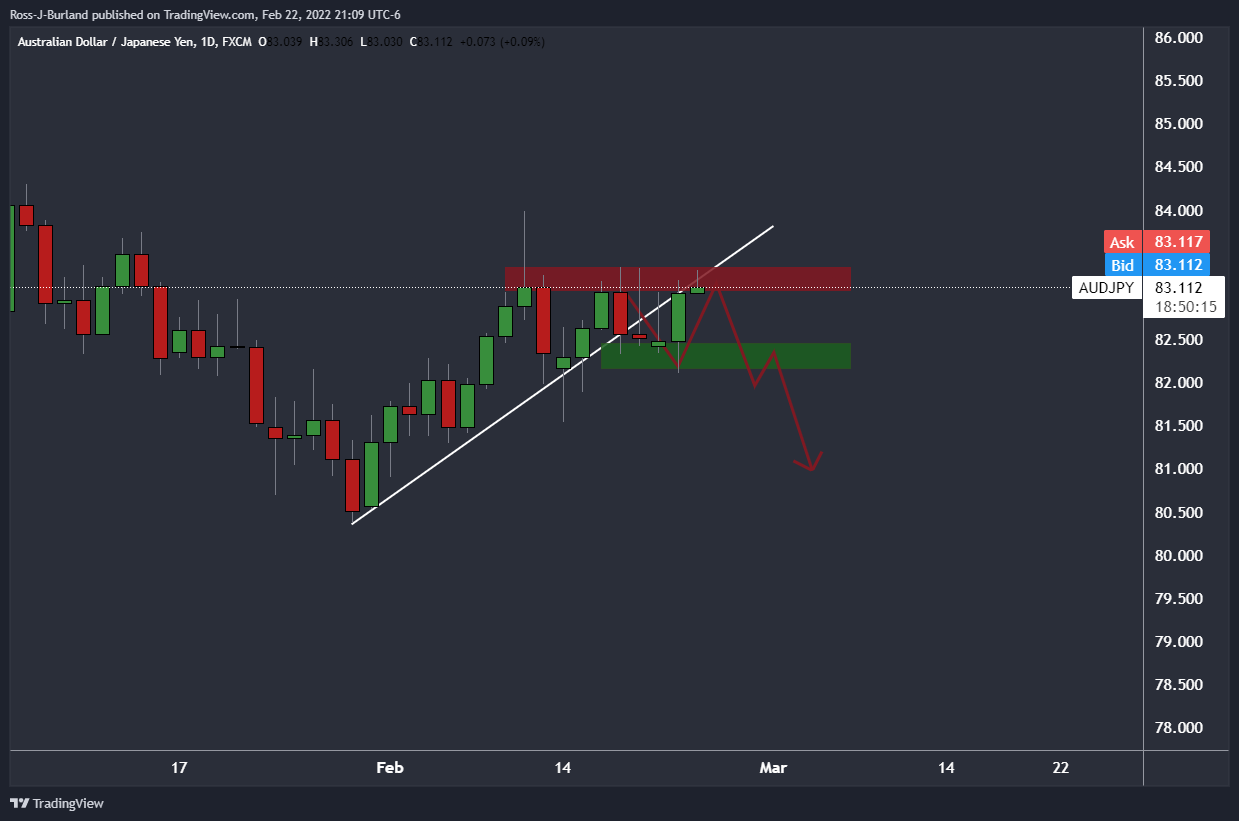
- The forex markets risk barometer, AUD/JPY, could be on the verge of another test of 82.12.

With markets across Asia tumbling on Tuesday amid the escalating threat of war, there is a spooky air of calm in Asian markets on Wednesday. With Japan on holiday, the Chinese indexes are higher despite the blatant risks of warfare in Central Asia and Europe.
The general consensus is, a Russian military incursion into Ukraine would have far-reaching economic ramifications in Asia in the near term. Russian energy, which could be sanctioned against by the West, is paramount as an economic driver for key nations in the region, including China and India, economic powerhouse nations that rely on steadily low oil prices.
Western countries are announcing sanctions in response to Russian President Vladimir Putin's decision to recognize the independence of two separatists "republics" in eastern Ukraine and send in Russian troops on a "peacekeeping" mission.
Measures forcing Russia to supply less crude or natural gas would have substantial implications on oil prices and the global economy. The price of Brent crude oil, an international benchmark, touched a seven-year high of more than $99 a barrel after President Vladimir Putin ordered troops into Ukraine's east. However, so far, there have been no sanctions on Russian energy. Instead, markets have welcomed a more measured approach, in what is regarded as a softer advance by the West, leaving the door open for discussions.
Sanctions are not enough to kick start the market crash
Sanctions from the EU and Germany, UK, US and Canada have for the main, been targeting Russian banks and Russian oligarchs that are in Putin's inner circle and sovereign debt. The penalties announced by the US president are the "first tranche of sanctions" intended to impose costs on Russia for its latest actions against Ukraine. US Sanctions are being applied to VEB bank and Russia's military bank, Promsvyazbank, which does defence deals, Biden said.
Starting on Wednesday US sanctions will begin against Russian elites and their family members. Biden also announced that the US will be working with Germany to halt the Nord Stream 2. Meanwhile, the European Union's foreign ministers will sanction the 351 Russian Duma members who voted to recognize the Donetsk and Luhansk People's Republics. Another 27 Russian entities and individuals accused of destabilizing Ukraine. The EU also agreed to target the "ability of the Russian state and government to access the EU's capital and financial markets and services." The UK will also sanction three "very high net worth individuals".
US pivots on the path to diplomacy
Meanwhile, what should be important to market sentiment are the stepping stones to a diplomatic resolution. However, on Tuesday, the US removed one of those in an announcement from US Secretary Antony Blinken. He said at the turn of early Asian forex markets, now that Russia's invasion is beginning, it doesn't make sense for him to meet with Russia's Lavrov anymore. He says he sent a letter the same day to him to inform him of that.
Key notes
- Blinken says Putin's 'disturbing' speech yesterday and statements today showed to the world that he views Ukraine as a 'subordinate' of Russia
- Blinken says now we know now that Putin's plan all along has been to invade Ukraine
- Blinken says Putin is blatantly breaking the laws and principles that have kept peace across Europe and in the world.
- Says the US will not allow Russia to claim the pretence of diplomacy.
- Says US and partners are always open to diplomacy but Moscow needs to demonstrate that it is serious about diplomacy.
- Says if Moscow's approach changes, US remains prepared to engage.
- Blinken says on the sanctions: we started high and we will stay high.
In an article written earlier in the US session on Tuesday, EUR/USD bulls move in to clean up on the risk-off stops, bull flag taking shape, it was stated that, ''as far as diplomacy, the White House said on Sunday a summit between the US and Russia will go ahead only 'if an invasion hasn't happened.' This means that the meeting between Secretary of State Antony Blinken and Russian Foreign Minister Sergey Lavrov in Europe this week will be a critical stepping stone in this direction.''
Now that this meeting has been taken off the agenda, it means that s summit between the US and Russian presidents are certainly not on either nation's radar and that leaves the door wide open for an invasion of more Ukrainian territory. After all, Kyiv has resisted negotiating directly with the governments of the Russian-controlled territories, saying it wants to speak with Moscow directly. However, there have been no signs from the Kremlin of welcoming such a summit and this leaves the situation on tenterhooks and on icy ground for financial markets.
Market implications
Meanwhile, traders have been steadily boosting bets against equities, as acknowledged in Bloomberg news that notes the highest levels in Put open interest on record.
''Whatever happens in Ukraine or how it affects Federal Reserve policy, the outcome will land in markets where investors have had time to prepare for the worst. It may be one reason the worst has so far been avoided,'' an article reads on BNN Bloomberg:
''They’ve been steadily boosting bets against equities, shaking off a reluctance to short tracing to last year’s meme stock upheaval. Bearish bets on the largest exchange-traded fund tracking the S&P 500 have surged, while put open interest on bond-focused products has risen to historic levels. Meanwhile, professional managers have been hedging their credit exposures.''
''As a result, not only have bearish bets on the SPY ETF surged, but put open interest on bond-focused products has also risen to historic levels. Meanwhile, professional managers have been hedging their credit exposures.''
With that all being said, however, in forex, we are not exactly seeing the kind of follow-through that one might expect from traders moving into safe-havens. The yen, for instance, as measured against a basket of currencies in the JXY, is barely holding in correction territory on the 4-hour chart, down vs, the Aussie by some 0.11% and flat vs the euro.
If there is going to be a meaningful move in sentiment, the forex markets risk barometer, AUD/JPY, that is retesting the daily counter-trendline, could be shaken out of its tree in the coming days. Eyes will be on whether it can take out the recent lows of 82.12:
Author

Ross J Burland
FXStreet
Ross J Burland, born in England, UK, is a sportsman at heart. He played Rugby and Judo for his county, Kent and the South East of England Rugby team.

















