|

IBIO Stock Price: iBio Inc. edges slightly lower after three consecutive days of big gains

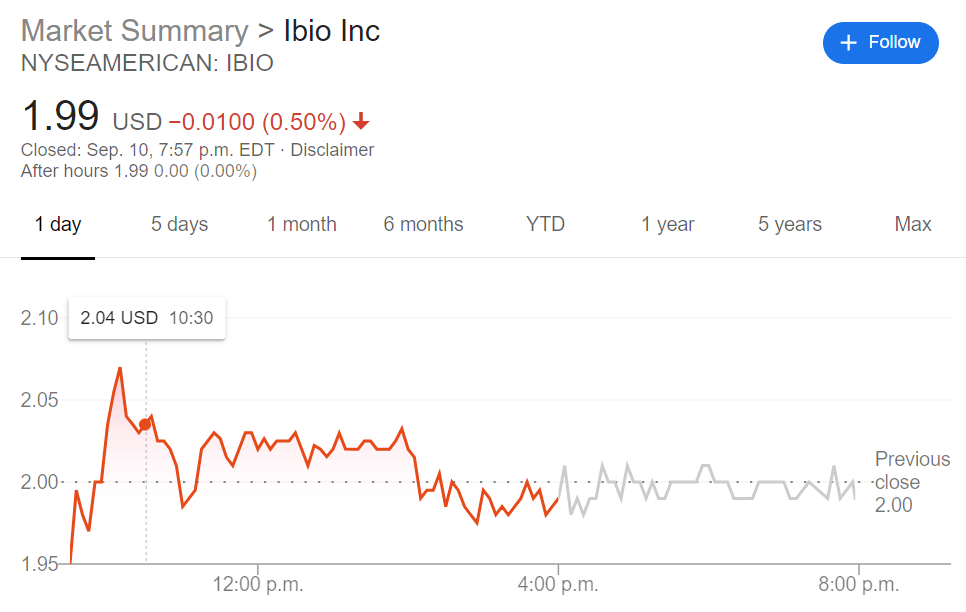
  • NYSEAMERICAN:IBIO falls by 0.50% on Thursday after three straight days of gains at the start of the week.
  • iBIO has finally decided on IBIO-201 as its coronavirus vaccine of choice.
  • The entire COVID-19 biotech industry gained this week after AstraZeneca’s leading vaccine trial was halted.

NYSEAMERICAN:IBIO finally fell on Thursday alongside broader markets as the fallout from AstraZeneca halting its coronavirus vaccine study finally levelled off. iBIO has been a popular biotech penny stock amongst bargain investors that are targeting these micro-cap firms as potential industry disruptors. The stock has performed admirably thus far this year up 212.50% during the past 52-weeks – although shares are down over 70% from its 52-week highs of $7.45.

IBIO is more than just a coronavirus vaccine candidate though and investors know that the New York-based company has some more aces up its sleeve. Even if IBIO-201 is not chosen as the one the vaccines used to combat COVID-19, iBIO Inc. is well-positioned to be a global manufacturer of vaccine components with its FastPharming facility located in Bryan, Texas. The world is going to need upwards of 7 billion vaccines at some point and it may inevitably be a combination of biotech firms that band together to conquer the novel coronavirus. 

IBIO Stock News
iBIO also has its hands in other sectors as it is developing IBIO-100 as well, which is a fusion protein for the treatment of fibrotic diseases. The recent selloff leading up to the AstraZeneca news has battered the stock down to levels where bargain investors should once again take notice. The race for the COVID-19 vaccine is wide open as other firms continue to fail and other companies have the chance to step up to the plate. While ultimately IBIO may not be the vaccine that is chosen, it certainly has a chance of carving out a role in the manufacturing of vaccines for global use.

Author

More from Stocks Reporter
Share:

Editor's Picks

AUD/USD bulls regain control above 0.6950 amid USD retreat

AUD/USD regains traction and extends the previous day's bounce from the weekly low, aiming for 0.7000 in Asia on Friday. The overnight pullback in US bond yields keeps the US Dollar below an 18-month high, which in turn offers some support to the pair. Meanwhile, hawkish RBA expectations also keep the major underpinned.

USD/JPY holds gains near 158.00 after Japan's weak Household Spending data

USD/JPY clings to gains around 158.00 after data showed on Friday that Japan's Household Spending fell for the ninth straight month, undermining the Japanese Yen. Meanwhile, the US Dollar remains depressed as the overnight fall in US bond yields counters a hawkish Fed and geopolitical uncertainties, could cap any downside in the pair.

Gold remains range-bound below $4,200

Gold has given up some ground after an initial bullish attempt to reach weekly highs, returning to below the $4,200 mark per troy ounce on Friday. The US Dollar’s strong upside momentum, combined with rising US Treasury yields across the curve, seems to keep further gains in the yellow metal under scrutiny.

Has Bitcoin really escaped the macro forces it was built to fight?
Over 17 years ago, Satoshi Nakamoto designed Bitcoin (BTC) on the back of a global financial crisis as an alternative to the global monetary system outside the control of central banks, governments and traditional intermediaries. This raises a key question: has Bitcoin really become independent of the macroeconomic forces it was built to challenge?
The Euro is not the sick man of Europe. France's bond market is
EUR/USD remains under pressure, near the 17-month low of 1.1161 reached on Monday. The pair has lost more than 7% since its yearly peak, as concerns over France's public finances increasingly weigh on the single currency. But behind the weakness of the Euro (EUR), the problem does not necessarily lie with the European economy as a whole.
Has Bitcoin really escaped the macro forces it was built to fight?
Over 17 years ago, Satoshi Nakamoto designed Bitcoin (BTC) on the back of a global financial crisis as an alternative to the global monetary system outside the control of central banks, governments and traditional intermediaries. This raises a key question: has Bitcoin really become independent of the macroeconomic forces it was built to challenge?
















