|

HTZ Stock Price: Hertz Global Holdings bankruptcy means new shares could be worthless, according to the firm

  • Hertz Global Holdings Inc's shares are falling by around 20%.
  • New shares "could be worthless," said the bankrupt firm.
  • Concerns about a second coronavirus wave are compounding the losses.

For those that did not understand the meaning of "bankrupt"  Hertz Global Holdings Inc – the firm behind the well-known car-renting brand – made it clear. 

The firm issued $500 in new shares but added a stark warning, saying the paper could be worthless. The reaction was swift, and NYSE: HTZ is trading at around $2.26, down some 20% on the day and nearly 90% from the high above $20 recorded just before the pandemic gripped the world.
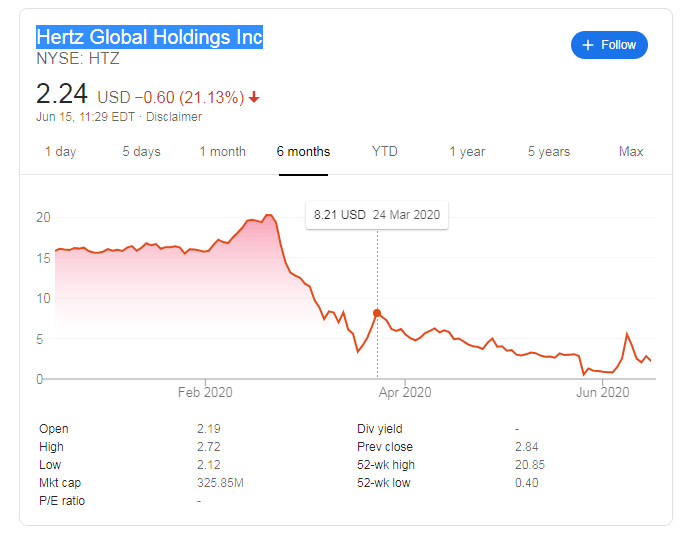
Hertz Stock News 

Coronavirus has hit the firm hard and triggered its Chapter 11 filing. It may now add misery to the stock price. Investors are concerned about a second coronavirus wave and selling shares. Cases in Florida, California, and Texas are on the rise. Hopes that warm weather would kill COVID-19 have been put aside as steaming hot Arizona is also seeing a leap in hospitalizations. 

Can Hertz eventually find bargain-seekers? Building confidence in a bankrupt firm was already hard, and halving the amount of share offered the public is not a confidence builder. The spike came amid an announcement of selling up to $1 billion worth of bonds. When the sum was reduced to half of that – the share tumbled as well.

At some point – perhaps at the 52-week low of $0.40 – Hertz would prove an opportunity for those willing to take the risk. The moment has yet to come. 

The Florida-based company was founded in 1918 when what is known now as Spanish influenza began ravaging around the war-torn world. Bankruptcy at a time of another pandemic seems poetic, but Hertz may still survive. Time will tell. 

Author

Yohay Elam

Yohay Elam

FXStreet

Yohay is in Forex since 2008 when he founded Forex Crunch, a blog crafted in his free time that turned into a fully-fledged currency website later sold to Finixio.


More from Yohay Elam
Share:

Editor's Picks

GBP/USD edges lower below 1.3650, with eyes on US PCE data

GBP/USD trades with a negative bias below 1.3650 in the European session on Wednesday, eroding a part of the previous day's strong gains. The pair, however, remains within striking distance of a six-month top, set last Friday, as traders keenly await the release of the US Personal Consumption Expenditures (PCE) Price Index data for a fresh impetus.

EUR/USD holds lower ground near 1.1650 ahead of key US data

EUR/USD is holding lower ground toward 1.1650 in Wednesday's European session. The US Dollar is recovering modestly amid profit-taking and Middle East uncertainty. US inflation, tracked by the PCE, and another revision of Q2 GDP data should keep investors entertained on Wednesday.

Gold remains depressed below $4,650 on firmer USD; looks to US PCE for Fed rate outlook

Gold sticks to modest losses below $4,650 heading into the European session, though it lacks bearish conviction and remains confined within the previous day's broader range. The US Dollar regains positive traction amid some repositioning ahead of the US Personal Consumption Expenditures Price Index and is seen as weighing on the commodity. Adding to this, Federal Reserve Chair Kevin Warsh's remarks at the Jackson Hole Symposium on Friday might offer more cues about the interest rate path.

Dogecoin, Shiba Inu, Pepe: Profit-taking cools last week’s rally

Meme coins, including Dogecoin (DOGE), Shiba Inu (SHIB), and Pepe (PEPE), are losing their bullish momentum after last week’s double-digit gains. Facing downside pressure amid profit-taking, DOGE and PEPE risk further decline while SHIB holds at a support level.

America’s self‑inflicted trade wound
I’m conflicted about the trade war that the U.S. has started with Canada. Let’s be clear: any representation that Canada has been taking unfair advantage of the U.S. or that they have been treating us badly for years is a bogus characterization. In reality, the shoe is on the other foot. It’s the U.S. that has been behaving badly.
Canada hits US goods with tariffs; The rate market sees a problem
On September 8, Canada begins charging its own importers 15%, 25% and 50% on roughly 700 lines of American goods. The measure is billed as dollar for dollar, and on the arithmetic of covered trade it is. What it is not is a tax on the United States.