Gold breaks below $3,650 amid renewed US Dollar strength
- Gold trades lower on Thursday as the US Dollar strength weighs.
- The Fed delivered its first rate cut since December, lowering the federal funds rate to the 4.00%-4.25 range.
- The Fed's updated dot plot signaled scope for two more cuts in 2025.

Gold (XAU/USD) extends losses on Thursday after a sharp reversal following the Federal Reserve’s (Fed) interest rate decision. The metal briefly spiked to a fresh all-time high near $3,707 in the immediate aftermath of the widely expected 25-basis-point (bps) rate cut on Wednesday, but gains quickly faded as the outcome had already been largely priced in.
At the time of writing, XAU/USD is edging lower, reversing after trading in positive territory earlier in the day. The metal is trading around $3,735 during the American session, down nearly 0.80% on the day, weighed down by renewed strength in the US Dollar.
The Fed has kicked off its rate-cutting cycle and delivered its first rate cut since December, lowering the federal funds rate to the 4.00%-4.25% range. In its monetary policy statement, the Fed noted that economic activity has moderated in recent months and labor market conditions have softened, with job growth showing signs of slowing. Policymakers highlighted that inflation has eased from its peaks but remains above the 2% target, and stressed that downside risks to employment have increased.
While the decision matched expectations, markets focused on the updated dot plot, which pointed to the possibility of two additional rate cuts later this year. Fed Chair Jerome Powell emphasized that the central bank is prepared to adjust as needed, but future cuts would depend on how growth, employment, and inflation data evolve.
Market movers: Fed cut, Powell presser, and market whiplash
- US economic data on Thursday showed weekly Initial Jobless Claims fell to 231K in the week ending September 13, below expectations of 240K, while the prior week was revised up to 264K from 263K. The Philadelphia Fed Manufacturing Survey for September surprised to the upside at 23.2, compared with 2.3 expected and -0.3 in August, signaling a sharp rebound in regional factory activity.
- The median dot for 2025 interest rates drifted lower, implying around 50 bps of additional easing by year-end to a target range of 3.50-3.75%. A large minority of officials (9 of 19 participants) projected just one or no additional cuts this year. Projections for 2026 and 2027 shifted lower as well, pointing at 3.4% and 3.1%, respectively, before stabilizing at 3.0% in the longer run.
- The Fed’s updated Summary of Economic Projections (SEP) showed real Gross Domestic Product (GDP) growth for 2025 at 1.6%, compared with 1.4% in the June projection. The Unemployment Rate was unchanged at 4.5%. Personal Consumption Expenditures (PCE) inflation is projected at 3.0% in 2025, the same pace foreseen in June, while core PCE is seen unchanged at 3.1%.
- The markets are already expecting the possibility of two more cuts later in 2025, and the Fed’s dovish tilt was largely anticipated. This echoed across asset classes with US Dollar and Treasury yields staging a sharp rebound.
- At his press conference, Fed Chair Powell described the decision as a “risk management cut,” stressing that monetary policy is “not on a preset course” and will be guided “meeting by meeting.” He underlined that the balance of risks has shifted compared with earlier this year, with softer employment offsetting lingering inflation pressure. While reiterating the Fed’s commitment to restoring inflation to 2%, Powell emphasized there was “no widespread support” for a larger 50 bps cut and said the central bank does not feel the need to move quickly on rates.
Technical analysis: XAU/USD slips below $3,650
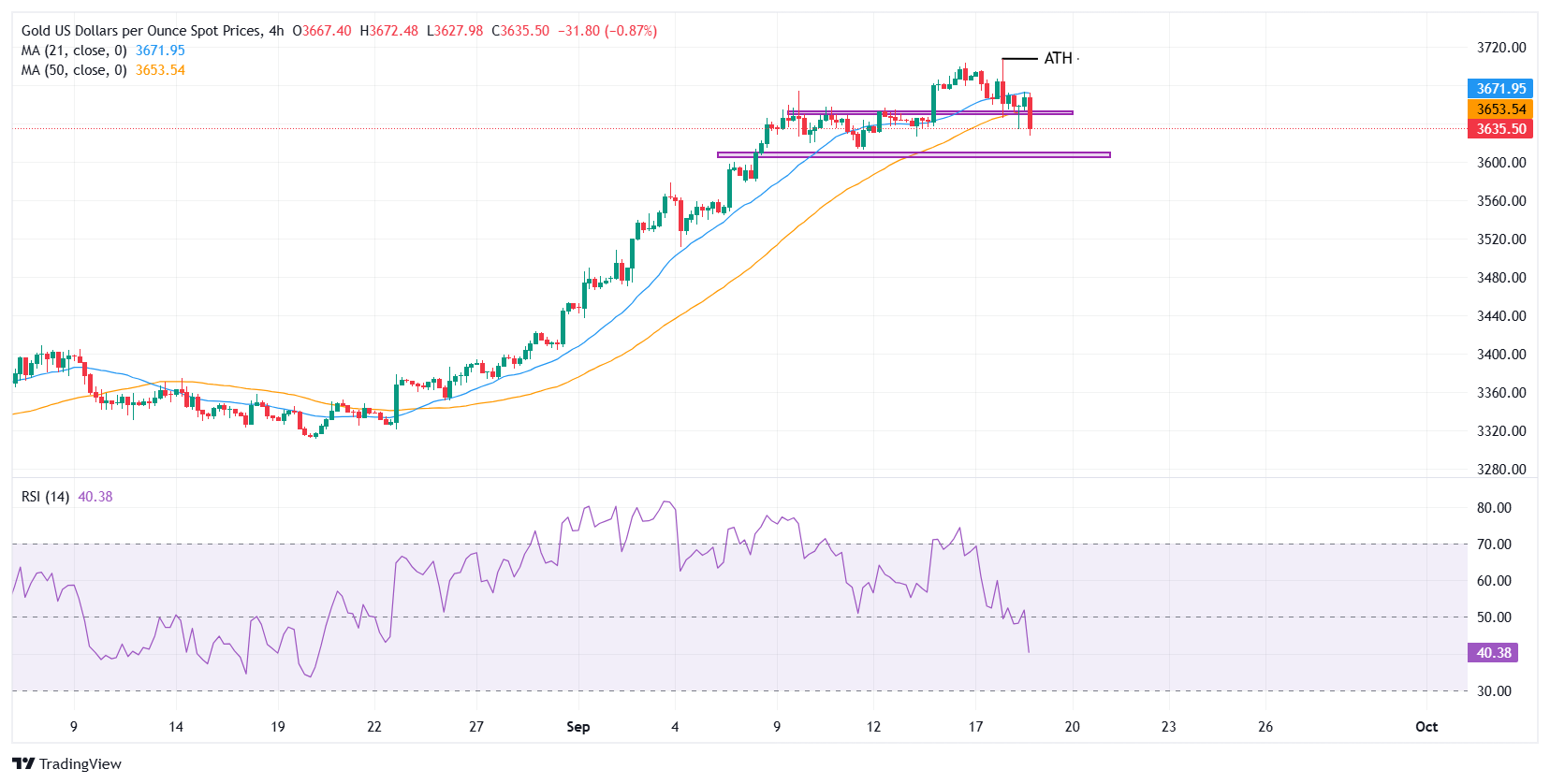
XAU/USD extends losses below its record peak after the Fed-driven volatility. The metal broke below the $3,650 level and the 50-period Simple Moving Average (SMA) on the 4-hour chart, shifting the near-term bias to the downside. The breakdown opens the door toward the $3,600 psychological handle, with stronger support seen around $3,560.
The $3,650 area together with the 50-SMA now acts as immediate resistance, capping any rebound attempts A break above this level would pave the way for a retest of the $3,700-$3,707 area. A clear push through the record peak could trigger bullish continuation toward the $3,730-$3,750 level.
The Relative Strength Index (RSI) remains subdued near 41, reinforcing bearish momentum. Unless Gold regains ground above $3,650, risks remain skewed toward further downside in the short term.
Gold FAQs
Gold has played a key role in human’s history as it has been widely used as a store of value and medium of exchange. Currently, apart from its shine and usage for jewelry, the precious metal is widely seen as a safe-haven asset, meaning that it is considered a good investment during turbulent times. Gold is also widely seen as a hedge against inflation and against depreciating currencies as it doesn’t rely on any specific issuer or government.
Central banks are the biggest Gold holders. In their aim to support their currencies in turbulent times, central banks tend to diversify their reserves and buy Gold to improve the perceived strength of the economy and the currency. High Gold reserves can be a source of trust for a country’s solvency. Central banks added 1,136 tonnes of Gold worth around $70 billion to their reserves in 2022, according to data from the World Gold Council. This is the highest yearly purchase since records began. Central banks from emerging economies such as China, India and Turkey are quickly increasing their Gold reserves.
Gold has an inverse correlation with the US Dollar and US Treasuries, which are both major reserve and safe-haven assets. When the Dollar depreciates, Gold tends to rise, enabling investors and central banks to diversify their assets in turbulent times. Gold is also inversely correlated with risk assets. A rally in the stock market tends to weaken Gold price, while sell-offs in riskier markets tend to favor the precious metal.
The price can move due to a wide range of factors. Geopolitical instability or fears of a deep recession can quickly make Gold price escalate due to its safe-haven status. As a yield-less asset, Gold tends to rise with lower interest rates, while higher cost of money usually weighs down on the yellow metal. Still, most moves depend on how the US Dollar (USD) behaves as the asset is priced in dollars (XAU/USD). A strong Dollar tends to keep the price of Gold controlled, whereas a weaker Dollar is likely to push Gold prices up.
Author

Vishal Chaturvedi
FXStreet
I am a macro-focused research analyst with over four years of experience covering forex and commodities market. I enjoy breaking down complex economic trends and turning them into clear, actionable insights that help traders stay ahead of the curve.
















