Gold surges near $4,000 as US–China trade tensions ignite haven demand
- XAU/USD holds around $4,000 as Trump warns of new tariffs, while China plans rare-earth export curbs.
- Risk-off sentiment deepens amid 10-day US government shutdown and fading hopes for swift reopening.
- Traders eye the delayed US CPI report in October 24 and further Fed easing bets supporting Gold’s rally.
Gold price rises during the North American session on Friday amid an escalation of the trade war between the US and China. This, the US government shutdown and expectation for further easing by the Federal Reserve (Fed) keep the yellow metal bid. XAU/USD trades at $3,997, up 0.60%, at the time of writing.
Bullion’s boosted by escalating tariff threats and prolonged Washington deadlock reigniting risk aversion
Risk aversion is the name of the game after US President Donald Trump warned of possible fresh duties on China, as the latter threatens to impose export controls on rare earths. Trump added that there is no reason to meet with China’s President Xi Jinping in two weeks in South Korea as planned.
On Thursday, the yellow metal posted losses of 1.59% as traders booked profits, along with the ceasefire between Israel and Gaza.
The US government shutdown extends to the tenth straight day and the chances of a reopening in the near term remain far.
Data-wise, the University of Michigan (UoM) revealed that Consumer Sentiment was steady in October, as households appear to shrug off the partial shutdown of the government.
Next week, the US economic docket is expected to release the Consumer Price Index (CPI) for September. Nevertheless, the US Bureau of Labor Statistics (BLS) revealed that it will be announced on Friday at 8:30 AM ET.
Daily market movers: Gold rallies amid global political turmoil
- Geopolitics are also playing their part on Gold prices. The political turmoil in France and Japan increases Bullion’s appeal.
- Reuters revealed that French President Emmanuel Macron won’t appoint a left-wing PM, triggering anger amongst leaders. Some of Macron’s opponents have urged him to either call fresh legislative elections or step down—options he has so far firmly resisted.
- In Japan, the election of Sanae Takaichi to become the first female Prime Minister is in doubt, as Komeito leader Tetsuo Saito said the two parties' 26-year partnership had broken down over the LDP's failure to respond to a political funding scandal that has dogged the ruling group for two years. The parliamentary vote will be held in the second half in October.
- Bullion is pressured as the US Dollar strengthens sharply across the board. The US Dollar Index (DXY), which tracks the performance of the buck’s value against a basket of six currencies, slides 0.43% down to 98.97.
- The US 10-year Treasury note yield plummets nine basis points to 4.048%. US real yields — which correlate inversely to Gold prices — are also diving nine and a half bps to 1.708%.
- St. Louis Fed President Alberto Musalem said that Fed goals are in tension, as inflation runs high and the labor market shows signs of softening. He said that although policy is between modestly restrictive and neutral, the financial conditions are accommodative.
- Goldman Sachs updated its Gold forecasts for 2026 from $4,300 to $4,900, citing strong flows into Gold ETFs and central bank demand.
- Money markets indicate that the Fed will cut interest rates by 25 basis points (bps) at the upcoming October 29 meeting. The odds stand at 94%, according to the Prime Market Terminal interest rate probability tool.
Technical outlook: Gold’s advances, but halts around $4,000
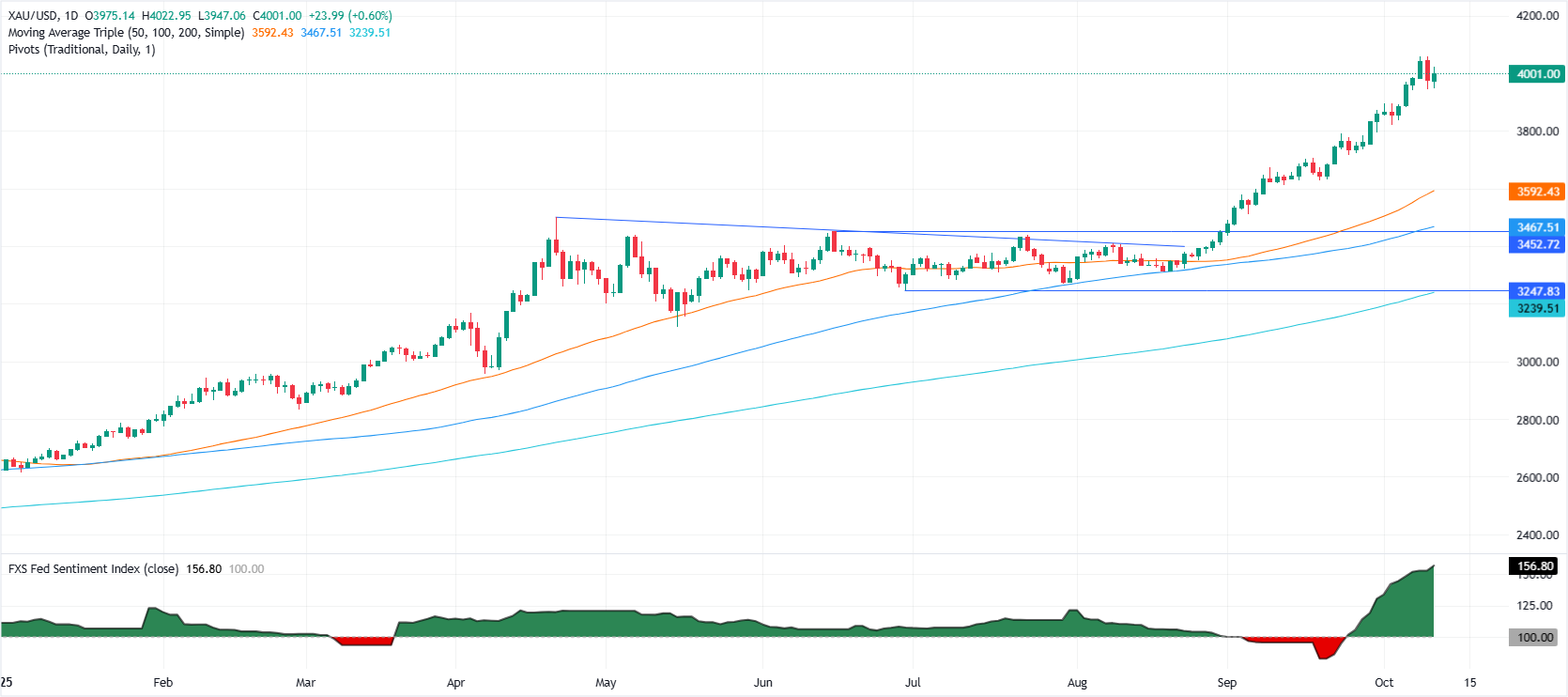
Gold’s technical picture remains bullish, though a daily close above $4,000 could cement the case for higher prices next week, with the all-time high sitting at $4,059. Otherwise, XAU/USD could be poised for a pullback, with sellers’ eyes on the October 1 high turned support at $3,895. A breach of the latter will expose the 20-day Simple Moving Average (SMA) at $3,818.
From a momentum standpoint, the Relative Strength Index (RSI) shows that buyers remain in charge, despite being overbought above 70 . However, the strong upward trend suggests that higher readings above the 80 level to seen as an overextended trend up.
Gold FAQs
Gold has played a key role in human’s history as it has been widely used as a store of value and medium of exchange. Currently, apart from its shine and usage for jewelry, the precious metal is widely seen as a safe-haven asset, meaning that it is considered a good investment during turbulent times. Gold is also widely seen as a hedge against inflation and against depreciating currencies as it doesn’t rely on any specific issuer or government.
Central banks are the biggest Gold holders. In their aim to support their currencies in turbulent times, central banks tend to diversify their reserves and buy Gold to improve the perceived strength of the economy and the currency. High Gold reserves can be a source of trust for a country’s solvency. Central banks added 1,136 tonnes of Gold worth around $70 billion to their reserves in 2022, according to data from the World Gold Council. This is the highest yearly purchase since records began. Central banks from emerging economies such as China, India and Turkey are quickly increasing their Gold reserves.
Gold has an inverse correlation with the US Dollar and US Treasuries, which are both major reserve and safe-haven assets. When the Dollar depreciates, Gold tends to rise, enabling investors and central banks to diversify their assets in turbulent times. Gold is also inversely correlated with risk assets. A rally in the stock market tends to weaken Gold price, while sell-offs in riskier markets tend to favor the precious metal.
The price can move due to a wide range of factors. Geopolitical instability or fears of a deep recession can quickly make Gold price escalate due to its safe-haven status. As a yield-less asset, Gold tends to rise with lower interest rates, while higher cost of money usually weighs down on the yellow metal. Still, most moves depend on how the US Dollar (USD) behaves as the asset is priced in dollars (XAU/USD). A strong Dollar tends to keep the price of Gold controlled, whereas a weaker Dollar is likely to push Gold prices up.
Author

Christian Borjon Valencia
FXStreet
Markets analyst, news editor, and trading instructor with over 14 years of experience across FX, commodities, US equity indices, and global macro markets.

















