Gold walks a line on day of US presidential election
- Gold trades steady on Tuesday, having reached a new five-day low earlier in the day as the US presidential election remains a question-mark event.
- The election could be polarizing for the US Dollar, impacting Gold, or even be a “win-win” for the precious metal.
- Technically, there are signs XAU/USD is entering a short-term downtrend.

Gold (XAU/USD) trades steady after finding support at $2,724 early on Tuesday. It has since bounced back to the $2,730s on the back of a marginally weaker US Dollar (USD), due to uncertainty over the US presidential election. A weaker Greenback, in turn, aids Gold since the precious metal is mostly priced and traded in USD.
Markets increasingly take the view that the final result of the election will be polarizing for the US currency, with a victory for Republican nominee Donald Trump USD-bullish but the opposite for Democrat nominee Kamala Harris.
Simmering tensions in the Middle East also keep Gold supported, after Iran's supreme leader, Ayatollah Ali Khamenei, said that the US and Israel "will definitely receive a crushing response," to Israel’s attack last month. Further, overweight long-positioning from trend-following hedge funds is also helping the yellow metal sustain its current highs.
Gold bounces ahead of US presidential election result
Gold recovers from safety flows due to the high level of uncertainty regarding the outcome of the US presidential election, which regardless of the winner alone can be bullish for the yellow metal.
“Regardless of the outcome, significant political shifts can unsettle financial markets, and such uncertainty typically fuels volatility, and both can serve as catalysts for higher Gold prices,” says Matthew Jones, precious metals analyst at Solomon Global.
The highly-rated election forecaster 538.com indicates a 50% probability of Vice President Harris winning on Tuesday whilst former President Donald Trump has a 49% chance of victory. That leaves a 1% chance of no overall winner. Over the last 24 hours, Harris has edged into the lead after lagging Trump for several days. This may also explain Gold’s turnaround on Tuesday.
Solomon’s Jones is bullish on Gold overall, seeing the election outcome as a “win-win” for the precious metal regardless of which candidate is victorious.
A Trump in the White House would lead to “inflationary pressures and geopolitical tensions,” according to the analyst, which could, “amplify Gold’s appeal as a safe-haven asset, driving demand upward.”
On the other hand, if Harris wins, the Democrat nominee “has outlined a vision marked by robust government expenditure on social programs, infrastructure, and climate initiatives,” writes Jones, adding that these policies “may exacerbate budget deficits, potentially weakening the (US) Dollar and stoking inflation fears. Investors could increasingly turn to Gold as a hedge (...) pushing prices higher.”
Technical Analysis: Short-term trend might have reversed
Gold could be showing signs of reversing its short-term uptrend as it continues steadily leaking lower.
XAU/USD 4-hour Chart
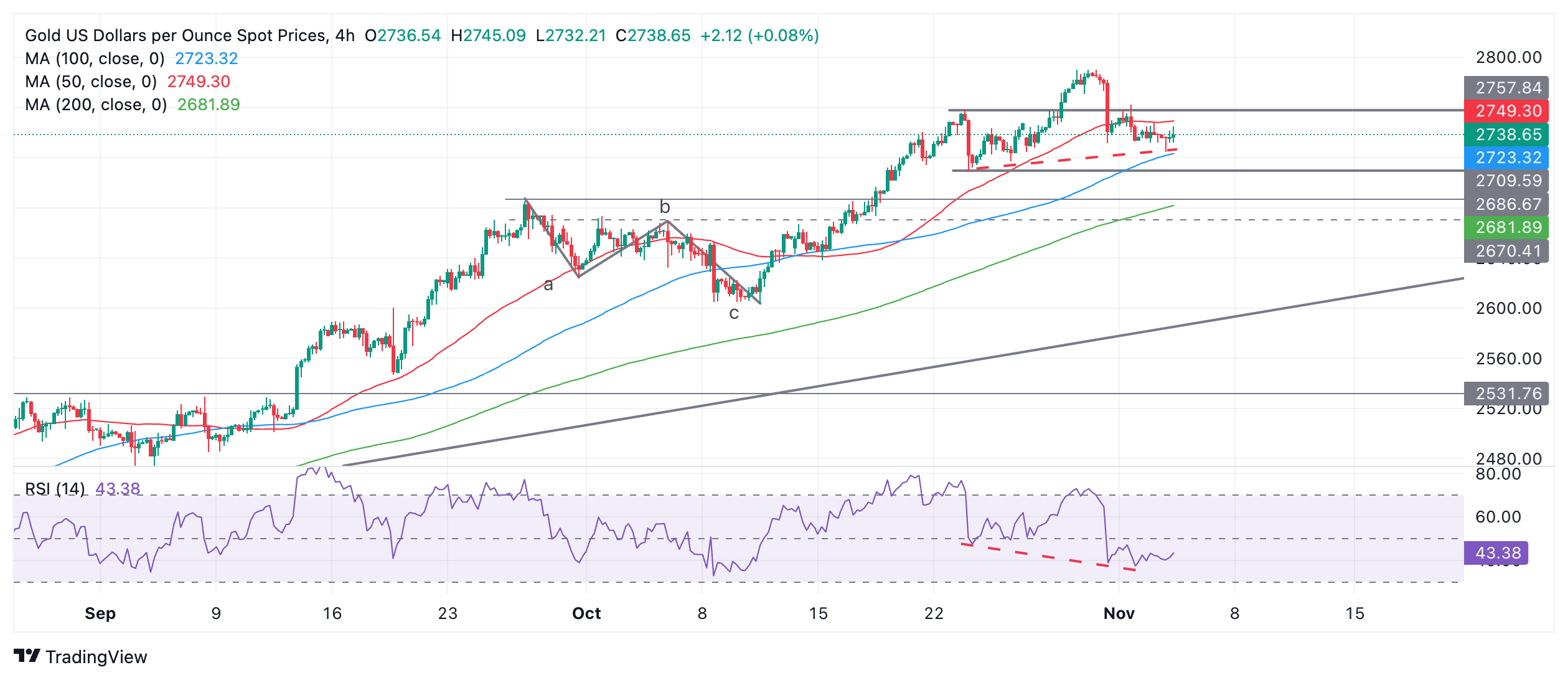
Although the precious metal remains in an uptrend on a medium and long-term basis, the establishment of a sequence of falling peaks and troughs on the 4-hour chart could be one of the first signs of a short-term downtrend taking root. Given the technical principle that “the trend is your friend,” this now might tilt the odds in favor of even more downside in the near term.
A break below the $2,724 day’s lows would add further confirmation to the short-term downtrend thesis and probably see prices fall to the bottom of the recent range at $2,709.
The Relative Strength Index (RSI) is also showing bearish divergence (red dashed lines on chart) when comparing the current price level to that on October 23. The RSI is lower than it was on October 23, whilst price remains higher, and this indicates underlying selling pressure is strong.
Alternatively, given the medium and long-term bullish trends, it is also possible that a recovery could unfold. In such a scenario, a break above the all-time high of $2,790 would probably lead to a move up to resistance at $2,800 (whole number and psychological number), followed by $2,850.
US Dollar FAQs
The US Dollar (USD) is the official currency of the United States of America, and the ‘de facto’ currency of a significant number of other countries where it is found in circulation alongside local notes. It is the most heavily traded currency in the world, accounting for over 88% of all global foreign exchange turnover, or an average of $6.6 trillion in transactions per day, according to data from 2022. Following the second world war, the USD took over from the British Pound as the world’s reserve currency. For most of its history, the US Dollar was backed by Gold, until the Bretton Woods Agreement in 1971 when the Gold Standard went away.
The most important single factor impacting on the value of the US Dollar is monetary policy, which is shaped by the Federal Reserve (Fed). The Fed has two mandates: to achieve price stability (control inflation) and foster full employment. Its primary tool to achieve these two goals is by adjusting interest rates. When prices are rising too quickly and inflation is above the Fed’s 2% target, the Fed will raise rates, which helps the USD value. When inflation falls below 2% or the Unemployment Rate is too high, the Fed may lower interest rates, which weighs on the Greenback.
In extreme situations, the Federal Reserve can also print more Dollars and enact quantitative easing (QE). QE is the process by which the Fed substantially increases the flow of credit in a stuck financial system. It is a non-standard policy measure used when credit has dried up because banks will not lend to each other (out of the fear of counterparty default). It is a last resort when simply lowering interest rates is unlikely to achieve the necessary result. It was the Fed’s weapon of choice to combat the credit crunch that occurred during the Great Financial Crisis in 2008. It involves the Fed printing more Dollars and using them to buy US government bonds predominantly from financial institutions. QE usually leads to a weaker US Dollar.
Quantitative tightening (QT) is the reverse process whereby the Federal Reserve stops buying bonds from financial institutions and does not reinvest the principal from the bonds it holds maturing in new purchases. It is usually positive for the US Dollar.
Author

Joaquin Monfort
FXStreet
Joaquin Monfort is a financial writer and analyst with over 10 years experience writing about financial markets and alt data. He holds a degree in Anthropology from London University and a Diploma in Technical analysis.