Gold holds steady below $4,000 amid Fed caution and easing US-China tensions
- Gold holds firm on Thursday as traders weigh the Fed’s interest rate cut and Powell’s cautious tone.
- The Fed cut interest rates by 25 bps to a range of 3.75%-4.00%, with two officials dissenting.
- Technically, Gold remains vulnerable below $4,000, with resistance near $4,020 and support around $3,900.

Gold (XAU/USD) steadies on Thursday after a volatile session, as traders digest the Federal Reserve’s (Fed) interest rate cut and cautious monetary policy outlook. At the time of writing, XAU/USD is trading around $3,980 after briefly revisiting the $4,000 psychological mark, up roughly 1.20 % on the day.
On Wednesday, the Fed delivered a second consecutive 25-basis-point (bps) “risk-management” rate cut, in line with market expectations. However, as the move was largely priced in, attention quickly turned to the Fed Chair Jerome Powell’s post-meeting remarks, which left the outlook for future rate cuts murky.
Powell said that “a further reduction in the policy rate at the December meeting is not a foregone conclusion, far from it,” a comment that briefly weighed on the precious metal while boosting the US Dollar (USD) and Treasury yields.
Gold’s near-term outlook appears mixed, as traders dial back expectations of a December rate cut following Powell’s cautious tone. Since lower interest rates typically enhance the appeal of non-yielding assets, fading prospects of further monetary easing limit the metal’s upside potential.
At the same time, the one-year trade truce between the United States (US) and China has eased some tensions, offering temporary relief to markets. Nevertheless, the ongoing United States (US) government shutdown, coupled with persistent geopolitical and economic uncertainties, keeps investors cautious.
Market movers: Fed cut, Powell caution and US-China trade truce shape market mood
- Earlier on Thursday, US President Donald Trump and Chinese President Xi Jinping concluded talks on the sidelines of the APEC summit in South Korea. The two leaders agreed to a one-year trade truce that includes reducing US tariffs on Chinese goods from about 57% to 47% and Chinese commitments to resume US soybean purchases. Trump claimed China has agreed to “continue the flow of rare earth, critical minerals, magnets, etc., openly and freely."
- The US central bank lowered the federal funds rate by 25 bps to a target range of 3.75%-4.00%. The decision was not unanimous, with Fed Governor Stephen Miran voting for a deeper 50 bps cut and Kansas City Fed President Jeffrey Schmid preferring to keep rates unchanged.
- In its Monetary Policy Statement, the Fed stated that economic activity continues to expand at a moderate pace, though job gains have slowed and inflation remains somewhat elevated. Policymakers acknowledged that uncertainty surrounding the outlook is still high and that downside risks to employment have increased in recent months. The Committee also announced plans to end Quantitative Tightening (QT) by halting the reduction of its securities holdings on December 1, signaling a pause in balance sheet runoff.
- In the press conference, Fed Chair Jerome Powell said that there is tension between tackling inflation and supporting employment, noting that both cannot be addressed with a single policy tool. He added that the policy rate is now within the range of many estimates of neutral and that if labor market data show signs of stabilizing or strengthening, it would influence future policy decisions. Powell also said there is a “growing chorus” within the Committee suggesting it may be better to wait before making another move.
- According to the World Gold Council’s (WGC) Q3 2025 Gold Demand Trends report, published on October 30, total gold demand rose 3% YoY to 1,313 tonnes, hitting a record quarterly high. Investment demand jumped 47% to 537 tonnes, driven by strong ETF inflows of 222 tonnes and continued bar and coin purchases of 316 tonnes. Central bank buying remained solid at 220 tonnes, up 28% from the previous quarter, while jewellery consumption declined 19% amid record-high prices.
Technical analysis: XAU/USD consolidates below $4,000 with modest bullish momentum
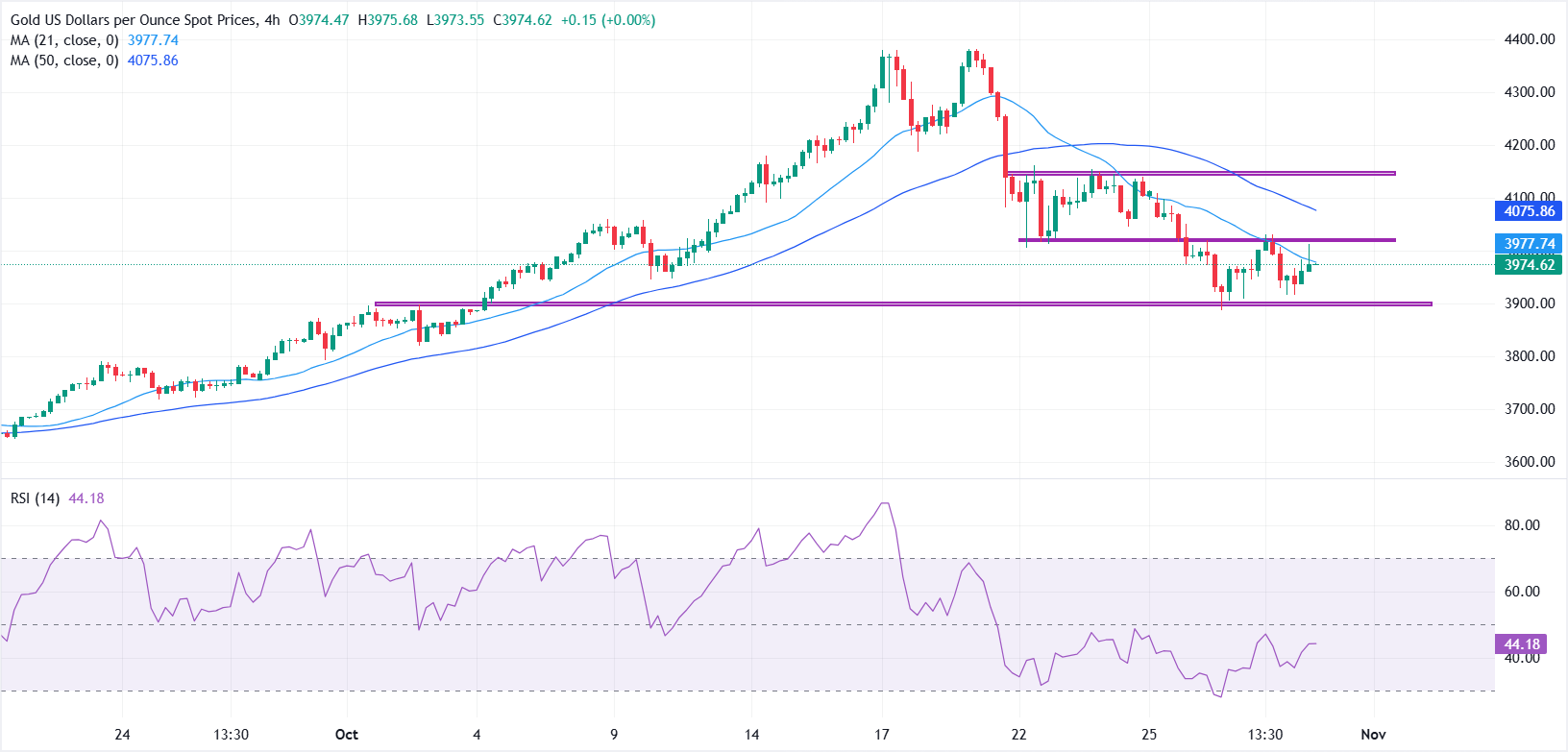
XAU/USD remains vulnerable below the $4,000 mark, attempting to stabilize after recent volatility, though lacking follow-through buying. On the four-hour chart, immediate resistance appears around the 21-period Simple Moving Average (SMA) near $3,982, followed by the $4,000-$4,020 zone.
A decisive break above this area could shift the near-term outlook to the upside, though the metal is likely to face renewed selling pressure around the $4,100-$4,200 region.
On the downside, $3,900 acts as a strong support level, where dip-buying interest has repeatedly emerged in recent sessions. A break below this level could signal a continuation of the broader corrective phase. The Relative Strength Index (RSI) holds near 44, indicating modestly bullish momentum with limited upside strength.
Gold FAQs
Gold has played a key role in human’s history as it has been widely used as a store of value and medium of exchange. Currently, apart from its shine and usage for jewelry, the precious metal is widely seen as a safe-haven asset, meaning that it is considered a good investment during turbulent times. Gold is also widely seen as a hedge against inflation and against depreciating currencies as it doesn’t rely on any specific issuer or government.
Central banks are the biggest Gold holders. In their aim to support their currencies in turbulent times, central banks tend to diversify their reserves and buy Gold to improve the perceived strength of the economy and the currency. High Gold reserves can be a source of trust for a country’s solvency. Central banks added 1,136 tonnes of Gold worth around $70 billion to their reserves in 2022, according to data from the World Gold Council. This is the highest yearly purchase since records began. Central banks from emerging economies such as China, India and Turkey are quickly increasing their Gold reserves.
Gold has an inverse correlation with the US Dollar and US Treasuries, which are both major reserve and safe-haven assets. When the Dollar depreciates, Gold tends to rise, enabling investors and central banks to diversify their assets in turbulent times. Gold is also inversely correlated with risk assets. A rally in the stock market tends to weaken Gold price, while sell-offs in riskier markets tend to favor the precious metal.
The price can move due to a wide range of factors. Geopolitical instability or fears of a deep recession can quickly make Gold price escalate due to its safe-haven status. As a yield-less asset, Gold tends to rise with lower interest rates, while higher cost of money usually weighs down on the yellow metal. Still, most moves depend on how the US Dollar (USD) behaves as the asset is priced in dollars (XAU/USD). A strong Dollar tends to keep the price of Gold controlled, whereas a weaker Dollar is likely to push Gold prices up.
Author

Vishal Chaturvedi
FXStreet
I am a macro-focused research analyst with over four years of experience covering forex and commodities market. I enjoy breaking down complex economic trends and turning them into clear, actionable insights that help traders stay ahead of the curve.