Gold holds steady as dovish Fed signals and soft US data lift rate-cut bets
- Gold trades steady as dovish Fed tone lifts December easing bets.
- Softer US PPI and Retail Sales data add pressure on the US Dollar and support XAU/USD.
- Technically, Gold is trading within a tightening symmetrical triangle on the daily chart, with price action squeezing toward a breakout.

Gold (XAU/USD) holds firm on Tuesday as traders price a greater likelihood of a Federal Reserve (Fed) interest rate cut in December following dovish-leaning remarks from policymakers. At the time of writing, XAU/USD is little changed around $4,130, after climbing to an over one-week high during the Asian session.
The latest leg higher in Gold was primarily driven by mounting rate-cut expectations, and the delayed US data released on Tuesday added to those expectations. Elsewhere, markets are also keeping an eye on developments surrounding the ongoing Russia-Ukraine peace talks aimed at ending the conflict. With geopolitical risks still in play and the prospect of a December Fed rate cut on the table, the near-term outlook for Gold remains tilted to the upside.
Market movers: Fed dovish shift and soft US data lift December rate cut bets
- The headline Producer Price Index (PPI) for September rose 0.3% MoM, matching the 0.3% forecast, after a 0.1% decline in August. On an annual basis, PPI held steady at 2.7% YoY, in line with expectations. Core PPI (excluding food and energy) increased 0.2% MoM, below the 0.3% forecast, while the annual rate eased to 2.6% YoY compared with 2.9% in August.
- Retail Sales also softened, with headline sales rising 0.2% MoM, missing the 0.4% forecast and slowing from 0.6% in August. On an annual basis, Retail Sales rose 4.3% YoY in September, easing from 5% in August.
- Dovish Fed signals in recent days have prompted traders to ramp up rate-cut bets, reversing the earlier hawkish repricing that had emerged from the cautious tone of Fed officials. San Francisco Fed President Mary Daly told The Wall Street Journal on Monday that she supports lowering rates at next month’s meeting, cautioning that the labour market is increasingly vulnerable and poses a greater risk than an inflation flare-up.
- Fed Governor Christopher Waller and New York Fed President John Williams also signalled room for near-term easing. Waller told Fox Business on Monday that his primary concern is the softening labour market, saying inflation is “not a big problem” given recent weakness in employment. Last week, Williams echoed a similar stance, describing policy as “modestly restrictive” and noting there is still scope for another adjustment to guide rates closer to neutral.
- According to the CME FedWatch Tool, markets are now pricing in roughly an 80% chance of a December rate cut. However, division among Fed officials and the fact that key inflation and labour data will come only after the December 9-10 meeting keep the outlook uncertain.
- On the geopolitical front, markets are monitoring US-brokered efforts to advance Russia-Ukraine peace talks. The Financial Times reported on Tuesday that US Army Secretary Dan Driscoll is holding discussions in Abu Dhabi with Ukraine’s military intelligence chief and a Russian delegation. The original 28-point proposal had drawn criticism for favouring Russia, leading negotiators to narrow it to 19 points after what were described as constructive US-Ukrainian talks in Geneva over the weekend.
Technical analysis: Bullish trend intact above key moving averages
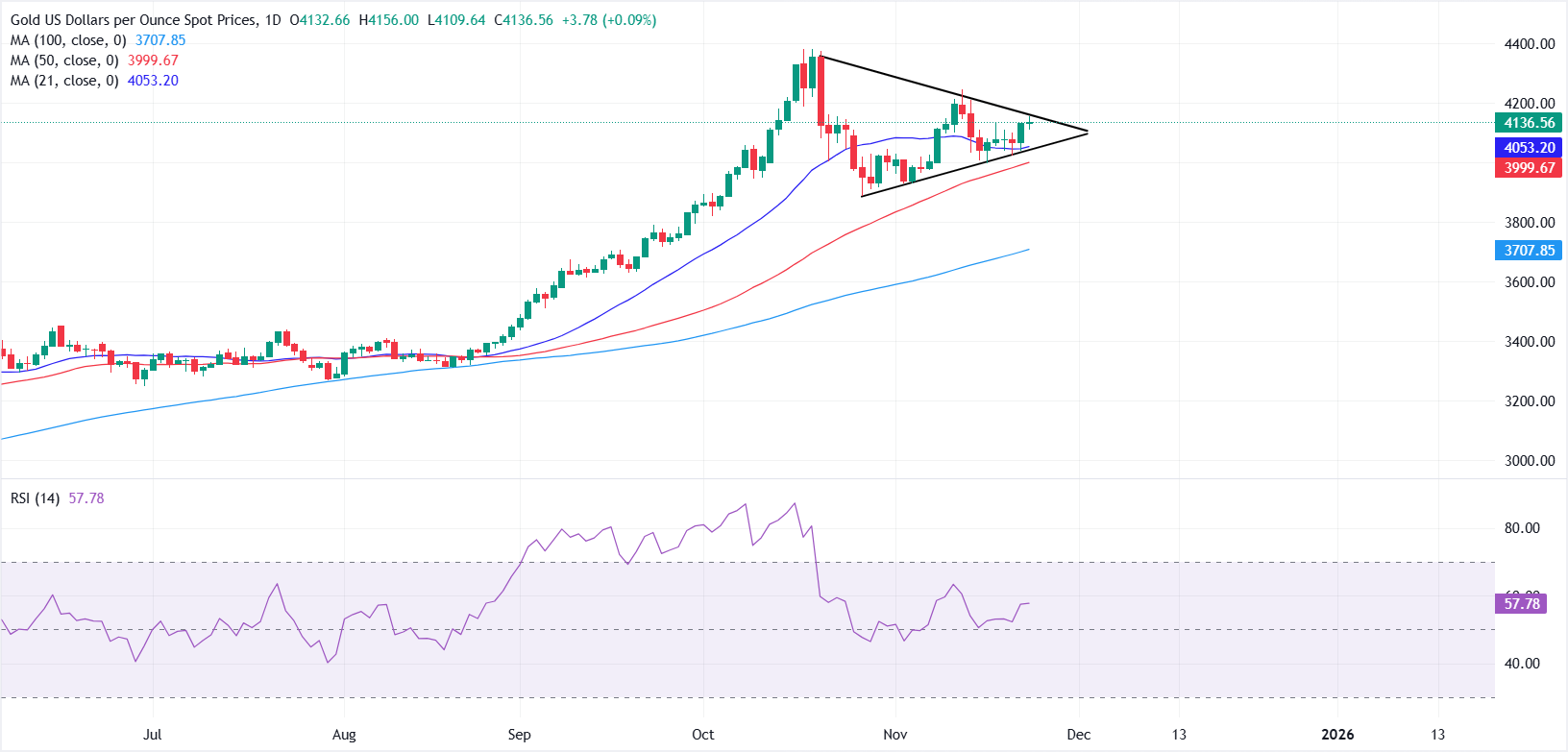
From a technical view, Gold is moving inside a tightening symmetrical triangle on the daily chart, with prices squeezing toward the tip of the pattern and hinting at a breakout soon. The pattern reflects consolidation after the strong rally seen this year, and with prices above key moving averages, the overall bias remains bullish.
On the upside, the $4,150 region aligns with the upper boundary of the triangle and acts as immediate resistance. A decisive break above this level would signal a bullish breakout and could accelerate buying pressure in line with the prevailing uptrend, opening the door toward $4,200 and then $4,250.
On the downside, initial support is seen around $4,100, followed by a stronger support zone near $4,050, where the lower edge of the triangle converges with the 21-day Simple Moving Average. A daily close below this area would weaken the structure and shift the near-term outlook toward a more corrective tone.
Gold FAQs
Gold has played a key role in human’s history as it has been widely used as a store of value and medium of exchange. Currently, apart from its shine and usage for jewelry, the precious metal is widely seen as a safe-haven asset, meaning that it is considered a good investment during turbulent times. Gold is also widely seen as a hedge against inflation and against depreciating currencies as it doesn’t rely on any specific issuer or government.
Central banks are the biggest Gold holders. In their aim to support their currencies in turbulent times, central banks tend to diversify their reserves and buy Gold to improve the perceived strength of the economy and the currency. High Gold reserves can be a source of trust for a country’s solvency. Central banks added 1,136 tonnes of Gold worth around $70 billion to their reserves in 2022, according to data from the World Gold Council. This is the highest yearly purchase since records began. Central banks from emerging economies such as China, India and Turkey are quickly increasing their Gold reserves.
Gold has an inverse correlation with the US Dollar and US Treasuries, which are both major reserve and safe-haven assets. When the Dollar depreciates, Gold tends to rise, enabling investors and central banks to diversify their assets in turbulent times. Gold is also inversely correlated with risk assets. A rally in the stock market tends to weaken Gold price, while sell-offs in riskier markets tend to favor the precious metal.
The price can move due to a wide range of factors. Geopolitical instability or fears of a deep recession can quickly make Gold price escalate due to its safe-haven status. As a yield-less asset, Gold tends to rise with lower interest rates, while higher cost of money usually weighs down on the yellow metal. Still, most moves depend on how the US Dollar (USD) behaves as the asset is priced in dollars (XAU/USD). A strong Dollar tends to keep the price of Gold controlled, whereas a weaker Dollar is likely to push Gold prices up.
Author

Vishal Chaturvedi
FXStreet
I am a macro-focused research analyst with over four years of experience covering forex and commodities market. I enjoy breaking down complex economic trends and turning them into clear, actionable insights that help traders stay ahead of the curve.