Gold steadies above $4,100 as Powell strikes neutral-dovish tone
- XAU/USD boosted as Powell signals meeting-by-meeting approach and says the economy may be “on a firmer trajectory.”
- Markets keep 96% odds of a 25-bps Fed rate cut on October 29 despite neutral remarks.
- Ongoing US shutdown and renewed trade-war risks keep Gold supported above the key $4,100 level.

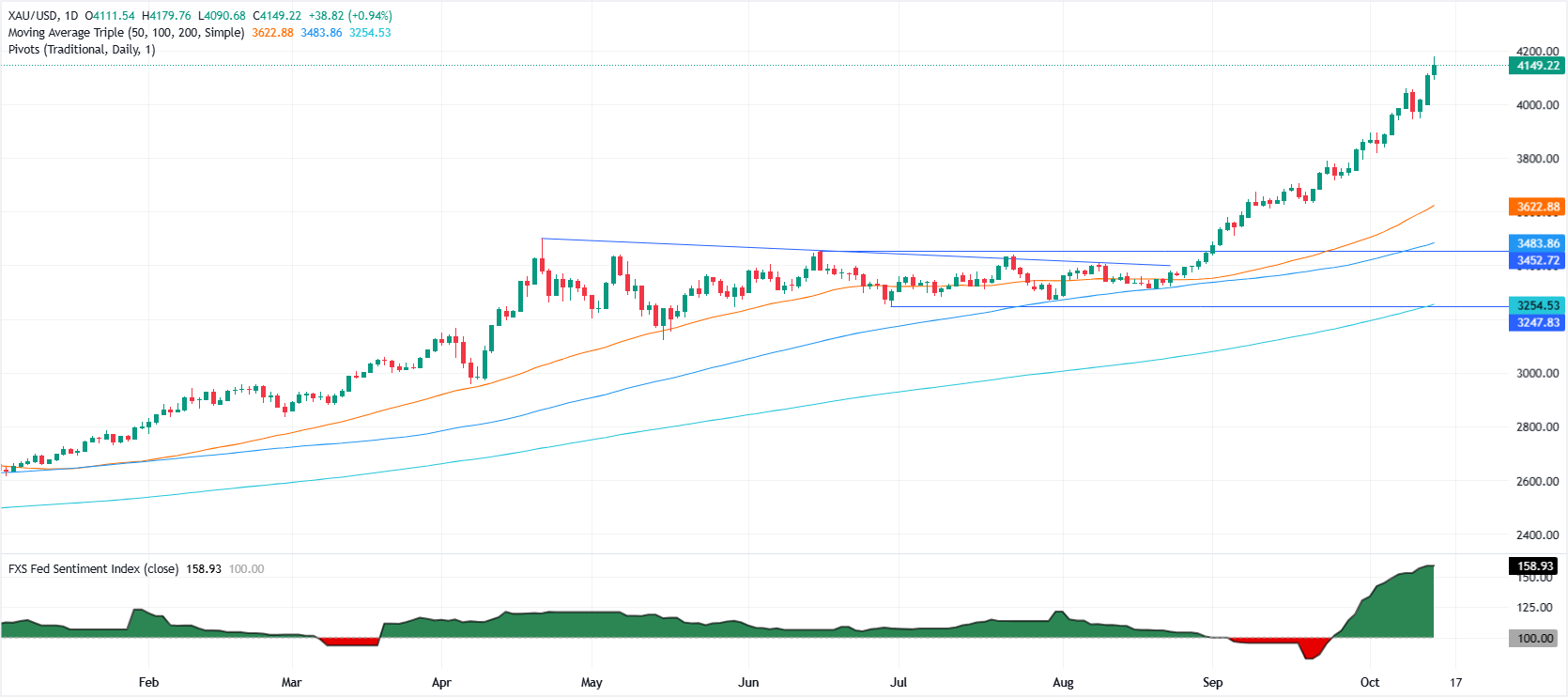
Gold price edges up during the North American session, yet trades below the all-time high of $4,179 reached earlier on Tuesday as investors digest Federal Reserve (Fed) Chair Jerome Powell's speech. This, along with China-US tensions regarding trade, increased the appeal for Bullion amid geopolitical uncertainty. At the time of writing, XAU/USD trades at $4,140.
Bullion stays near record highs as safe-haven demand persists amid Fed caution and Sino-US uncertainty
On Tuesday, Jerome Powell was slightly neutral in his speech and during the Q&A session in Philadelphia, as he said the economy “may be on a somewhat firmer trajectory than expected,” while adopting a meeting-by-meeting approach on setting interest rates
After his remarks, expectations for a rate cut had not changed, according to the Prime Market Terminal interest rate probability tool. The odds of a 25-basis-point cut at the October 29 meeting are at 96%.
Bullion continued to rally amid geopolitical uncertainty, strong central bank buying and the US government shutdown, which so far has remained closed for the fourteenth straight day.
The escalation of the trade war pushed XAU/USD past the $4,100 mark after US President Donald Trump threatened to impose 100% additional tariffs on Chinese goods as retaliation. On Friday, Beijing announced rare-earth export controls and port fees for US ships while exempting China-made vessels owned by US companies from paying those duties.
US small business sentiment declined in September as owners grew more pessimistic about business conditions over the next six months, according to data from the National Federation of Independent Business (NFIB).
Daily market movers: Gold advances boosted by Powell's dovish remarks
- Powell said that based on the data that they have, “the outlook for employment and inflation does not appear to have changed much since our September meeting four weeks ago.” Furthermore, added that data shows that economic activity might be firmer than expected. He added that risks to the labor market had increased, along with inflationary pressures.
- Powell said that elevated inflation is due to rising goods prices, which reflect “tariffs rather than broader inflationary pressures.”
- The Fed will receive an update on consumer price inflation on October 24. The Bureau of Labor Statistics announced that it will release its latest Consumer Price Index (CPI) report amid the ongoing shutdown.
- The NFIB Business Optimism Index tumbled 2 points to 98.8 last month, the first decline in three months. The NFIB Uncertainty Index jumped 7 points from August to 100, the fourth highest reading in over 51 years.
- The NFIB Chief Economist Bill Dunkelberg said “Uncertainty is very high, the (Trump) administration has a lot of policy changes still in the air, lots of moving parts.” Despite this, he revealed that economic growth is solid, driven “perhaps” by AI-related investments, then “by spending that impacts Main Street firms.”
- Bullion prices are underpinned by US Dollar weakness. The US Dollar Index (DXY), which tracks the performance of the buck’s value against a basket of six currencies, sheds 0.25% of its value, down to 99.00.
- Conversely, the US 10-year Treasury note yield dives three basis points to 4.029%. US real yields — which correlate inversely to Gold prices — are also diving nearly three and a half bps to 1.728%.
Technical outlook: Gold’s remains bullish, poised to test $4,200
Gold price is upward biased, even though the yellow metal trades at record highs near $4,180. Momentum favors further upside as the Relative Strength Index (RSI) is bullish, an indication that buyers are gathering steam.
If XAU/USD clears the previous high, the next resistance would be $4,200, followed by $4,250 and $4,300. Conversely, a daily close below $4,150 would clear the path for a pullback, with traders targeting $4,100. Once cleared, the next support would be the previous all-time high of $4,059, followed by $4,000.
Gold FAQs
Gold has played a key role in human’s history as it has been widely used as a store of value and medium of exchange. Currently, apart from its shine and usage for jewelry, the precious metal is widely seen as a safe-haven asset, meaning that it is considered a good investment during turbulent times. Gold is also widely seen as a hedge against inflation and against depreciating currencies as it doesn’t rely on any specific issuer or government.
Central banks are the biggest Gold holders. In their aim to support their currencies in turbulent times, central banks tend to diversify their reserves and buy Gold to improve the perceived strength of the economy and the currency. High Gold reserves can be a source of trust for a country’s solvency. Central banks added 1,136 tonnes of Gold worth around $70 billion to their reserves in 2022, according to data from the World Gold Council. This is the highest yearly purchase since records began. Central banks from emerging economies such as China, India and Turkey are quickly increasing their Gold reserves.
Gold has an inverse correlation with the US Dollar and US Treasuries, which are both major reserve and safe-haven assets. When the Dollar depreciates, Gold tends to rise, enabling investors and central banks to diversify their assets in turbulent times. Gold is also inversely correlated with risk assets. A rally in the stock market tends to weaken Gold price, while sell-offs in riskier markets tend to favor the precious metal.
The price can move due to a wide range of factors. Geopolitical instability or fears of a deep recession can quickly make Gold price escalate due to its safe-haven status. As a yield-less asset, Gold tends to rise with lower interest rates, while higher cost of money usually weighs down on the yellow metal. Still, most moves depend on how the US Dollar (USD) behaves as the asset is priced in dollars (XAU/USD). A strong Dollar tends to keep the price of Gold controlled, whereas a weaker Dollar is likely to push Gold prices up.
Author

Christian Borjon Valencia
FXStreet
Markets analyst, news editor, and trading instructor with over 14 years of experience across FX, commodities, US equity indices, and global macro markets.