Gold above $2,900, though faces pressure towards President Trump's speech
- Weak US data and tariff threats boost hopes for more Federal Reserve interest rate cuts this year.
- Gold price consolidates losses and is looking for support to bounce off, on Wednesday.
- Market sentiment tries to snap Tuesday’s downbeat performance and could see support Gold price.

Gold’s price (XAU/USD) trades near $2,910 at the time of writing on Wednesday, consolidating its position following a 1.3% drop the previous day after traders got concerned over the US consumer confidence data and more tariff threats from President Trump’s administration. Meanwhile, United States (US) yields have plunged substantially, with markets projecting a 25 basis points (bps) rate cut in June from the Federal Reserve (Fed). This is supportive for the precious metal and should see price action bottoming out from here.
Markets are looking forward to March 4, when tariffs on Mexico and Canada are set to be enabled. Just ahead of that, the Fed’s preferred inflation gauge, the Personal Consumption Expenditures Price Index (PCE), will be released on Friday. Plenty of moving parts and elements might see traders keeping their powder dry before those events.
Daily digest market movers: President Trump set to speak
- Near 14:00 GMT, US President Donald Trump is set to speak.
- Gold remained supported in recent days by weak US data that boosted hopes for a Federal Reserve interest rate cut as soon as June and President Donald Trump’s increasing tariff threats that have increased haven demand, Bloomberg reports.
- In an opinion piece from Bloomberg, Lee Baker (owner and president of Claris Financial Advisors, based in Atlanta, and a member of CNBC's Advisor Council) warned that current elevated levels in Gold are setting up markets for a harsh correction with investors willing to buy at any cost. That momentum is often seen as a greed move that usually proceeds to a broad washout, Bloomberg reports.
- The CME Fedwatch Tool sees that the chances of an interest rate cut in June only grow by the day. Currently, the tool projects a 66.2% chance of interest rates being lower than current levels compared to 33.8% for no rate cut.
Technical Analysis: Yield gap narrows
For the second day in a row, Gold price trades below the daily Pivot Point. Although price action looks flat and consolidation is taking place, the risk still remains that more downside could materialize. The Relative Strength Index indicator in the 4-hour chart has room for more downside, so a drop to $2,880 could be possible if the market rout picks up again this Wednesday.
Looking up, the first level to recover is the daily Pivot Point at $2,918, which failed to provide support in the first hours of trading this Wednesday. In case Gold can get supported should US yields drop off further, the R1 resistance at $2,948 and the all-time high at $2,956 are the best levels to look for on the upside.
On the flip side, revisiting Tuesday’s low at $2,890 is a very plausible outcome. Seeing that the S1 support comes in lower at $2,882, there is really not much in the way for more downside. Further down, watch out for $2,878 (February 17 low), where some substantial support could kick in.
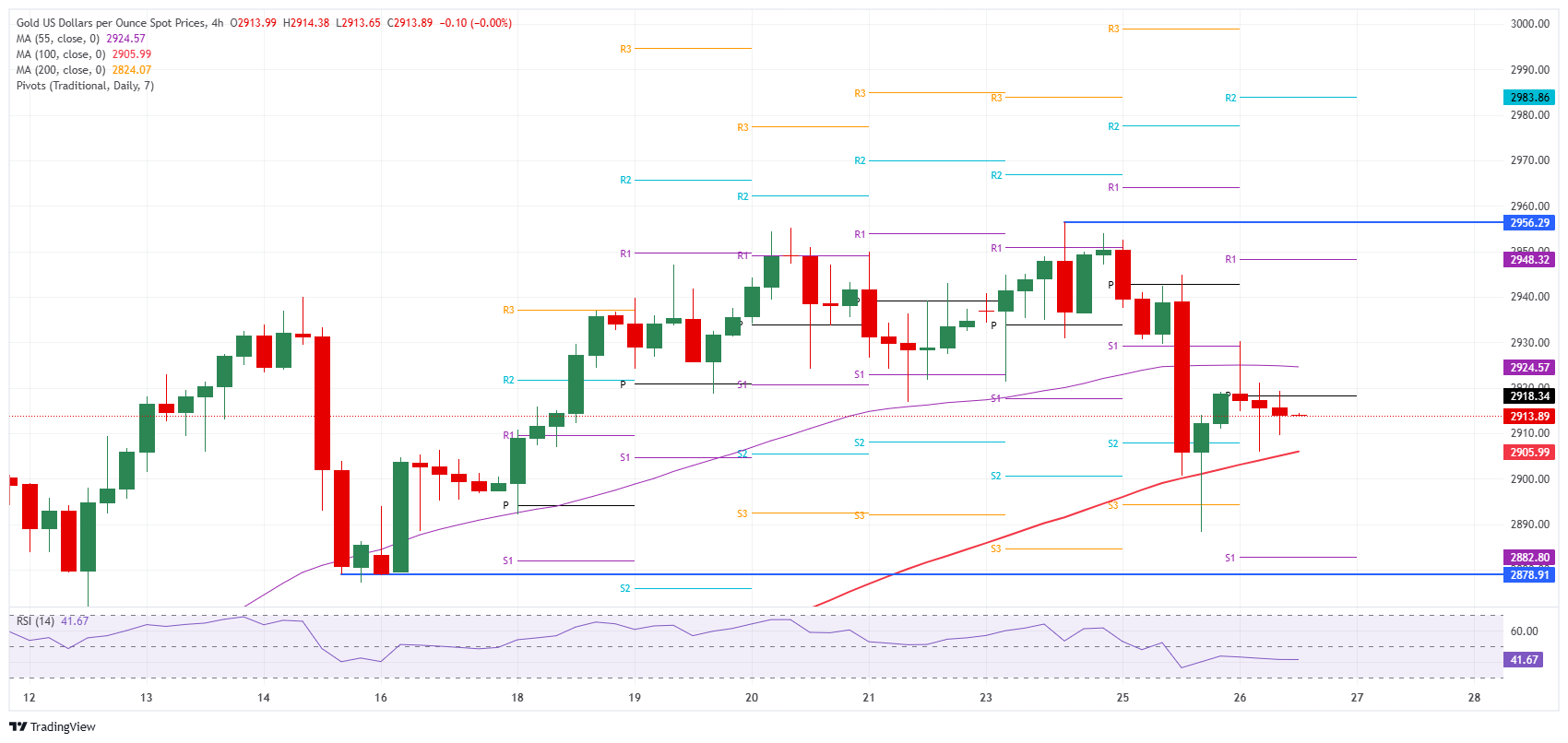
XAU/USD: 4-hour Chart
Interest rates FAQs
Interest rates are charged by financial institutions on loans to borrowers and are paid as interest to savers and depositors. They are influenced by base lending rates, which are set by central banks in response to changes in the economy. Central banks normally have a mandate to ensure price stability, which in most cases means targeting a core inflation rate of around 2%. If inflation falls below target the central bank may cut base lending rates, with a view to stimulating lending and boosting the economy. If inflation rises substantially above 2% it normally results in the central bank raising base lending rates in an attempt to lower inflation.
Higher interest rates generally help strengthen a country’s currency as they make it a more attractive place for global investors to park their money.
Higher interest rates overall weigh on the price of Gold because they increase the opportunity cost of holding Gold instead of investing in an interest-bearing asset or placing cash in the bank. If interest rates are high that usually pushes up the price of the US Dollar (USD), and since Gold is priced in Dollars, this has the effect of lowering the price of Gold.
The Fed funds rate is the overnight rate at which US banks lend to each other. It is the oft-quoted headline rate set by the Federal Reserve at its FOMC meetings. It is set as a range, for example 4.75%-5.00%, though the upper limit (in that case 5.00%) is the quoted figure. Market expectations for future Fed funds rate are tracked by the CME FedWatch tool, which shapes how many financial markets behave in anticipation of future Federal Reserve monetary policy decisions.
Author

Filip Lagaart
FXStreet
Filip Lagaart is a former sales/trader with over 15 years of financial markets expertise under its belt.

















