Gold soars to two-week high on trade jitters, India-Pakistan tensions
- Renewed conflict between India and Pakistan boosts haven flows into Gold, weighs on Wall Street sentiment.
- Trump signals flexibility on tariffs; markets ignore upbeat tone from US Treasury Secretary.
- Traders await FOMC rate decision and Powell’s press conference for clues on policy path.

Gold rallied to a two-week peak on Tuesday as the Chinese markets resumed operations following a long weekend holiday and concerns about US trade policies. Geopolitical risks also boosted the precious metal, with a new conflict emerging between Pakistan and India. At the time of writing, XAU/USD trades at $3,400, surging over 2.70%.
Wall Street ended Tuesday’s session with losses as traders digested US President Trump's latest comments regarding trade policies. He said he would dictate tariff levels and acknowledged that he would be flexible in setting duties. Investors dismissed earlier comments from US Treasury Secretary Scott Bessent about possible deals with 17 countries.
Bloomberg reported that India hit terrorist camps in Pakistan but no military sites. The Indian government said, “It conducted military strikes against “terrorist camps” in Pakistan, an expected move after it pledged retaliation for a militant attack last month in Kashmir that killed dozens of tourists.”
In the meantime, Pakistan’s defense chief has warned of an “imminent” confrontation with India as tensions escalate over a dispute concerning river water rights and accusations surrounding a recent terrorist attack in Kashmir.
In addition, the US trade deficit widened in March, revealing the US Commerce Department as all eyes are set on the Federal Open Market Committee (FOMC) decision. The Fed is likely to keep rates unchanged as expected by investors, which would be scrutinizing Fed Chair Jerome Powell's post-decision press conference.
Daily digest market movers: Gold price capitalizes falling US Treasury bond yields
- Falling US Treasury yields boosted Gold prices. The US 10-year Treasury note yield is diving five basis points to 4.298%. At the same time, US real yields fall three bps to 2.038%, as shown by the US 10-year Treasury Inflation-Protected Securities yields.
- The US Commerce Department revealed that the Balance of Trade was $-140 billion higher than expected, at $-137 billion, and exceeded February’s $-123.2 billion print.
- The US economy remains solid, as revealed by last week's Nonfarm Payrolls report and Monday's solid ISM Services PMI release. Nevertheless, heightened tensions in the Russia-Ukraine conflict, the Israel vs. Hamas war, and hostilities between India and Pakistan might override traders' reliance on macroeconomic data, favoring market sentiment.
XAU/USD technical outlook: Gold price poised to challenge $3,350 support
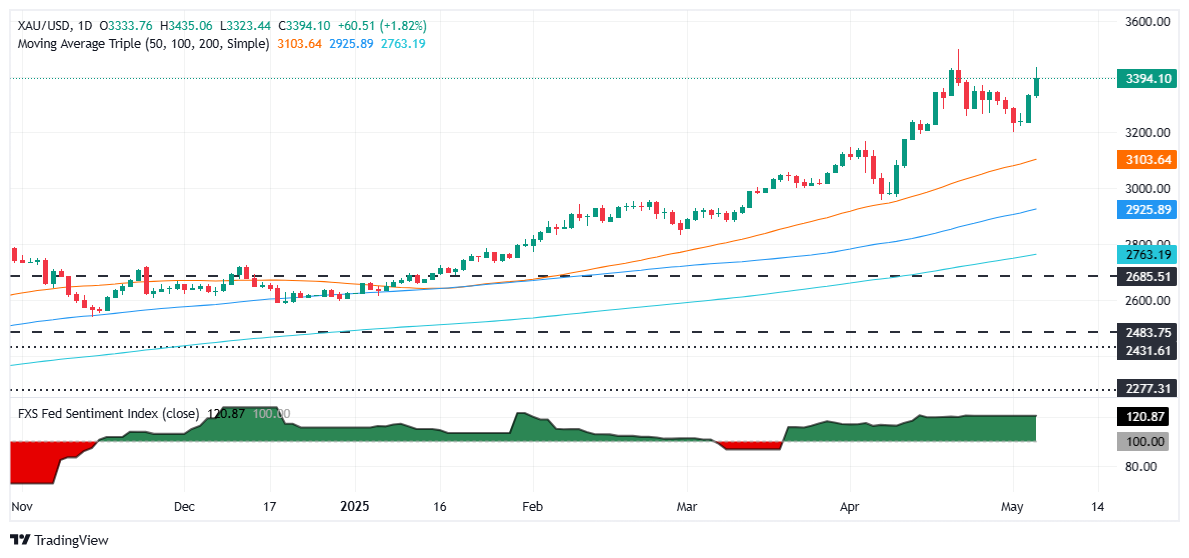
Gold price is set to extend its gains amid a sour market mood. The confirmation of a ‘bullish harami’ two-candle chart pattern sent XAU/USD rallying sharply, though the advance was prompted by geopolitical tensions and China’s markets reopening on Tuesday.
Once XAU/USD clears the $3,400 mark, a re-test of $3,450 is on the cards. The next stop would be the record high at $3,500. Conversely, if Gold price falls below $3,400, the next support would be the $3,350 figure. On further weakness, buyers'' next line of defense would be $3,300.
Gold FAQs
Gold has played a key role in human’s history as it has been widely used as a store of value and medium of exchange. Currently, apart from its shine and usage for jewelry, the precious metal is widely seen as a safe-haven asset, meaning that it is considered a good investment during turbulent times. Gold is also widely seen as a hedge against inflation and against depreciating currencies as it doesn’t rely on any specific issuer or government.
Central banks are the biggest Gold holders. In their aim to support their currencies in turbulent times, central banks tend to diversify their reserves and buy Gold to improve the perceived strength of the economy and the currency. High Gold reserves can be a source of trust for a country’s solvency. Central banks added 1,136 tonnes of Gold worth around $70 billion to their reserves in 2022, according to data from the World Gold Council. This is the highest yearly purchase since records began. Central banks from emerging economies such as China, India and Turkey are quickly increasing their Gold reserves.
Gold has an inverse correlation with the US Dollar and US Treasuries, which are both major reserve and safe-haven assets. When the Dollar depreciates, Gold tends to rise, enabling investors and central banks to diversify their assets in turbulent times. Gold is also inversely correlated with risk assets. A rally in the stock market tends to weaken Gold price, while sell-offs in riskier markets tend to favor the precious metal.
The price can move due to a wide range of factors. Geopolitical instability or fears of a deep recession can quickly make Gold price escalate due to its safe-haven status. As a yield-less asset, Gold tends to rise with lower interest rates, while higher cost of money usually weighs down on the yellow metal. Still, most moves depend on how the US Dollar (USD) behaves as the asset is priced in dollars (XAU/USD). A strong Dollar tends to keep the price of Gold controlled, whereas a weaker Dollar is likely to push Gold prices up.
Author

Christian Borjon Valencia
FXStreet
Markets analyst, news editor, and trading instructor with over 14 years of experience across FX, commodities, US equity indices, and global macro markets.