Gold soars to $3,682 record as Fed week sparks easing bets
- XAU/USD climbs to fresh record high on Monday above $3,680.
- Markets price in 25 bps for September Fed cut as minority see 50 bps.
- On Tuesday, US Retail Sales may set tone ahead of Fed decision.

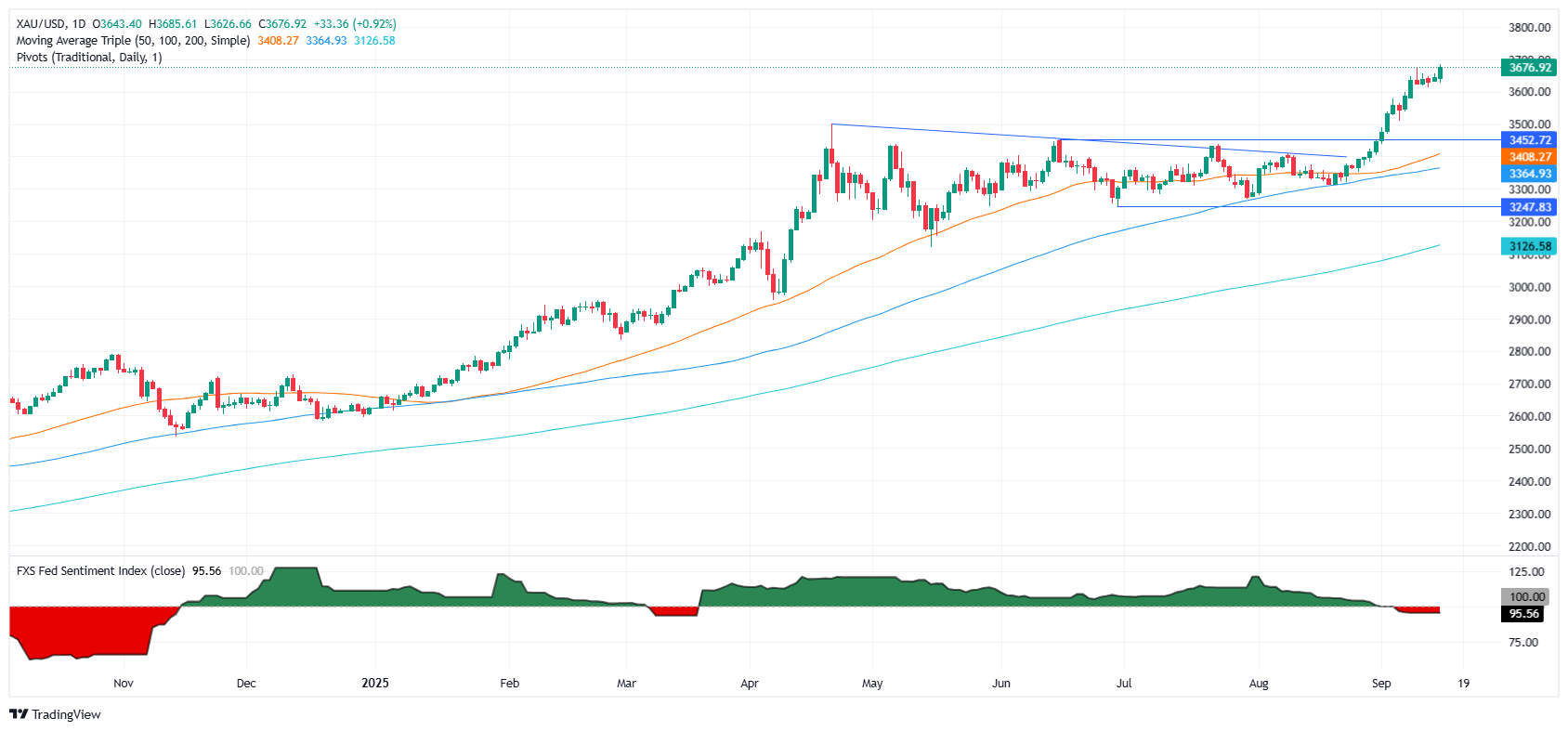
Gold prices on Monday rallied past the previous record high of $3,674, hitting $3,682 and poised to challenge the $3,700 level in the near term. Traders are setting up for the Federal Open Market Committee's (FOMC)monetary policy meeting on September 16-17. Expectations for a rate cut are high, therefore, US Treasury yields tumbled on Monday. At the time of writing, XAU/USD trades at $3,681, up by over 1%.
Bullion rallies over 1% with traders eyeing September 16–17 Fed cut
It's Federal Reserve (Fed) week once again, and Gold prices are reflecting a resumption of the Fed’s easing cycle amid a scenario of mixed data. Inflation remains high, but the revision of payrolls last Tuesday, revealing that job gains between April 2024 and March 2025 were overstated by 911K, triggered fears of deterioration in the labor market.
Hence, last week’s data and the sudden pivot by Fed Chair Jerome Powell at the Jackson Hole Symposium in late August, opened the door to a 25-basis-point (bps) rate cut. Despite this, there is a minority that projects a 50 bps reduction.
Alongside the decision, Fed officials will unveil its latest economic projections and the infamous “dot plot,” in which the board depicts the fed funds rate path moving forward.
In the meantime, Bullion prices have rallied to a new all-time high, underpinned by the fall in US Treasury yields and the US Dollar, which sits near one-week lows.
Ahead this week, the docket will feature US Retail Sales on Tuesday before the Fed’s policy decision on Wednesday.
Daily digest market movers: Gold rallies as US yields tumble
- The US Senate is poised to vote on Dr. Stephen Miran, President Trump's nominee to the Federal Reserve, on Monday. If confirmed, this will allow him to join this week’s policy meeting.
- US President Donald Trump posted on this social network that the Fed should cut “bigger than he (Powell) had in mind.”
- Last week’s University of Michigan (UoM) Consumer Sentiment poll showed that Americans are growing pessimistic about the economy, as the Consumer Sentiment Index dipped from 58.2 to 55.4. Inflation expectations for one year were unchanged at 4.8%, while for five years they rose from 3.5% to 3.9%.
- Deutsche Bank expects the Fed to cut interest rates by 25 bps in all three remaining meetings this year, meaning that the fed funds rate will reach the 3.50%-3.75% range.
- The US Dollar Index (DXY), which tracks the buck’s performance against a basket of six currencies, is down 0.33% at 97.29.
- US Treasury yields are surging, with the 10-year Treasury note up three and a half basis points (bps) to 4.034%. US real yields — calculated by subtracting inflation expectations from the nominal yield — rose nearly four basis points to 1.674% at the time of writing.
Technical outlook: Gold price eyes $3,700
The Gold price uptrend resumed on Monday with the non-yielding metal reaching a new all-time high of $3,682, before retreating somewhat below $3,680. Despite this, the yellow metal remains poised to test higher prices, but momentum in the short term opens the way for a pullback.
The Relative Strength Index (RSI) is flashing overbought signals, suggesting limited room for further upside in the near term.
If Gold drops below the September 9 high of $3,674, the next stop would be $3,650, followed by the September 11 low of $3,613. If those two levels are taken, $3,600 would be up for grabs. On the flip side, if XAU/USD clears $3,682, the next resistance level would be $3,700.
Gold FAQs
Gold has played a key role in human’s history as it has been widely used as a store of value and medium of exchange. Currently, apart from its shine and usage for jewelry, the precious metal is widely seen as a safe-haven asset, meaning that it is considered a good investment during turbulent times. Gold is also widely seen as a hedge against inflation and against depreciating currencies as it doesn’t rely on any specific issuer or government.
Central banks are the biggest Gold holders. In their aim to support their currencies in turbulent times, central banks tend to diversify their reserves and buy Gold to improve the perceived strength of the economy and the currency. High Gold reserves can be a source of trust for a country’s solvency. Central banks added 1,136 tonnes of Gold worth around $70 billion to their reserves in 2022, according to data from the World Gold Council. This is the highest yearly purchase since records began. Central banks from emerging economies such as China, India and Turkey are quickly increasing their Gold reserves.
Gold has an inverse correlation with the US Dollar and US Treasuries, which are both major reserve and safe-haven assets. When the Dollar depreciates, Gold tends to rise, enabling investors and central banks to diversify their assets in turbulent times. Gold is also inversely correlated with risk assets. A rally in the stock market tends to weaken Gold price, while sell-offs in riskier markets tend to favor the precious metal.
The price can move due to a wide range of factors. Geopolitical instability or fears of a deep recession can quickly make Gold price escalate due to its safe-haven status. As a yield-less asset, Gold tends to rise with lower interest rates, while higher cost of money usually weighs down on the yellow metal. Still, most moves depend on how the US Dollar (USD) behaves as the asset is priced in dollars (XAU/USD). A strong Dollar tends to keep the price of Gold controlled, whereas a weaker Dollar is likely to push Gold prices up.
Author

Christian Borjon Valencia
FXStreet
Markets analyst, news editor, and trading instructor with over 14 years of experience across FX, commodities, US equity indices, and global macro markets.