Gold unable to recover incurred losses ahead of US trading session on Friday's quadruple witching
- Gold breaks below $3,050 and even briefly breached $3,030 in the European trading session on Friday.
- Traders remain cautious with geopolitical turmoil and trade war fears still present.
- Gold expected to remain supported above $3,000 and keep a new all-time high in reach.

Gold’s price (XAU/USD) faces a second day of losses while the weekly performance is still positive. The precious metal trades around $3,030 at the time of writing on Friday after reaching a fresh all-time high at $3,057 the previous day. This downside move should not come as a surprise with Quadruple Witching taking place. Quadruple Witching is an event in financial markets when four different sets of futures and options expire on the same day, and investors need to decide whether to sell and buy back their positions or just sell them.
Meanwhile, on the geopolitical front, tensions remain in Gaza and Turkey. Later during the day, markets will brace for comments on tariffs from United States (US) President Donald Trump, as announced reciprocal tariffs will come into effect on April 2 and might shake up markets.
Daily digest market movers: Trump calls on mining
- US President Donald Trump is invoking emergency powers to boost the ability of the US to produce critical minerals, as part of a broad effort to ramp up the development of domestic natural resources and make the country less reliant on foreign imports, Bloomberg reports.
- Gold has climbed 16% this year in a rally that has produced 15 all-time highs in 2025, extending last year’s strong gains as investors seek safety. Geopolitical conflicts in the Middle East and Ukraine have bolstered the precious metal’s appeal. Several major banks have raised their price targets for bullion in recent weeks, with Macquarie Group forecasting it could rise as high as $3,500 an ounce, Bloomberg reports.
- An example of how not only traders enjoy the Gold’s rally comes with numbers from the Ontario Teachers’ Pension Plan. The pension fund gained 9.4% last year, driven by strong returns in stocks, venture growth and commodities. The performance boosted the fund’s net assets to $185.2 billion at the end of 2024, according to a statement Thursday, Bloomberg reports.
- Indonesian mining Stocks tumbled on Friday after the government signaled it was pushing forward with plans to hike royalties paid by producers in a bid to bolster public finances, Reuters reports. The local industry index for miners, including PT Vale Indonesia and PT Merdeka Copper Gold, fell as much as 3.2%, the biggest slide since the plan was first proposed at the start of last week.
Technical Analysis: Some breathing
The quadruple witching this Friday offers traders and funds a window of opportunity to take some profit from the precious metal. Big volumes will be traded, which means market participants are less exposed and it is not likely that expiring contracts will result in sales. At the end of this Friday, the question remains about how many contract holders in Bullion will have rolled over their contracts at current elevated prices.
Regarding technical levels, the intraday Pivot Point at $3,042 is the first resistance to recover, followed by the new all-time high at $3,057 reached on Thursday. The next target is the R1 resistance at $3,059, just below the $3,060 round number. If the last one is broken, then R2 resistance comes in at $3,074.
On the downside, the S1 support at $3,027 is doing its job for now during the European trading session, seeing some buyers coming in just below that level. In case more selling pressure should occur, look for the S2 support at $3,011 and the $3,000 round number to try and avoid a sharp correction.
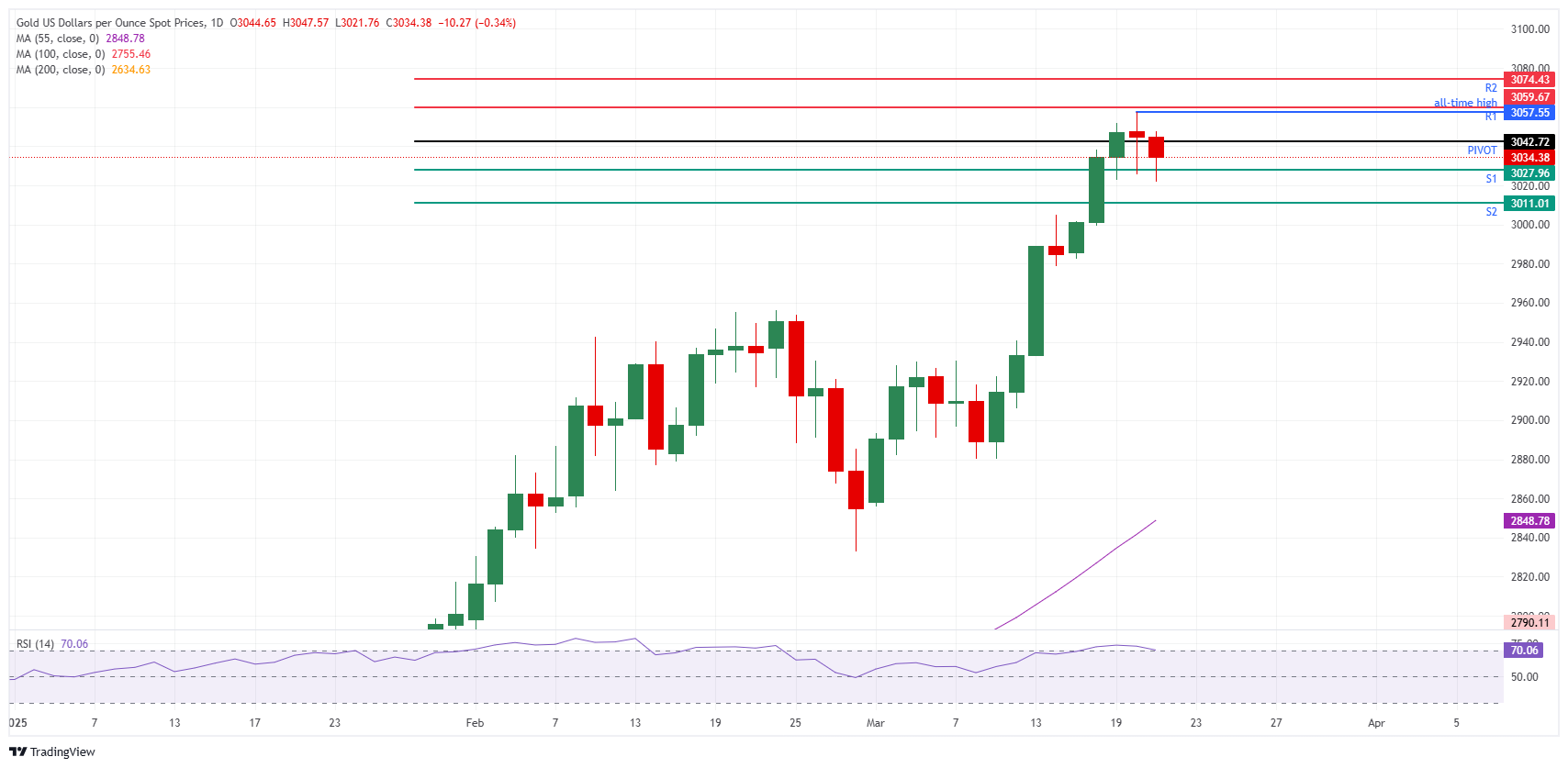
XAU/USD: Daily Chart
Risk sentiment FAQs
In the world of financial jargon the two widely used terms “risk-on” and “risk off'' refer to the level of risk that investors are willing to stomach during the period referenced. In a “risk-on” market, investors are optimistic about the future and more willing to buy risky assets. In a “risk-off” market investors start to ‘play it safe’ because they are worried about the future, and therefore buy less risky assets that are more certain of bringing a return, even if it is relatively modest.
Typically, during periods of “risk-on”, stock markets will rise, most commodities – except Gold – will also gain in value, since they benefit from a positive growth outlook. The currencies of nations that are heavy commodity exporters strengthen because of increased demand, and Cryptocurrencies rise. In a “risk-off” market, Bonds go up – especially major government Bonds – Gold shines, and safe-haven currencies such as the Japanese Yen, Swiss Franc and US Dollar all benefit.
The Australian Dollar (AUD), the Canadian Dollar (CAD), the New Zealand Dollar (NZD) and minor FX like the Ruble (RUB) and the South African Rand (ZAR), all tend to rise in markets that are “risk-on”. This is because the economies of these currencies are heavily reliant on commodity exports for growth, and commodities tend to rise in price during risk-on periods. This is because investors foresee greater demand for raw materials in the future due to heightened economic activity.
The major currencies that tend to rise during periods of “risk-off” are the US Dollar (USD), the Japanese Yen (JPY) and the Swiss Franc (CHF). The US Dollar, because it is the world’s reserve currency, and because in times of crisis investors buy US government debt, which is seen as safe because the largest economy in the world is unlikely to default. The Yen, from increased demand for Japanese government bonds, because a high proportion are held by domestic investors who are unlikely to dump them – even in a crisis. The Swiss Franc, because strict Swiss banking laws offer investors enhanced capital protection.
Author

Filip Lagaart
FXStreet
Filip Lagaart is a former sales/trader with over 15 years of financial markets expertise under its belt.