Gold smashes record above $3,500 as risk aversion fuels rush
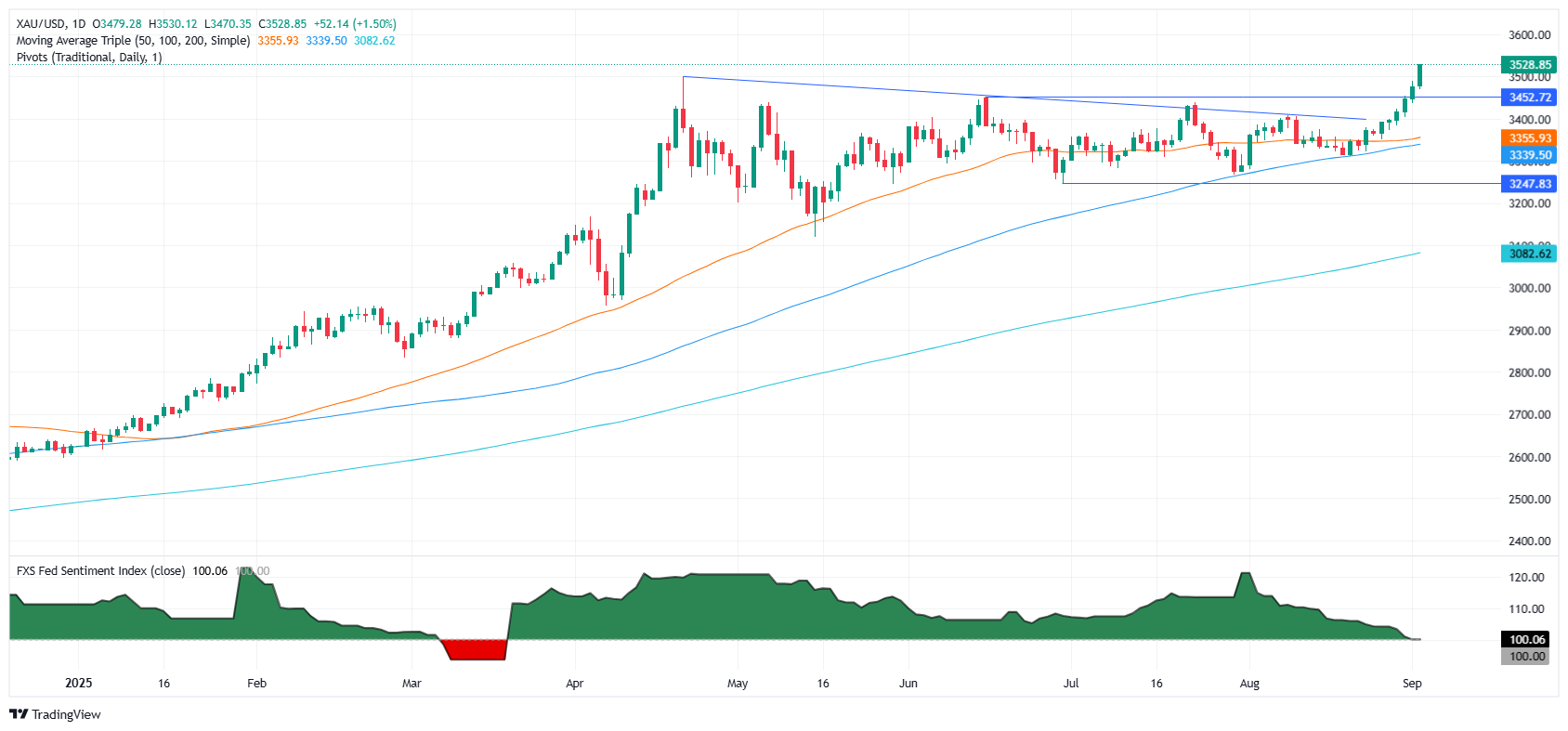
- XAU/USD rallies over 2% after clearing April’s peak and setting a new record high at $3,530.
- Safe-haven demand surges amid Fed independence fears, US policy uncertainty and higher Gold ETF inflows.
- Mixed US PMI data deepens risk-off tone, with focus shifting to Friday’s pivotal Nonfarm Payrolls release.

Gold prices soar to a new all-time high past the $3,500 figure on Tuesday, rallying more than 2% even though the US Dollar advances and US Treasury yields rise. Risk aversion dominates, despite forecasts of a potential Federal Reserve (Fed) rate cut in September. XAU/USD trades above the $3,520 figure, after bouncing off daily lows of $3,470.
Bullion hits fresh all-time high at $3,530 despite stronger Dollar and surging US Treasury yields
Market mood is downbeat, hence favoring flows toward the yellow metal, which cleared April’s 22 peak of $3,500 and hit a record high at $3,530, poised to reach higher prices.
Factors such as uncertainty around US policy, Fed independence threats and an increase in flows to Gold ETFs, are the drivers of Tuesday’s session. Data-wise, mixed Manufacturing Purchasing Managers Index (PMIs) readings revealed by S&P Global and the Institute for Supply Management (ISM) prompted investors to buy the precious metals instead of US equities.
In the FX space, the Greenback is advancing and US Treasury yields are also surging as fixed income traders are demanding a higher premium across the whole curve, though they are more focused on the belly and long end of the yield curve.
Meanwhile, traders are awaiting August’s US Nonfarm Payroll figures on Friday. An upbeat report could trigger a retracement of Gold prices as traders reassess the possible outcome of the Fed holding rates unchanged, instead of a cut.
Daily digest market movers: Gold skyrockets alongside the Dollar
- Gold price advancement continued, even though the US Dollar is also strengthening. The US Dollar Index (DXY), which tracks the performance of the buck against a basket of six currencies, is up 0.61% at 98.28.
- US Treasury yields are soaring as well, with the 10-year Treasury note rising four basis points (bps) to 4.273%. US real yields—calculated by subtracting inflation expectations from the nominal yield—have increased by nearly 4.5 basis points to 1.862% at the time of writing.
- The ISM Manufacturing PMI contracted for the sixth straight month despite improving, from 48 to 48.7 in August, below estimates of 49. The sub-components of the ISM showed that prices paid dipped from 64.8 to 63.7 in August, an indication that tariffs are feeding into inflation. Factory employment remained subdued, while production fell.
- S&P Global revealed that business activity in the manufacturing sector deteriorated, from 53.3 to 53.
- Gold ETF inflows are reinforcing the rally, with SPDR Gold Trust saying that its holdings rose 1.01% last Friday to 977.68 tons, the highest since August 2022.
- Fed September rate cut odds are at 94.75%, according to the Prime Market Terminal interest rate probabilities tool.
Technical outlook: Gold price poised to challenge $3,600 in the near term
Gold’s uptrend resumed on Tuesday as the non-yielding metal traveled to uncharted territory at all-time highs past the $3,500 barrier. The Relative Strength Index (RSI), despite turning overbought, shows that bulls continue to strengthen and traders must look to the 80 level for the most extreme overbought condition.
If XAU/USD climbs past $3,550, this will open the way to challenge $3,600. On the other hand, if Gold retreats, the first area of interest would be the $3,500 figure. A breach of the latter will expose the August 29 high of $3,454, before sliding to $3,400.
Gold FAQs
Gold has played a key role in human’s history as it has been widely used as a store of value and medium of exchange. Currently, apart from its shine and usage for jewelry, the precious metal is widely seen as a safe-haven asset, meaning that it is considered a good investment during turbulent times. Gold is also widely seen as a hedge against inflation and against depreciating currencies as it doesn’t rely on any specific issuer or government.
Central banks are the biggest Gold holders. In their aim to support their currencies in turbulent times, central banks tend to diversify their reserves and buy Gold to improve the perceived strength of the economy and the currency. High Gold reserves can be a source of trust for a country’s solvency. Central banks added 1,136 tonnes of Gold worth around $70 billion to their reserves in 2022, according to data from the World Gold Council. This is the highest yearly purchase since records began. Central banks from emerging economies such as China, India and Turkey are quickly increasing their Gold reserves.
Gold has an inverse correlation with the US Dollar and US Treasuries, which are both major reserve and safe-haven assets. When the Dollar depreciates, Gold tends to rise, enabling investors and central banks to diversify their assets in turbulent times. Gold is also inversely correlated with risk assets. A rally in the stock market tends to weaken Gold price, while sell-offs in riskier markets tend to favor the precious metal.
The price can move due to a wide range of factors. Geopolitical instability or fears of a deep recession can quickly make Gold price escalate due to its safe-haven status. As a yield-less asset, Gold tends to rise with lower interest rates, while higher cost of money usually weighs down on the yellow metal. Still, most moves depend on how the US Dollar (USD) behaves as the asset is priced in dollars (XAU/USD). A strong Dollar tends to keep the price of Gold controlled, whereas a weaker Dollar is likely to push Gold prices up.
Author

Christian Borjon Valencia
FXStreet
Markets analyst, news editor, and trading instructor with over 14 years of experience across FX, commodities, US equity indices, and global macro markets.
















