Gold slips below $4,000 as US–China trade hopes lift risk appetite
- XAU/USD drops 0.63% to $3,955 after rebounding from three-week lows under $3,900.
- Signs of a US–China trade thaw redirect flows toward equities, while geopolitical tensions rise in the Middle East.
- Fed is seen cutting rates by 25 bps on Wednesday, with another move expected in December.
Gold price drops 0.63% on Tuesday during the North American session with the yellow metal suffering from its safe-haven appeal as hopes of a de-escalation of the US-China trade war keep ebbs and flows going toward riskier assets like US equities. At the time of writing, XAU/USD trades at $3,955, after bouncing off three-week lows beneath $3,900.
Yellow metal loses safe-haven bid ahead of Trump–Xi meeting; Fed cut expectations to cushion fall
The US-China trade war seems to be fading following last week’s meeting between senior officials in Malaysia. Discussions about tariffs, shipping fees, fentanyl and rare-earth export controls had set the stage for a possible agreement as US President Donald Trump and his Chinese counterpart Xi Jinping will meet on Thursday.
Meanwhile, geopolitics could cap Gold’s losses as the Jerusalem Post reported that “The response to the current violations by Hamas will be significantly greater than the response last time,” citing sources.
If hostilities in the Middle East resume, Bullion could trim some of its last two weeks’ losses and be poised to reclaim the $4,000 figure.
Gold, a traditional hedge during times of uncertainty and a non-yielding asset, has gained 51% this year, bolstered by geopolitical and trade tensions, as well as lower interest rates in the US.
Aside from this, the Federal Reserve (Fed) is expected to cut rates by 25 basis points (bps) at the Wednesday's meeting, followed by a subsequent reduction in December, according to Prime Market Terminal interest rate probability tool.
Daily market movers: Gold price dives despite broad US Dollar weakness
- The US Dollar Index (DXY), which tracks the performance of the buck versus six currencies, edges down 0.11% to 98.68.
- The US 10-year Treasury note yield is virtually unchanged at 3.981%. US real yields — which correlate inversely to Gold prices — are unchanged at 1.701%.
- Gold could also print a leg-up if central banks resume purchases. South Korea's central bank is considering adding Gold reserves in the medium-to-long term, according to the Head of Reserve Investment at the Bank of Korea, Heung-Soon Jung, at a precious metals conference on Tuesday.
- Actually, the South Korean central bank has had 104 metric tons of Gold reserves since 2013.
- Bank of America updated its Gold forecasts to $3,800 per ounce in Q4. They said that “The market has become overbought, which finally gave rise to this week's correction.”
Technical outlook: Gold price slumps below $4,000, sellers in charge
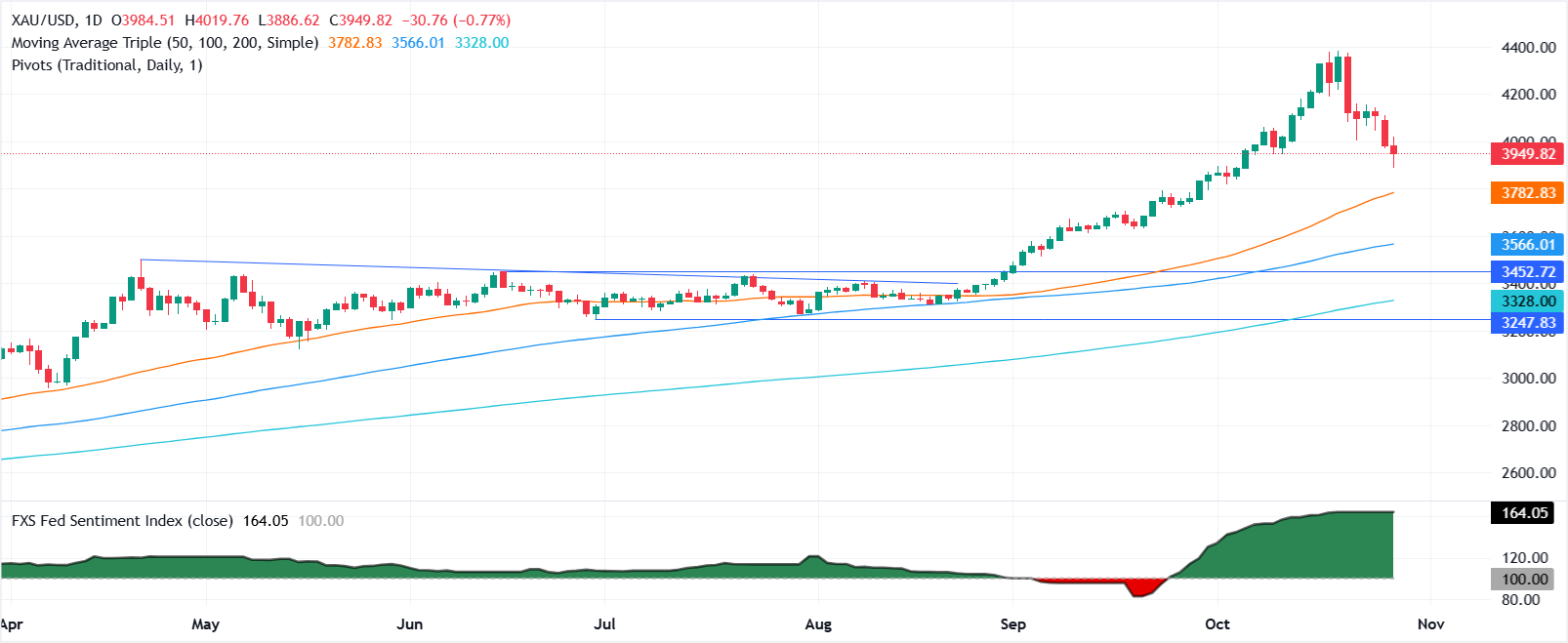
Gold’s broader uptrend stays intact despite the dip below $3,900, which pushed prices toward $3,886, a three-week low. The Relative Strength Index (RSI) continued to tilt lower, signaling that sellers are gaining momentum, and it turned bearish.
If Gold posts a daily close under $4,000, traders could expect prices to fluctuate between the $3,900-$4,000 figure. A breach of the bottom of the range will expose October’s 28 low of $3,886, followed by the 50-day Simple Moving Average (SMA) near $3,779.
Conversely, if XAU/USD clears $4,000, resistance is seen at $4,100, followed by the October 22 peak at $4,161.
Gold FAQs
Gold has played a key role in human’s history as it has been widely used as a store of value and medium of exchange. Currently, apart from its shine and usage for jewelry, the precious metal is widely seen as a safe-haven asset, meaning that it is considered a good investment during turbulent times. Gold is also widely seen as a hedge against inflation and against depreciating currencies as it doesn’t rely on any specific issuer or government.
Central banks are the biggest Gold holders. In their aim to support their currencies in turbulent times, central banks tend to diversify their reserves and buy Gold to improve the perceived strength of the economy and the currency. High Gold reserves can be a source of trust for a country’s solvency. Central banks added 1,136 tonnes of Gold worth around $70 billion to their reserves in 2022, according to data from the World Gold Council. This is the highest yearly purchase since records began. Central banks from emerging economies such as China, India and Turkey are quickly increasing their Gold reserves.
Gold has an inverse correlation with the US Dollar and US Treasuries, which are both major reserve and safe-haven assets. When the Dollar depreciates, Gold tends to rise, enabling investors and central banks to diversify their assets in turbulent times. Gold is also inversely correlated with risk assets. A rally in the stock market tends to weaken Gold price, while sell-offs in riskier markets tend to favor the precious metal.
The price can move due to a wide range of factors. Geopolitical instability or fears of a deep recession can quickly make Gold price escalate due to its safe-haven status. As a yield-less asset, Gold tends to rise with lower interest rates, while higher cost of money usually weighs down on the yellow metal. Still, most moves depend on how the US Dollar (USD) behaves as the asset is priced in dollars (XAU/USD). A strong Dollar tends to keep the price of Gold controlled, whereas a weaker Dollar is likely to push Gold prices up.
Author

Christian Borjon Valencia
FXStreet
Markets analyst, news editor, and trading instructor with over 14 years of experience across FX, commodities, US equity indices, and global macro markets.

















