Gold tanks further below $3,300 as Powell blames tariffs for delayed cuts
- Gold dives as Fed Chair Jerome Powell revealed that tariffs reflection on prices would be slower, hinting steady rates.
- Fed holds rates steady, but Waller and Bowman dissent in favor of a cut.
- Statement cites moderated growth and “somewhat elevated” inflation; balance sheet runoff to continue.

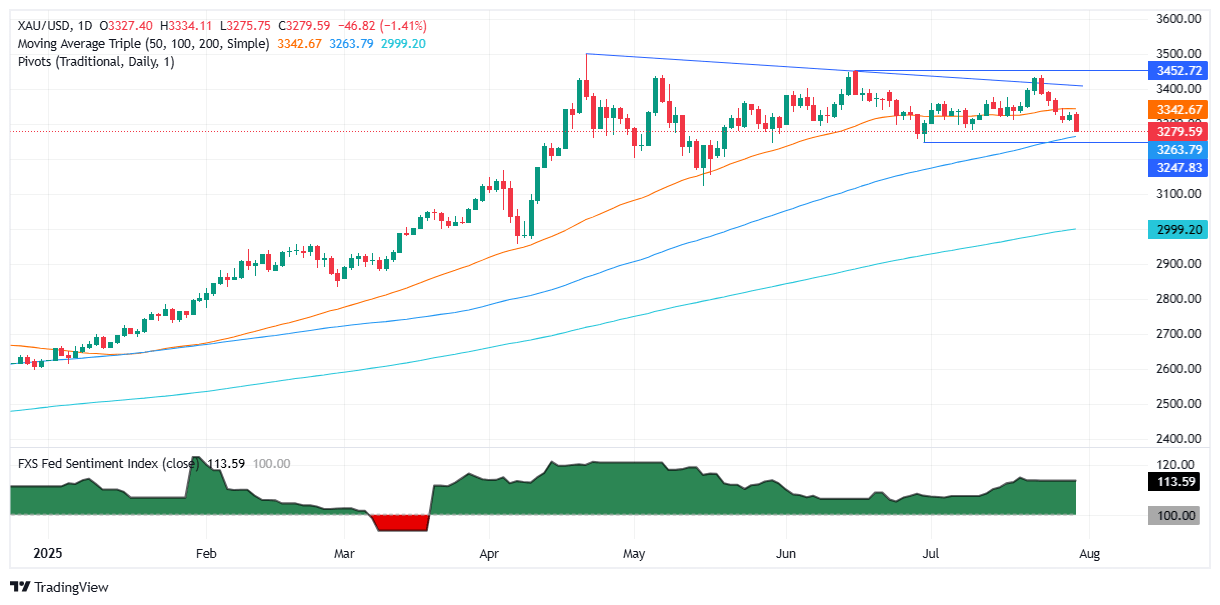
Gold Price plummets sharply as the Fed Chair Powell leaned hawkish on remarks at its press conference, following the Federal Reserve’s decision to held interest rates unchanged though not unanimously. The XAU/USD sinks further below $3,300, down more than 1.30%.
During his press conference, the Fed Chair Jerome Powell said that the central bank has a long way to go, to know the impact of tariffs, adding that he expects to see more tariff impacts on data. Furthermore, stated “Tariff passthrough to prices may be slower than thought.”
On the statement, Fed officials expressed that growth of economic activity has moderated in the first half, though the unemployment rate remains low and inflation remains “somewhat elevated.”
The statement revealed the committee’s commitment to achieve maximum employment and inflation at a rate of 2% and acknowledged that “Uncertainty about the economic outlook remains elevated.”
Regarding the balance sheet reduction, the Fed revealed that they will continue to reduce its holding of Treasury securities, agency debt and agency mortgage-backed securities. Up next is the Fed Chair Jerome Powell press conference, at around 18:30 GMT.
Gold Price Forecast: Technical outlook
XAU/USD aimed above $3,300, but it has retreated somewhat, as US President Donald Trump is also crossing the wires, as he signed an executive order, setting Brazil tariffs on 50%. Further upside is seen above the day’s high at $3,334. On the flip side, the firs support is $3,288, with eyes set on the 100-day SMA at $3,250.
Interest rates FAQs
Interest rates are charged by financial institutions on loans to borrowers and are paid as interest to savers and depositors. They are influenced by base lending rates, which are set by central banks in response to changes in the economy. Central banks normally have a mandate to ensure price stability, which in most cases means targeting a core inflation rate of around 2%. If inflation falls below target the central bank may cut base lending rates, with a view to stimulating lending and boosting the economy. If inflation rises substantially above 2% it normally results in the central bank raising base lending rates in an attempt to lower inflation.
Higher interest rates generally help strengthen a country’s currency as they make it a more attractive place for global investors to park their money.
Higher interest rates overall weigh on the price of Gold because they increase the opportunity cost of holding Gold instead of investing in an interest-bearing asset or placing cash in the bank. If interest rates are high that usually pushes up the price of the US Dollar (USD), and since Gold is priced in Dollars, this has the effect of lowering the price of Gold.
The Fed funds rate is the overnight rate at which US banks lend to each other. It is the oft-quoted headline rate set by the Federal Reserve at its FOMC meetings. It is set as a range, for example 4.75%-5.00%, though the upper limit (in that case 5.00%) is the quoted figure. Market expectations for future Fed funds rate are tracked by the CME FedWatch tool, which shapes how many financial markets behave in anticipation of future Federal Reserve monetary policy decisions.
Author
Christian Borjon Valencia
FXStreet
Markets analyst, news editor, and trading instructor with over 14 years of experience across FX, commodities, US equity indices, and global macro markets.