Gold drops as hot US data supports Fed hold outlook
- Gold trims early losses as US Jobless Claims and retail sales dent rate cut hopes.
- US data beats estimates, reinforcing Fed's steady policy stance ahead of the July meeting.
- Fed officials signal patience, with inflation still above the target range.

Gold price dropped by over 0.26% during the North American session on Thursday, trimming some of its earlier losses of nearly 1%. The release of solid economic data from the United States, which supports the Federal Reserve’s (Fed) stance to hold rates unchanged at the upcoming July meeting, contributed to this decline. At the time of writing, XAU/USD trades at $3,340.
The market mood remains positive throughout the trading day, which serves as a headwind for Gold prices, as investors digest the latest job and consumer data. Initial Jobless Claims for the last week continued to show improvement in the labor market. At the same time, Retail Sales data indicated that American households remain resilient, although the data suggest that the jump in sales is mainly attributed to higher prices.
After the data, some Fed officials crossed the wires. Governor Adriana Kugler commented that monetary policy needs to remain steady for quite some time. San Francisco Fed President Mary Daly stated that there’s some work to be done on inflation, as they have not yet achieved price stability.
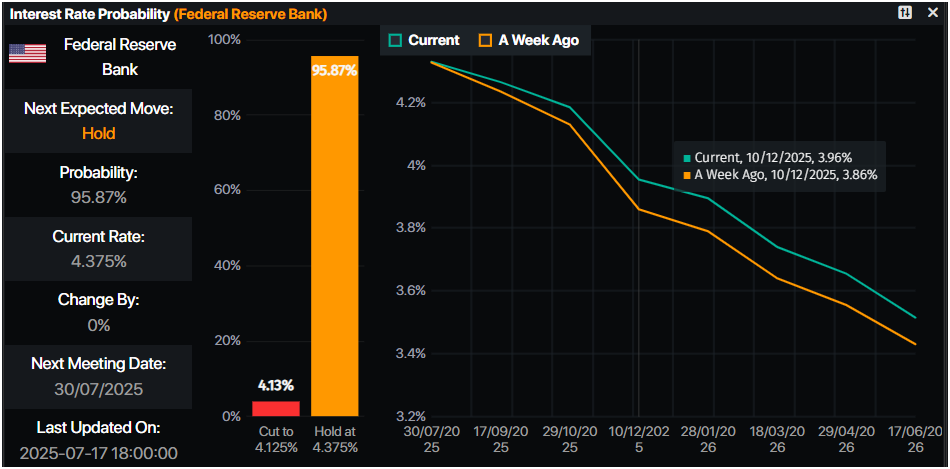
In the meantime, investors continued to price in less easing by the Fed as further data became available, which dampens the demand for the non-yielding metal. The December 2025 fed funds rates futures contract shows that traders expect 42 basis points (bps) of easing, as revealed by the CBOT.
On the trade side, Japan’s negotiator Ryosei Akazawa held talks with the US Commerce Secretary Howard Lutnick in efforts to avert or diminish 25% tariffs imposed on Japanese products.
Ahead this week, traders will eye Fed speeches and the University of Michigan Consumer Sentiment report.
Gold daily market movers: Extends losses on upbeat US jobs data
- US Initial Jobless Claims for the week ending July 12 dipped from 228K on the previous print to 221K, below forecasts of 235K. The data support the Fed’s cautious stance, as the labor market remains healthy, although it hasn’t been cited as a cause for inflation.
- Retail Sales in June exceeded forecasts of 0.1% MoM, rose by 0.6% MoM and crushed May’s 0.9% plunge as some of the increase is a reflection of higher prices due to tariffs. Inflation on the consumer side revealed earlier in the week that prices are edging higher
- Fed Governor Adriana Kugler added to her hawkish remarks that inflation remains above target, while the labor market remains stable and resilient. She added that CPI inflation is broadening to core goods.
- San Francisco Fed President Mary Daly commented that the economy is in a good place and that, despite restrictive rates, the June CPI began to show the effect of tariffs. Despite this, she added that duties might have a muted impact on inflation and that she still favors two rate cuts.
- US Treasury yields remain flat on Thursday, with the US 10-year Treasury yield, which typically correlates negatively with Gold, steady at 4.461%. However, Bullion prices remain weighed by the strength of the Dollar. The US Dollar Index (DXY), which tracks the buck’s performance value against a basket of six currencies, is up 0.45% at 98.72.
- Interest rate probability indicates that the Federal Reserve will maintain its current rates, with odds standing at 95% for a hold and 5% for a 25-basis-point rate cut at the July 30 meeting.
Source: Prime Market Terminal
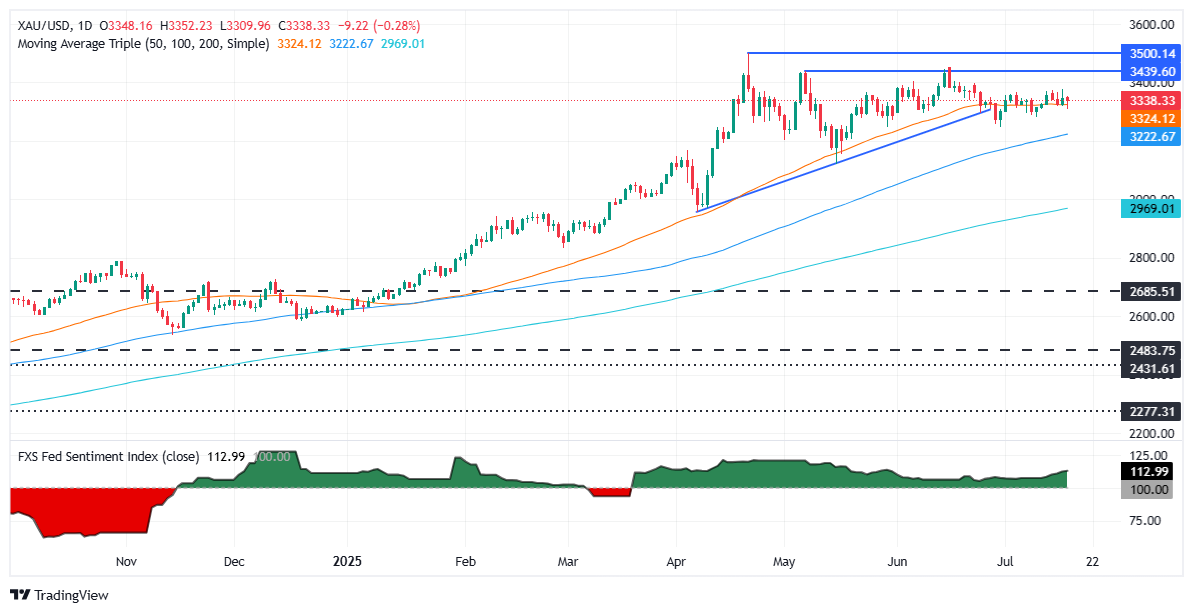
XAU/USD technical outlook: Gold remains directionless, trapped within the $3,300-$3,400 range
Consolidation is the name of the game, as depicted by Gold’s daily chart. The Relative Strength Index (RSI) is above its neutral line, but its slope remains flat, indicating further sideways action. However, from a price action standpoint, bulls remain in control, but they need to clear key resistance levels.
For a bullish continuation, XAU/USD must climb past $3,400, which will expose the June 16 high of $3,452, ahead of the record high of $3,500. Conversely, if XAU/USD drops below $3,300, look for a decline to the June 30 low of $3,246, followed by the 100-day Simple Moving Average (SMA) at $3,209.
Fed FAQs
Monetary policy in the US is shaped by the Federal Reserve (Fed). The Fed has two mandates: to achieve price stability and foster full employment. Its primary tool to achieve these goals is by adjusting interest rates. When prices are rising too quickly and inflation is above the Fed’s 2% target, it raises interest rates, increasing borrowing costs throughout the economy. This results in a stronger US Dollar (USD) as it makes the US a more attractive place for international investors to park their money. When inflation falls below 2% or the Unemployment Rate is too high, the Fed may lower interest rates to encourage borrowing, which weighs on the Greenback.
The Federal Reserve (Fed) holds eight policy meetings a year, where the Federal Open Market Committee (FOMC) assesses economic conditions and makes monetary policy decisions. The FOMC is attended by twelve Fed officials – the seven members of the Board of Governors, the president of the Federal Reserve Bank of New York, and four of the remaining eleven regional Reserve Bank presidents, who serve one-year terms on a rotating basis.
In extreme situations, the Federal Reserve may resort to a policy named Quantitative Easing (QE). QE is the process by which the Fed substantially increases the flow of credit in a stuck financial system. It is a non-standard policy measure used during crises or when inflation is extremely low. It was the Fed’s weapon of choice during the Great Financial Crisis in 2008. It involves the Fed printing more Dollars and using them to buy high grade bonds from financial institutions. QE usually weakens the US Dollar.
Quantitative tightening (QT) is the reverse process of QE, whereby the Federal Reserve stops buying bonds from financial institutions and does not reinvest the principal from the bonds it holds maturing, to purchase new bonds. It is usually positive for the value of the US Dollar.
Author

Christian Borjon Valencia
FXStreet
Markets analyst, news editor, and trading instructor with over 14 years of experience across FX, commodities, US equity indices, and global macro markets.

















