Gold trims gains as Fed’s Logan warns against early easing
- XAU/USD falls as Dallas Fed’s Logan flags inflation above target, urges vigilance.
- Government shutdown halts BLS releases, though September NFP data likely secured.
- Markets still price in 99% odds of October Fed rate cut, leaving Gold supported despite short-term US Dollar strength.

Gold price retreats during the North American session on Thursday as the Greenback recovers some ground, trimming some of its weekly losses after Dallas Fed President Lorie Logan delivered a hawkish message. At the time of writing, XAU/USD trades at $3,844, down 0.50%.
Bullion dips below $3,820 after Logan warns on inflation trend
The Dallas Federal Reserve's Lorie Logan said that inflation is running above target and trending upward. However, she acknowledged risks on both sides of the dual mandate, saying that the labor market appears fairly balanced but slowing.
In the meantime, US economic data releases by the Bureau of Labor Statistics (BLS) will be halted due to the government shutdown. Senator Elizabeth Warren said that data for the September Nonfarm Payrolls report had been collected and is still likely to be released, according to CNN.
Challenger Job Cuts for September showed that companies announced plans to fire 54,064 people, less than August’s 85,979. Andy Challenger, senior vice president at Challenger, Gray & Christmas, said, “Right now, we’re dealing with a stagnating labor market, cost increases, and a transformative new technology.”
The data further justifies the need for further interest rate cuts by the Federal Reserve (Fed). Market participants are pricing in a 99% chance for a 25 bps rate cut at the October 29 meeting, which would bring the fed funds rate to the 3.75%-4% range.
Ahead this week, the economic docket will be absent, except for data to be released by private companies. On Friday, the Institute for Supply Management (ISM) is expected to release the Services Purchasing Managers Index (PMI) for September.
Daily market movers: Gold price tumbles on US Dollar strength
- Bullion price is on the defensive as the Greenback recovers, shown by the US Dollar Index (DXY). The DXY, which tracks the buck’s value against a basket of six currencies, is up 0.20% at 97.88.
- US Treasury yields retreat as the 10-year Treasury note loses one basis point to 4.08%. US real yields are also down slightly to 1.738%.
- On Friday, the ISM Services PMI is expected to slow down from 52.0 to 51.7. The Employment sub-component, which could be sought in the case that payrolls are not released, was at 46.5 in August.
- Wednesday’s data revealed ADP figures for September, which showed that private companies cut 32K people from the workforce, below the 50K estimated to be hired.
- Business activity in the manufacturing sector improved, as depicted by the ISM Manufacturing PMI. The index increased to 49.1 in September from 48.7 in August, though it was the seventh month that the PMI was in contractionary territory.
- US job openings inched higher in August, rising to 7.23 million from 7.21 million, suggesting a still resilient labor market. However, the hiring rate slipped to 3.2%, its lowest since June 2024, while layoffs remained at historically low levels.
Technical outlook: Gold bulls take a breather ahead of challenging $3,900
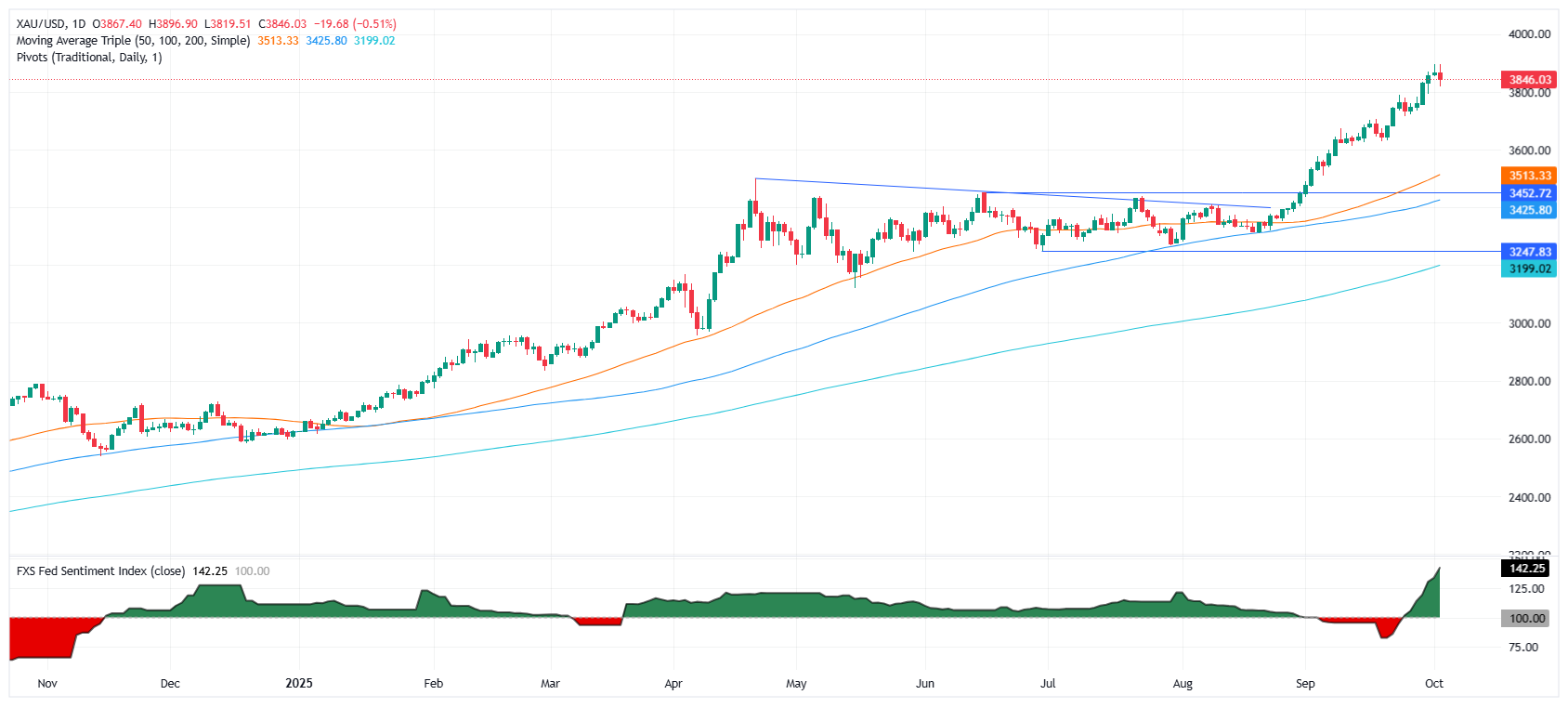
Gold price is upwardly biased despite the formation of a "shooting star" candle, which is shifting toward an "evening star" as the US Dollar rises and Bullion sinks. A daily close below the September 30 open of $3,832 could pave the way for further downside.
The first support would be September 30 swing low of $3,793, followed by a test of the 20-day Simple Moving Average (SMA) at $3,713. Conversely, the XAU/USD could challenge $3,850 ahead of the all-time high at $3,895, before testing $3,900.
Fed FAQs
Monetary policy in the US is shaped by the Federal Reserve (Fed). The Fed has two mandates: to achieve price stability and foster full employment. Its primary tool to achieve these goals is by adjusting interest rates. When prices are rising too quickly and inflation is above the Fed’s 2% target, it raises interest rates, increasing borrowing costs throughout the economy. This results in a stronger US Dollar (USD) as it makes the US a more attractive place for international investors to park their money. When inflation falls below 2% or the Unemployment Rate is too high, the Fed may lower interest rates to encourage borrowing, which weighs on the Greenback.
The Federal Reserve (Fed) holds eight policy meetings a year, where the Federal Open Market Committee (FOMC) assesses economic conditions and makes monetary policy decisions. The FOMC is attended by twelve Fed officials – the seven members of the Board of Governors, the president of the Federal Reserve Bank of New York, and four of the remaining eleven regional Reserve Bank presidents, who serve one-year terms on a rotating basis.
In extreme situations, the Federal Reserve may resort to a policy named Quantitative Easing (QE). QE is the process by which the Fed substantially increases the flow of credit in a stuck financial system. It is a non-standard policy measure used during crises or when inflation is extremely low. It was the Fed’s weapon of choice during the Great Financial Crisis in 2008. It involves the Fed printing more Dollars and using them to buy high grade bonds from financial institutions. QE usually weakens the US Dollar.
Quantitative tightening (QT) is the reverse process of QE, whereby the Federal Reserve stops buying bonds from financial institutions and does not reinvest the principal from the bonds it holds maturing, to purchase new bonds. It is usually positive for the value of the US Dollar.
Author

Christian Borjon Valencia
FXStreet
Markets analyst, news editor, and trading instructor with over 14 years of experience across FX, commodities, US equity indices, and global macro markets.

















