Gold rises on broad USD weakness as geopolitcal and tariffs fears mount
- XAU/USD climbs as Russia-Ukraine conflict revs up and Trump revives tariff threats.
- Rising US-China trade tensions spark risk-off flight to Gold.
- Trump hikes steel tariffs to 50% starting June 4, adding to global market jitters.
- Fed’s Waller leaves door open for rate cuts; ISM Manufacturing PMI shows mixed signals ahead of NFP.


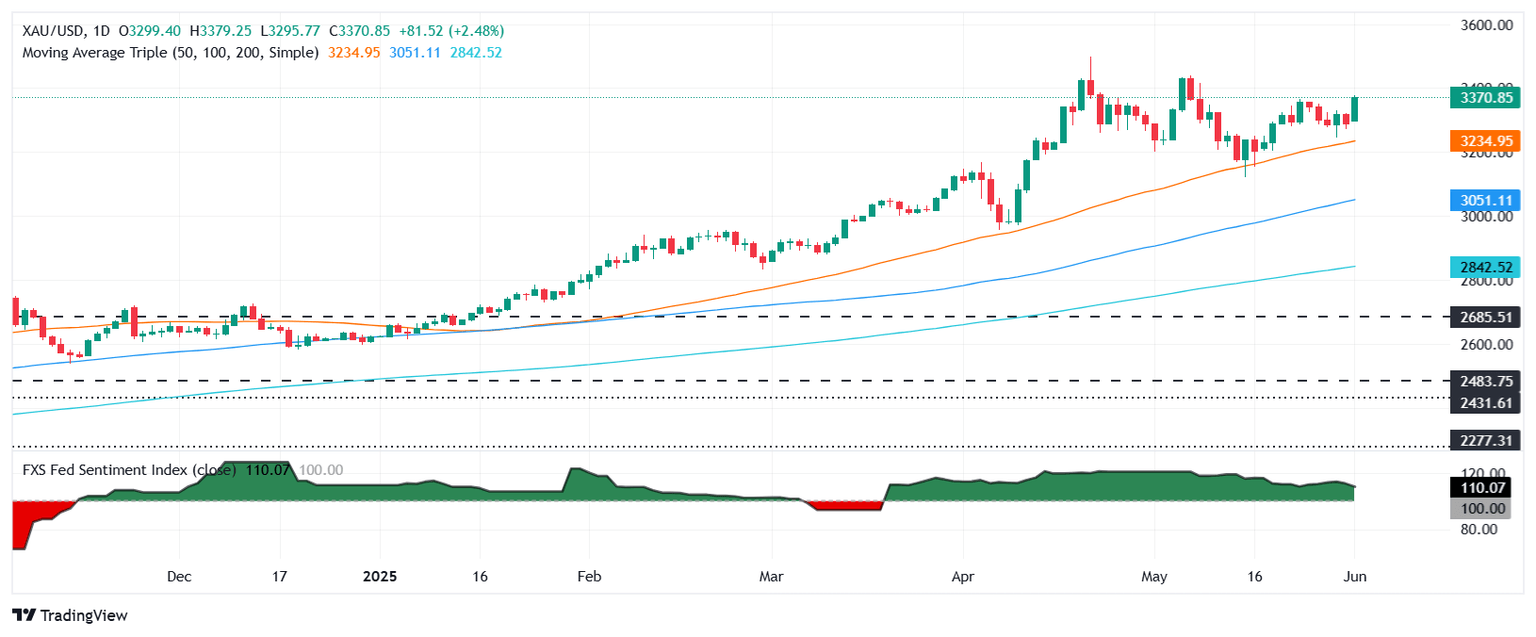
Gold prices rallied sharply on Monday, reaching their highest level in over four weeks, as geopolitical risks escalated over the Russia-Ukraine conflict. Renewed tensions on trade between the United States (US) and China prompted investors to buy the yellow metal throughout the day. At the time of writing, XAU/USD trades at $3,377, up by 2.70%.
Market sentiment shifted sour as news broke that Ukraine staged an aerial attack on Russia, which destroyed long-range bombers and other aircraft. Meanwhile, US President Donald Trump doubled down on tariffs over steel and aluminum imports to 50%, effective June 4, and rhetoric against China sent US global equities lower.
CNBC reported that Trump and China’s President Xi Jinping could speak this week, but not on Monday.
On the data front, the ISM Manufacturing PMI for May revealed that business activity deteriorated. Nevertheless, there were some improvements in the prices paid sub-component, which fell. Meanwhile, the employment index sub-component improved compared to the previous number, and it was received positively by market participants, who are eyeing Friday’s Nonfarm Payrolls figures.
Bullion prices are also up following Federal Reserve (Fed) Governor Christopher Waller's slightly dovish approach, saying that rate cuts remain possible later this year. However, he warned that policymakers are mainly focused on controlling inflation.
Gold daily market movers: Bullion rallies sharply as Greenback plummets
- Gold price surges as the US Dollar tanks. The US Dollar Index (DXY), which tracks the Greenback’s value against a basket of six currencies, tumbles 0.72% at 98.71.
- US Treasury bond yields are rising, with the US 10-year Treasury note yielding up almost six basis points to 4.458%. US real yields had followed suit and are also surging by six basis points to 2.118%.
- The ISM Manufacturing PMI rose by 48.5, down from April’s 48.7, hitting its lowest reading since November. The Prices Index remained in expansion territory, registering 69.4 percent, while the Employment Index stood in contractionary territory but improved from 46.5 to 46.8.
- The S&P Global Manufacturing PMI remained in expansionary territory, yet dipped in May from April’s 52.3 to 52.
- After the data release, the Atlanta Fed’s GDPNow preliminary reading of economic growth for Q2 2025 rose sharply from 3.8% to 4.6%.
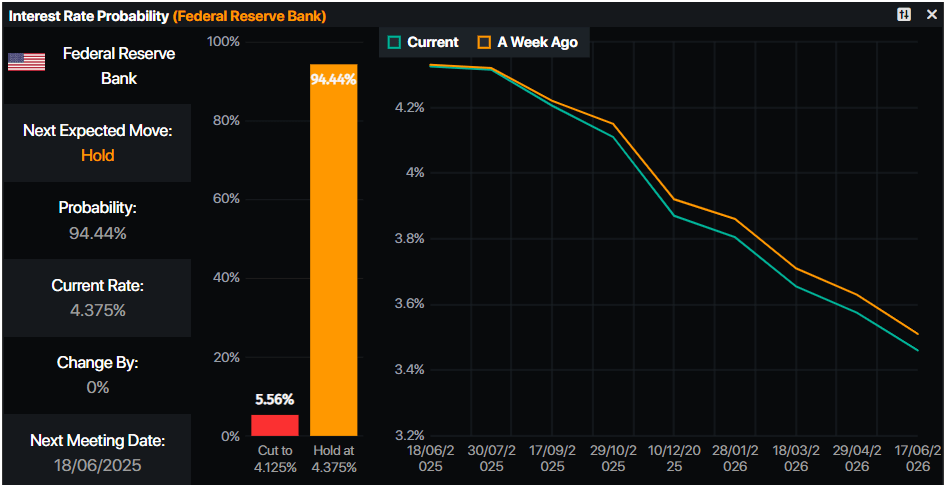
- Money markets suggest that traders are pricing in 51 basis points of easing toward the end of the year, according to Prime Market Terminal data.
Source: Prime Market Terminal
XAU/USD technical outlook: Gold surges past $3,350 with bulls targeting $3,400
Gold price is bullishly biased as buyers lifted the XAU/USD spot price above $3,370, eyeing a clear break of the $3,400 level. The Relative Strength Index (RSI) indicates that buyers are gaining momentum.
If Gold climbs above $3,400, the next resistance would be $3,438, the May 7 peak, ahead of the record high of $3,500.
For a bearish resumption, Gold must tumble below $3,300, so sellers could drag prices to $3,250. If cleared, the next stop would be the 50-day Simple Moving Average (SMA) at $3,228, followed by the April 3 high turned support at $3,167.
US-China Trade War FAQs
Generally speaking, a trade war is an economic conflict between two or more countries due to extreme protectionism on one end. It implies the creation of trade barriers, such as tariffs, which result in counter-barriers, escalating import costs, and hence the cost of living.
An economic conflict between the United States (US) and China began early in 2018, when President Donald Trump set trade barriers on China, claiming unfair commercial practices and intellectual property theft from the Asian giant. China took retaliatory action, imposing tariffs on multiple US goods, such as automobiles and soybeans. Tensions escalated until the two countries signed the US-China Phase One trade deal in January 2020. The agreement required structural reforms and other changes to China’s economic and trade regime and pretended to restore stability and trust between the two nations. However, the Coronavirus pandemic took the focus out of the conflict. Yet, it is worth mentioning that President Joe Biden, who took office after Trump, kept tariffs in place and even added some additional levies.
The return of Donald Trump to the White House as the 47th US President has sparked a fresh wave of tensions between the two countries. During the 2024 election campaign, Trump pledged to impose 60% tariffs on China once he returned to office, which he did on January 20, 2025. With Trump back, the US-China trade war is meant to resume where it was left, with tit-for-tat policies affecting the global economic landscape amid disruptions in global supply chains, resulting in a reduction in spending, particularly investment, and directly feeding into the Consumer Price Index inflation.
Author
Christian Borjon Valencia
FXStreet
Markets analyst, news editor, and trading instructor with over 14 years of experience across FX, commodities, US equity indices, and global macro markets.