Gold price turns positive while Ukraine-Russia talks are breaking down
- Gold price recovers after earlier being down nearly 10% from its all-time high.
- Traders are seeing a lot except white smoke emerging from Turkey on Ukraine-Russia truce talks
- Bullion traders could expect Gold to retest the $3,000 level if further easing and Ukraine-Russia truce would materialize.

Gold (XAU/USD) reverses course and heads higher towards $3,192 at the time of writing on Thursday with tensions building around the Ukraine-Russia talks taking place in Turkey. Earlier Gold dove lower after headlines from United States (US) President Donald Trump that led traders book more profits and sell more stake in their Gold holding. In his latest comments on Thursday during a visit to the Middle East, Trump said talks with Iran on a nuclear deal are possible, CNN reports. Trump added that both Syria and Yemen deserve a chance, which is seen as a huge step in defusing tensions in the Middle East.
These headlines led traders to sell Gold as they signal that global geopolitical tensions are easing. Meanwhile, progress in trade talks also added to bearish headwinds for the precious metal, with China suspending a ban on exports of items with both military and civil applications to 28 US companies. The détente between the two largest economies has reduced the bid for Gold already earlier this week, Bloomberg reports.
US President Trump meanwhile added that peace talks will go nowhere in Turkey as long Trump does not meet with Russian President Vladimir Putin, Trump commented on Air Force One, Bloomberg reported. Meanwhile Ukraine President Volodymyr Zelenskyy appears to be ready to already leave Istanbul after commenting that with this light-weight Russian delegation, there is nothing to do for him, Bloomberg reports.
Daily digest market movers: Risk premium
- US yields are not helping in the case for some upside reprieve in Gold prices. The US 10-year benchmark rate keeps climbing higher towards 4.54% in early Thursday trading, way above the 4.11% seen at the start of May.
- On Wednesday, Vice Chair Philip Jefferson said that the Federal Reserve's (Fed) policy is well positioned to respond in a timely way on a surprise drop or surge in inflation. Jefferson added that there is a high uncertainty that inflationary pressures would be temporary. Prospects of high interest rates for longer weigh on non-interest-bearing assets such as Gold.
- Hedge funds are rebalancing their holdings on Gold. First Eagle Investments’ $59 billion global fund, for example, maneuvered through April’s plunging markets by selling Gold and using the proceeds to buy freshly discounted stocks. The rebalancing trade helped the portfolio ride the rebound in equities and boosted its returns to almost 10% this year. Matthew McLennan of the First Eagle Global Fund is still bullish on Gold, but trimmed the position to prevent the fund from becoming overly concentrated, Bloomberg reports.
Gold Price Technical Analysis: Buying the dip
Gold is now quickly racking up losses and looks set to be facing some more downturn. Easing geopolitical tensions, trade war fears, and the Fed likely to keep its monetary policy unchanged for longer, all bearish elements for the Gold price, are eating away at its momentum. Once the 55-day Simple Moving Average (SMA) at $3,130 snaps and faces a daily close below, there is not much is in the way to avoid the Gold price from dropping towards $3,000 and lower.
On the upside, the pivotal technical level at $3,167 (April 3 high)is now overturned into a resistance and could be difficult to reclaim. Once through there, the daily Pivot Point comes in line with the big $3,200 figure. In case that level can be recovered, the R1 resistance at $3,233 and the R2 resistance at $3,289 are the following levels to watch, though a major catalyst would be needed to get it there.
On the other side, as already mentioned above, one level to watch is the 55-day SMA at $3,130. Once that gives way, the technical level at $3,004 (March 14 high), which roughly coincides with the $3,000 big marker, could be quickly tested. Further down, the 100-day SMA at $2,971 is the bottom level foreseen for now.
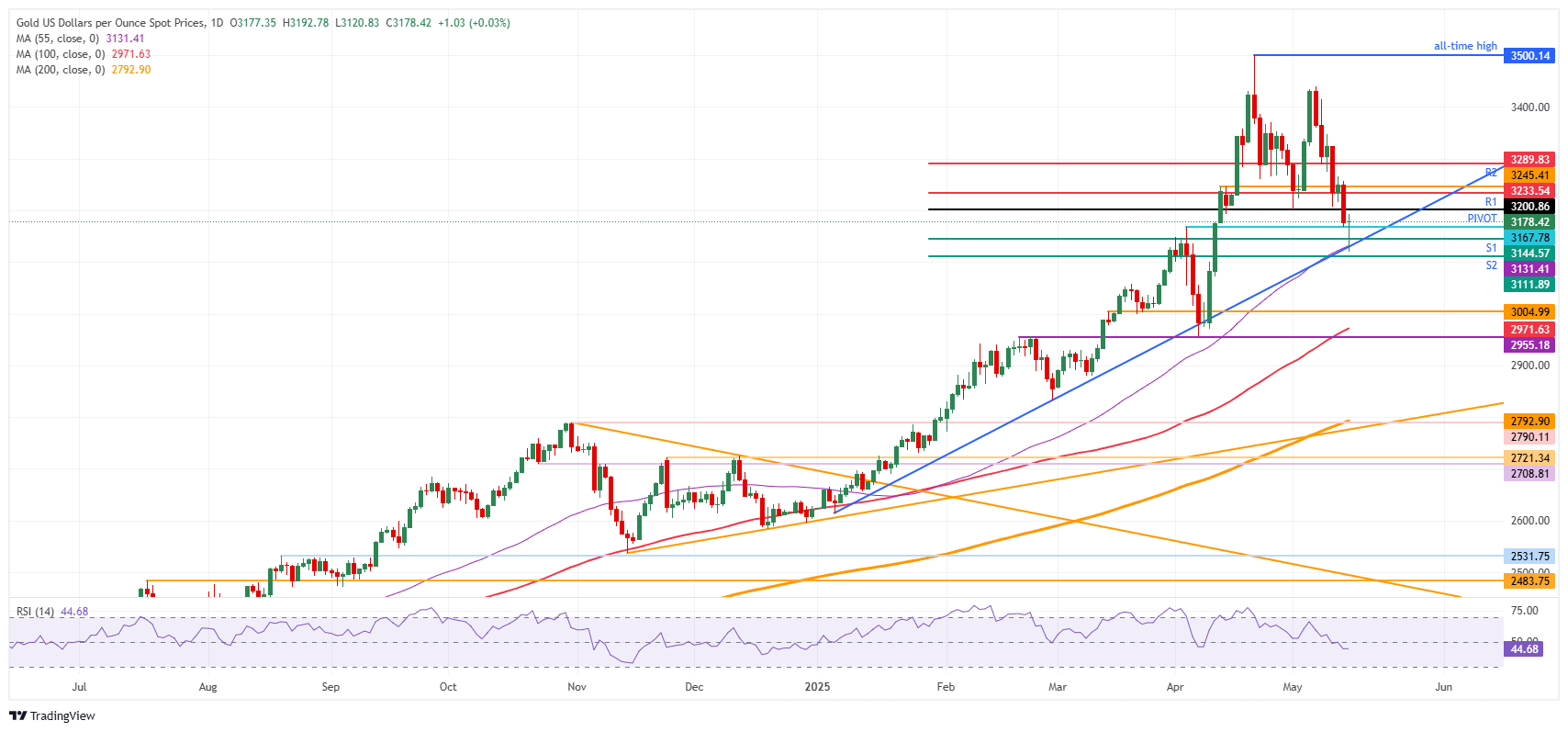
XAU/USD: Daily Chart
Interest rates FAQs
Interest rates are charged by financial institutions on loans to borrowers and are paid as interest to savers and depositors. They are influenced by base lending rates, which are set by central banks in response to changes in the economy. Central banks normally have a mandate to ensure price stability, which in most cases means targeting a core inflation rate of around 2%. If inflation falls below target the central bank may cut base lending rates, with a view to stimulating lending and boosting the economy. If inflation rises substantially above 2% it normally results in the central bank raising base lending rates in an attempt to lower inflation.
Higher interest rates generally help strengthen a country’s currency as they make it a more attractive place for global investors to park their money.
Higher interest rates overall weigh on the price of Gold because they increase the opportunity cost of holding Gold instead of investing in an interest-bearing asset or placing cash in the bank. If interest rates are high that usually pushes up the price of the US Dollar (USD), and since Gold is priced in Dollars, this has the effect of lowering the price of Gold.
The Fed funds rate is the overnight rate at which US banks lend to each other. It is the oft-quoted headline rate set by the Federal Reserve at its FOMC meetings. It is set as a range, for example 4.75%-5.00%, though the upper limit (in that case 5.00%) is the quoted figure. Market expectations for future Fed funds rate are tracked by the CME FedWatch tool, which shapes how many financial markets behave in anticipation of future Federal Reserve monetary policy decisions.
Author

Filip Lagaart
FXStreet
Filip Lagaart is a former sales/trader with over 15 years of financial markets expertise under its belt.