Gold retreats from record high as Powell cools cut bets, US Dollar strengthens
- Gold tumbles as Fed's Powell reiterates balanced dual mandate, notes labor risks and high inflation, dampening rate-cut hopes.
- US Treasury yields climb, boosting the US Dollar Index to 97.85 and pressuring bullion after three-day rally.
- Traders eye GDP, jobless claims, and Core PCE data for fresh direction on Fed easing outlook.

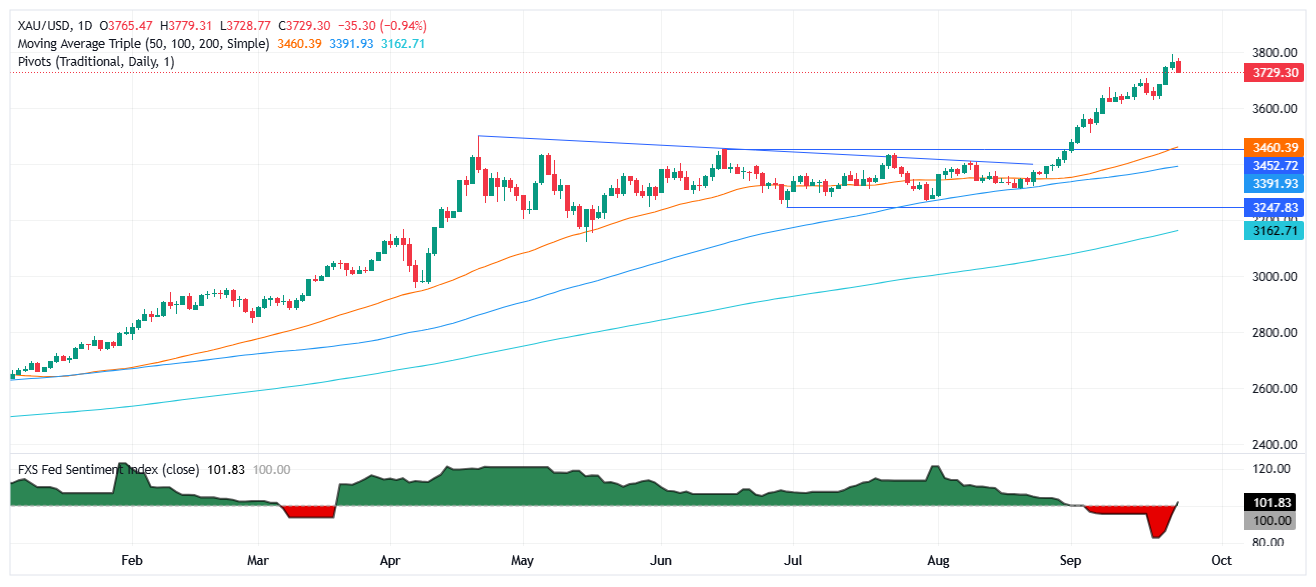
Gold (XAU/USD) price turns negatively on Wednesday after rallying for three consecutive trading days, which pushed the yellow metal to a record high at $3,791, before retreating somewhat as investors digest Federal Resever (Fed) Chair Jerome Powell's comments, which seem to pour cold water on rate cut expectations.
Gold slips as rising yields and Greenback demand weigh; focus shifts to GDP and PCE inflation
XAU/USD trades at $3,734, down 0.78% at the time of writing. Greenback’s advance is one of the reasons that put a lid on Bullion prices, underpinned by Powell’s neutral stance.
Fed Chair Powell said that policymakers must look at both sides of the dual mandate equally. He recognized that risks in the labor market had risen as well as for inflation, from which he said that it remains “somewhat elevated,” and added that monetary policy is modestly restrictive, but “well positioned to respond to potential economic developments.”
On the data front, housing data was positive on Wednesday after Tuesday’s weaker-than-expected S&P Global Flash Purchasing Managers’ Index (PMI) report.
The sudden drop in Bullion prices could also be attributed to the rise of US Treasury yields, which are underpinning the American currency. The US Dollar Index (DXY), which tracks the buck’s value against a basket of six currencies, is up 0.66% at 97.85.
Regarding geopolitics, US President Donald Trump's sudden shift towards supporting Ukraine, as he said, “Kyiv can win all of Ukraine back from Russia.”
The US economic docket will feature Gross Domestic Product (GDP) figures, Initial Jobless Claims data and the Fed’s preferred inflation gauge, the Core Personal Consumption Expenditures (PCE) Price Index.
Daily digest market movers: US Treasury yields weigh on Gold prices
- US Treasury yields are climbing, with the 10-year Treasury note up three basis points (bps) at 4.137%. US real yields—calculated by subtracting inflation expectations from the nominal yield—, which correlate inversely to Gold prices, surge nearly three and a half bps to 1.767%.
- New Home Sales in August improved sharply, from 0.664 million to 0.8 million, a 20.5% increase that exceeded forecasts of 0.65 million. Although the data was positive, the latest S&P Global Purchasing Managers Index (PMI) print in the services and manufacturing sectors indicates that the economy is cooling.
- Traders are eyeing the release of Initial Jobless Claims for the week ending September 20, with estimates of 235K people filing for unemployment benefits, above the previous number of 231K.
- Durable Goods Orders in August are projected to improve, following July’s dismal print of -2.8%. Economists estimate that orders will dip -0.5% MoM. At the same time, the final reading of the US GDP for the second quarter is expected to remain unchanged at 3.3% YoY.
- A flurry of Federal Reserve speakers will cross the wires, with regional Fed Presidents Schmid, Williams, Logan and Daly, leading the pack. Fed Governors Bowman and Barr will complete the parade.
- The Federal Reserve is expected to cut rates by 25 bps at the October 19 meeting, as revealed by data from Prime Market Terminal. Odds are at 91%.
Technical outlook: Gold price sinks below $3,750, bears eye $3,700
Gold price bullish bias remains intact in the long-term, but daily, a reversal is underway, threatening to keep prices below $3,750 towards the end of the day. If achieved, XAU/USD could remain range-bound within the $3,700-$3,750 range as market participants wait for fresh catalysts.
If XAU/USD drops below $3,700, the next support would be the 20-day Simple Moving Average (SMA) at $3,613, ahead of challenging $3,600. Otherwise, if buyers claim $3,750, the next area of interest would be the all-time high at $3,791.
Gold FAQs
Gold has played a key role in human’s history as it has been widely used as a store of value and medium of exchange. Currently, apart from its shine and usage for jewelry, the precious metal is widely seen as a safe-haven asset, meaning that it is considered a good investment during turbulent times. Gold is also widely seen as a hedge against inflation and against depreciating currencies as it doesn’t rely on any specific issuer or government.
Central banks are the biggest Gold holders. In their aim to support their currencies in turbulent times, central banks tend to diversify their reserves and buy Gold to improve the perceived strength of the economy and the currency. High Gold reserves can be a source of trust for a country’s solvency. Central banks added 1,136 tonnes of Gold worth around $70 billion to their reserves in 2022, according to data from the World Gold Council. This is the highest yearly purchase since records began. Central banks from emerging economies such as China, India and Turkey are quickly increasing their Gold reserves.
Gold has an inverse correlation with the US Dollar and US Treasuries, which are both major reserve and safe-haven assets. When the Dollar depreciates, Gold tends to rise, enabling investors and central banks to diversify their assets in turbulent times. Gold is also inversely correlated with risk assets. A rally in the stock market tends to weaken Gold price, while sell-offs in riskier markets tend to favor the precious metal.
The price can move due to a wide range of factors. Geopolitical instability or fears of a deep recession can quickly make Gold price escalate due to its safe-haven status. As a yield-less asset, Gold tends to rise with lower interest rates, while higher cost of money usually weighs down on the yellow metal. Still, most moves depend on how the US Dollar (USD) behaves as the asset is priced in dollars (XAU/USD). A strong Dollar tends to keep the price of Gold controlled, whereas a weaker Dollar is likely to push Gold prices up.
Author

Christian Borjon Valencia
FXStreet
Markets analyst, news editor, and trading instructor with over 14 years of experience across FX, commodities, US equity indices, and global macro markets.