Gold retreats as Fed cut bets fade and safe-haven demand weakens
- XAU/USD retreats to $4,204 after touching a three-week high of $4,245, as fading Fed cut expectations cool early-session momentum.
- The US government reopening and US–China trade truce reduce safe-haven demand, potentially limiting further upside.
- Mixed Fed rhetoric continues, with Daly being dovish, while Kashkari warns inflation remains uncomfortably high.

Gold (XAU/USD) rose on Thursday to a nearly three-week high of $4,245 as the US government reopening pushed the Greenback lower. Speculation that September’s jobs data could be the catalyst for the Federal Reserve (Fed) to cut rates pushed the yellow metal higher.
At the time of writing, XAU/USD trades at $4,204, up 0.25% daily, losing some of its shine as market participants trimmed bets that the Fed would cut rates at the December meeting.
Bullion pares gains as traders trim December easing expectations despite softer Dollar and ongoing macro uncertainty
Last month, the US central bank lowered borrowing costs by 25 bps to the 3.75%-4% range, but Fed Chair Jerome Powell warned that for December’s meeting is not guaranteed.
Catalysts pushing Gold prices higher due to uncertainty could be the reason behind Bullion’s ongoing dip. The trade-truce between the US and China, and US government’s reopening, might be headwinds and push XAU/USD lower.
In the meantime, Federal Reserve officials are grabbing the headlines, as San Francisco Fed President Mary Daly reaffirmed her dovish stance, while Minneapolis Fed Neel Kashkari was hawkish, reaffirming that the costs of living are elevated.
Daily market movers: Gold holds firm despite high US real yields
- The US Dollar Index (DXY), which tracks the performance of the buck’s value against six other currencies, plunges 0.43% to 99.04 despite the government’s reopening.
- Conversely, US Treasury yields are rising, with the 10-year US Treasury note up three and a half basis points to 4.10%. US real yields — which correlate inversely to Gold prices — are also surging nearly four bps to 1.83%.
- The US House of Representatives approved the stopgap funding bill late on Wednesday in a 222-209 split vote, which restores the government’s operations through January 30, 2026, with some departments fully funded until the end of September 2026. Nevertheless, fears of another shutdown in early February 2026 loom.
- Minneapolis Neel Kashkari sees mixed signals from the economy, but emphasized that inflation is too high, “running around 3%.” Conversely, San Francisco’s Mary Daly said “it’s premature to say definitely no cut or definitely cut” in December. She stressed that the Fed’s dual mandate is in balance but noted that the job market has deteriorated.
- Expectations that the September Nonfarm Payrolls report could be released next week are rising, though the White House economic adviser Kevin Hassett said that the Unemployment Rate would not be published. In this regard, Fox’s Edward Lawrence said that September’s jobs report is expected to come out next week, citing sources.
- Meanwhile, the latest ADP report revealing that private companies slashed workers and Challenger’s reporting that US employers shed 153,074 jobs in October hint that it could be a dismal Nonfarm Payrolls report.
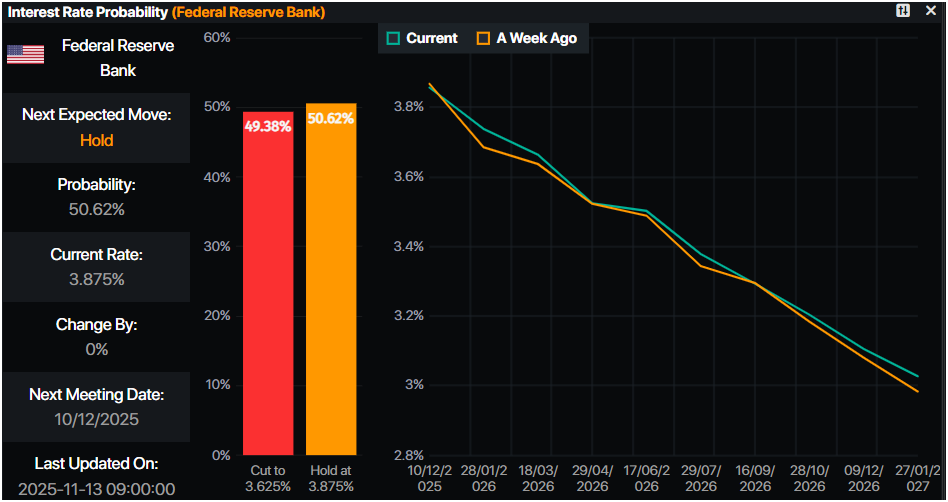
- The chances for a Fed rate cut at the December meeting are a coin flip, with odds for a hold standing at 50%, according to Prime Market Terminal Interest Rate Probability.
Technical outlook: Gold steadies near $4,200
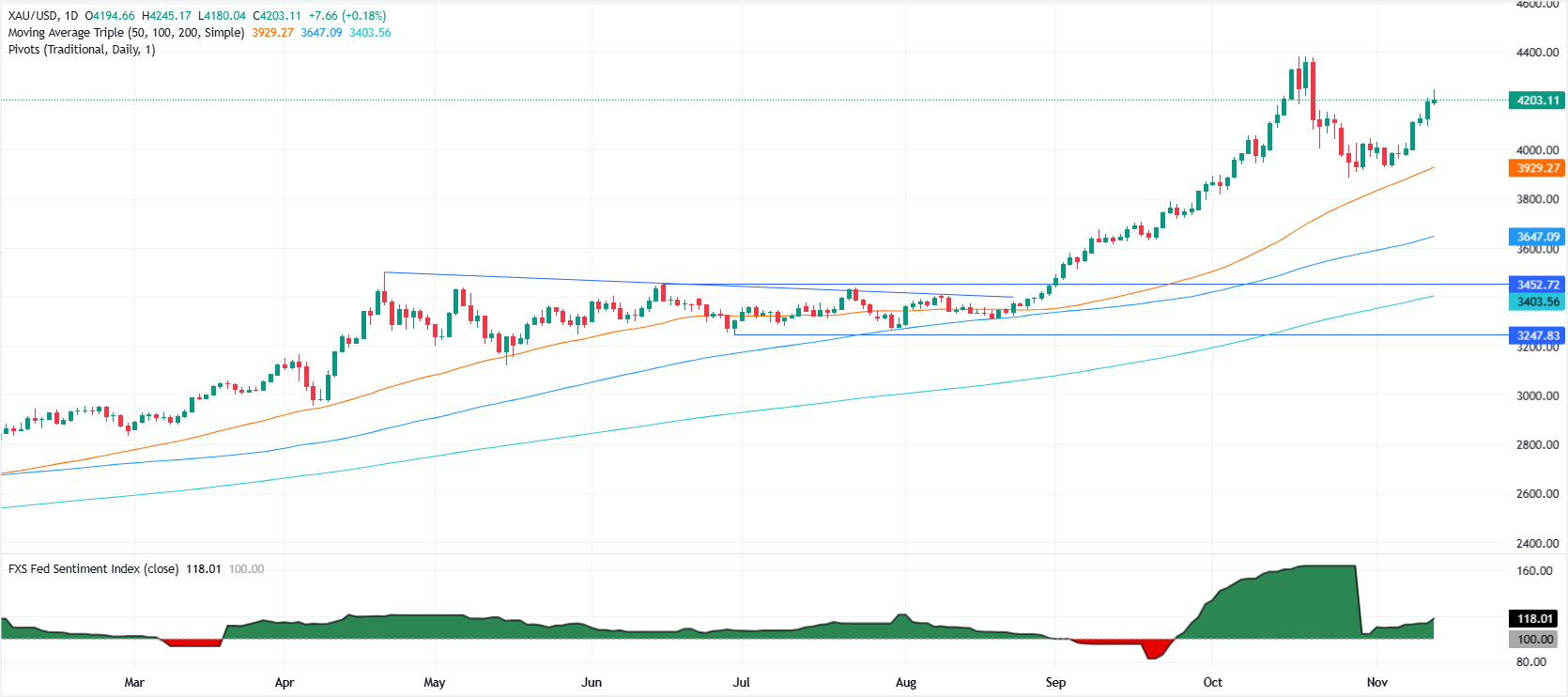
Gold’s uptrend remains intact, but buying pressure is fading unless Bullion ends on a daily basis above $4,200. Bullish momentum seems to be fading as shown by the Relative Strength Index (RSI) turning almost horizontal, but suggesting that buyers are in charge,
However, if XAU/USD closes below $4,200 on the day, this clears the path for sellers to push Gold towards $4,100 and below the 20-day Simple Moving Average (SMA) at $4,074. Once cleared, the next stop would be the October 28 low near $3,886.
Gold FAQs
Gold has played a key role in human’s history as it has been widely used as a store of value and medium of exchange. Currently, apart from its shine and usage for jewelry, the precious metal is widely seen as a safe-haven asset, meaning that it is considered a good investment during turbulent times. Gold is also widely seen as a hedge against inflation and against depreciating currencies as it doesn’t rely on any specific issuer or government.
Central banks are the biggest Gold holders. In their aim to support their currencies in turbulent times, central banks tend to diversify their reserves and buy Gold to improve the perceived strength of the economy and the currency. High Gold reserves can be a source of trust for a country’s solvency. Central banks added 1,136 tonnes of Gold worth around $70 billion to their reserves in 2022, according to data from the World Gold Council. This is the highest yearly purchase since records began. Central banks from emerging economies such as China, India and Turkey are quickly increasing their Gold reserves.
Gold has an inverse correlation with the US Dollar and US Treasuries, which are both major reserve and safe-haven assets. When the Dollar depreciates, Gold tends to rise, enabling investors and central banks to diversify their assets in turbulent times. Gold is also inversely correlated with risk assets. A rally in the stock market tends to weaken Gold price, while sell-offs in riskier markets tend to favor the precious metal.
The price can move due to a wide range of factors. Geopolitical instability or fears of a deep recession can quickly make Gold price escalate due to its safe-haven status. As a yield-less asset, Gold tends to rise with lower interest rates, while higher cost of money usually weighs down on the yellow metal. Still, most moves depend on how the US Dollar (USD) behaves as the asset is priced in dollars (XAU/USD). A strong Dollar tends to keep the price of Gold controlled, whereas a weaker Dollar is likely to push Gold prices up.
Author

Christian Borjon Valencia
FXStreet
Markets analyst, news editor, and trading instructor with over 14 years of experience across FX, commodities, US equity indices, and global macro markets.

















