Gold rebounds to $3,330 as US yields fall, JOLTS miss boosts bullion bid
- XAU/USD recovers on soft labor data and easing Dollar after a four-day slide.
- JOLTS job openings fell to 7.437M, stoking hiring concerns amid tariff uncertainties.
- Treasury yields retreat, helping gold bounce off a three-week low near $3,300.
- The Fed is expected to hold rates on Wednesday; focus on possible dissent and inflation outlook.

Gold price recovered some ground on Tuesday after falling for the fourth straight day as the Greenback trimmed some of its earlier gains, which boosted appetite for the yellow metal. A drop in US Treasury yields and a soft labor market report in the United States (US) prompted investors to buy Bullion.
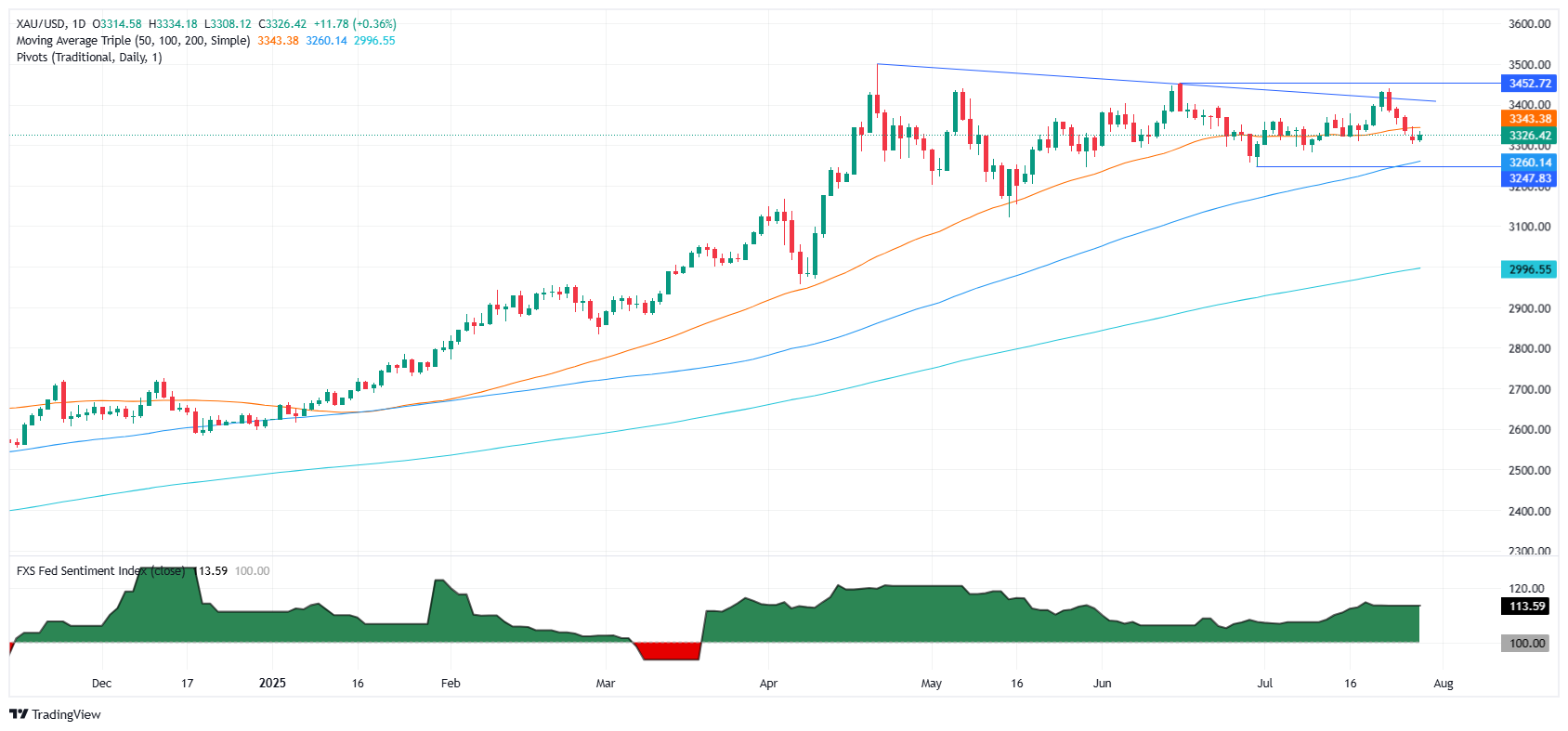
The XAU/USD trades at $3,330, up by 0.50% after reaching a three-week low of $3,301 on Monday and a daily low of $3,308.
The US Bureau of Labor Statistics (BLS) revealed that the Job Openings and Labor Turnover Survey (JOLTS) for June missed estimates as companies seemed reluctant to hire, spurred by tariff uncertainty. Nevertheless, trade news improved the tone as Beijing and Washington are going to continue talks over maintaining a tariff truce before it expires in two weeks, according to Bloomberg, as revealed by US Treasury Secretary Scott Bessent.
Other data showed that Consumer Confidence improved in July, according to the Conference Board (CB), though some comments from the survey showed households are struggling to find jobs.
In the meantime, traders brace for the Federal Reserve’s monetary policy decision, which would end on Wednesday, with the central bank expected to hold rates unchanged. Worth noting, if there are dissenters on the decision, following the latest remarks from Fed Governors Christopher Waller and Michelle Bowman.
After this, the US economic docket would be packed, with the release of Gross Domestic Product (GDP) figures, jobs data, the ISM Manufacturing PMI, and the Fed’s favorite inflation gauge, the Core Personal Consumption Expenditures (PCE) Price Index.
Daily digest market movers: Gold rallies in tandem with the Dollar as US yields tumble
- The June JOLTS report revealed that job openings dropped to 7.437 million, down from 7.769 million in May and below expectations of 7.5 million, according to the Bureau of Labor Statistics. The decline reflects growing business hesitancy to hire amid uncertainty over future tariff levels. The data arrives just before the Federal Reserve’s two-day policy meeting and the release of July’s Nonfarm Payrolls report, which is expected to show a slowdown in job creation to 102,000 from June’s 147,000.
- Separately, the Conference Board reported that Consumer Confidence rose in July, with the index climbing to 97.2 from 93.0 in June, topping estimates of 95.0.
- The Dollar prolonged its gains as portrayed by the US Dollar Index (DXY), which tracks the buck’s performance against six currencies, is up 0.25% at 98.91.
- US Treasury yields are down on Tuesday, providing a tailwind for Gold prices. The US 10-year T-note yield drops nine bps to 4.183%. US real yields are also falling nine basis points to 1.884%.
- Last week's US economic data, particularly employment, reaffirmed the Fed’s stance to keep the fed fund rate unchanged. This is because inflation metrics had not resumed their downward trend towards the US central bank 2% goal.
- A Reuters poll revealed that market participants expect the Gold price to average $3,320 a troy ounce in 2025, and $3,400 for 2026.
- The CME FedWatch Tool indicates that markets are pricing a 66% chance of a 25-basis-point rate cut by the Fed at the September 17 meeting.
XAU/USD technical outlook: Gold bounces back above $3,300, below the confluence of 20-, 50-day SMAs
Gold price shows signs of recovery, after a string of four days of losses, which dragged XAU from around $3,438 to $3,301. Momentum shows that sellers are taking a breather, as depicted by the Relative Strength Index (RSI). Still, further downside is seen as the RSI turned bearish, and XAU/USD is still below the 50-day Simple Moving Average (SMA) at $3,336.
If the 50-day SMA is cleared, look for a test of the 20-day SMA at $3,345, $3,350, and the $3,400 mark. Otherwise, if XAU/USD extends its losses below $3,300, the next support would be the confluence of the 100-day Simple Moving Average (SMA) and the June 30 low, around $3,242-3,246, respectively.
Gold FAQs
Gold has played a key role in human’s history as it has been widely used as a store of value and medium of exchange. Currently, apart from its shine and usage for jewelry, the precious metal is widely seen as a safe-haven asset, meaning that it is considered a good investment during turbulent times. Gold is also widely seen as a hedge against inflation and against depreciating currencies as it doesn’t rely on any specific issuer or government.
Central banks are the biggest Gold holders. In their aim to support their currencies in turbulent times, central banks tend to diversify their reserves and buy Gold to improve the perceived strength of the economy and the currency. High Gold reserves can be a source of trust for a country’s solvency. Central banks added 1,136 tonnes of Gold worth around $70 billion to their reserves in 2022, according to data from the World Gold Council. This is the highest yearly purchase since records began. Central banks from emerging economies such as China, India and Turkey are quickly increasing their Gold reserves.
Gold has an inverse correlation with the US Dollar and US Treasuries, which are both major reserve and safe-haven assets. When the Dollar depreciates, Gold tends to rise, enabling investors and central banks to diversify their assets in turbulent times. Gold is also inversely correlated with risk assets. A rally in the stock market tends to weaken Gold price, while sell-offs in riskier markets tend to favor the precious metal.
The price can move due to a wide range of factors. Geopolitical instability or fears of a deep recession can quickly make Gold price escalate due to its safe-haven status. As a yield-less asset, Gold tends to rise with lower interest rates, while higher cost of money usually weighs down on the yellow metal. Still, most moves depend on how the US Dollar (USD) behaves as the asset is priced in dollars (XAU/USD). A strong Dollar tends to keep the price of Gold controlled, whereas a weaker Dollar is likely to push Gold prices up.
Author

Christian Borjon Valencia
FXStreet
Markets analyst, news editor, and trading instructor with over 14 years of experience across FX, commodities, US equity indices, and global macro markets.