Gold retreats as rising yields and firm USD weigh ahead of Trump-Zelenskyy talks
- Gold gives up intraday gains after rebounding from a two-week low, as cautious market sentiment prevails ahead of the Trump–Zelenskyy meeting.
- The US Dollar holds firm, while rising Treasury yields add pressure on Gold, as equity markets trade near record highs and dampen demand for safe-haven assets.
- Mixed US economic data tempers rate cut optimism, though markets still largely expect a 25 bps cut in September.


Gold (XAU/USD) kicks off the week on a volatile note, staging a sharp intraday recovery after briefly dipping to an 11-day low near $3,323 during early Monday trade. The rebound was initially driven by renewed safe-haven demand amid geopolitical uncertainties surrounding the Russia-Ukraine peace talks, following the weekend summit between US President Donald Trump and Russian President Vladimir Putin, which failed to deliver a breakthrough.
However, the precious metal has since given up its earlier gains and is edging lower during the American session, pressured by a rebound in US Treasury yields and a firm US Dollar. At the time of writing, Gold is trading near $3,336, down from its intraday high around $3,358. The recovery attempt appears to have stalled as rising yields weigh on non-yielding assets, while broader risk appetite remains supported by strong equity markets.
Despite the earlier bounce, Gold continues to trade within the familiar range established last week, with traders staying cautious as attention turns to a scheduled meeting later on Monday between President Donald Trump, Ukrainian President Volodymyr Zelenskyy, and several European leaders, which could shape the next phase of diplomatic efforts on the Ukraine conflict.
The Trump-Putin meeting, held in Alaska on Friday, ended without a clear resolution to the conflict in Ukraine. There was no ceasefire agreement, although talks about possible security guarantees for Ukraine gave some hope that progress could still be made.
President Trump shifted focus away from demanding an immediate ceasefire and instead supported a broader peace agreement framework. At the same time, reports said that Russia asked for control over disputed areas like Donetsk, a concession that Ukraine is unlikely to accept. With the proposals now on the table, the next move rests with Ukraine and its allies.
Market movers: Dollar steady, ahead of Trump-Zelenskyy talks
- The US Dollar Index (DXY), which measures the Greenback's value against a basket of six major currencies, is holding firm above a two-week low, trading near the 98.00 psychological level.
- US Treasury yields rebound across the curve after easing earlier, with the benchmark 10-year yield climbing to 4.328% and the 30-year rising to 4.927%. The recovery in yields is weighing on bullion, which typically struggles when real yields move higher.
- US Retail Sales in July rose 0.5% MoM, in line with expectations, but slower than the upwardly revised 0.9% increase in June. On a yearly basis, sales growth eased to 3.9% from 4.4%, pointing to some cooling in consumer spending.
- Consumer sentiment also softened, with the preliminary University of Michigan Consumer Sentiment Index for August dropping to 58.6 from 61.7, while long-term inflation expectations spiked — the one-year outlook surged to 4.9% and the five-year view rose to 3.9%.
- Last week’s US inflation data pointed to a mixed picture. While consumer prices rose steadily, the sharp jump in wholesale inflation challenged the case for a surprise 50 bps rate cut or aggressive easing by the Federal Reserve (Fed).
- While markets still see a high chance of a rate cut in September, traders trimmed some bets after the latest US data. According to the CME FedWatch Tool, the probability of a 25 basis point cut at the next Fed meeting stands at 84%, down from nearly 100% earlier last week following the Consumer Price Index (CPI) release. Rate cut expectations continue to act as a tailwind for Gold, helping to limit its downside.
- The CFTC’s Gold Commitment of Traders (CoT) report, released on August 15, showed that speculative net-long positions fell to 229,500 contracts from 237,100 the previous week. The data suggests that investors have slightly reduced their bullish exposure to Gold amid cautious market sentiment.
- A quiet US economic calendar on Monday leaves Gold more sensitive to geopolitical headlines, with traders closely watching developments around the Trump-Zelenskyy meeting.
- This week’s key highlights include the Federal Open Market Committee (FOMC) meeting minutes due Wednesday and Fed Chair Jerome Powell’s speech at the Jackson Hole symposium on Friday, both of which could offer fresh clues on the Fed’s monetary policy outlook.
Technical analysis: XAU/USD trapped in range as bulls struggle above $3,350
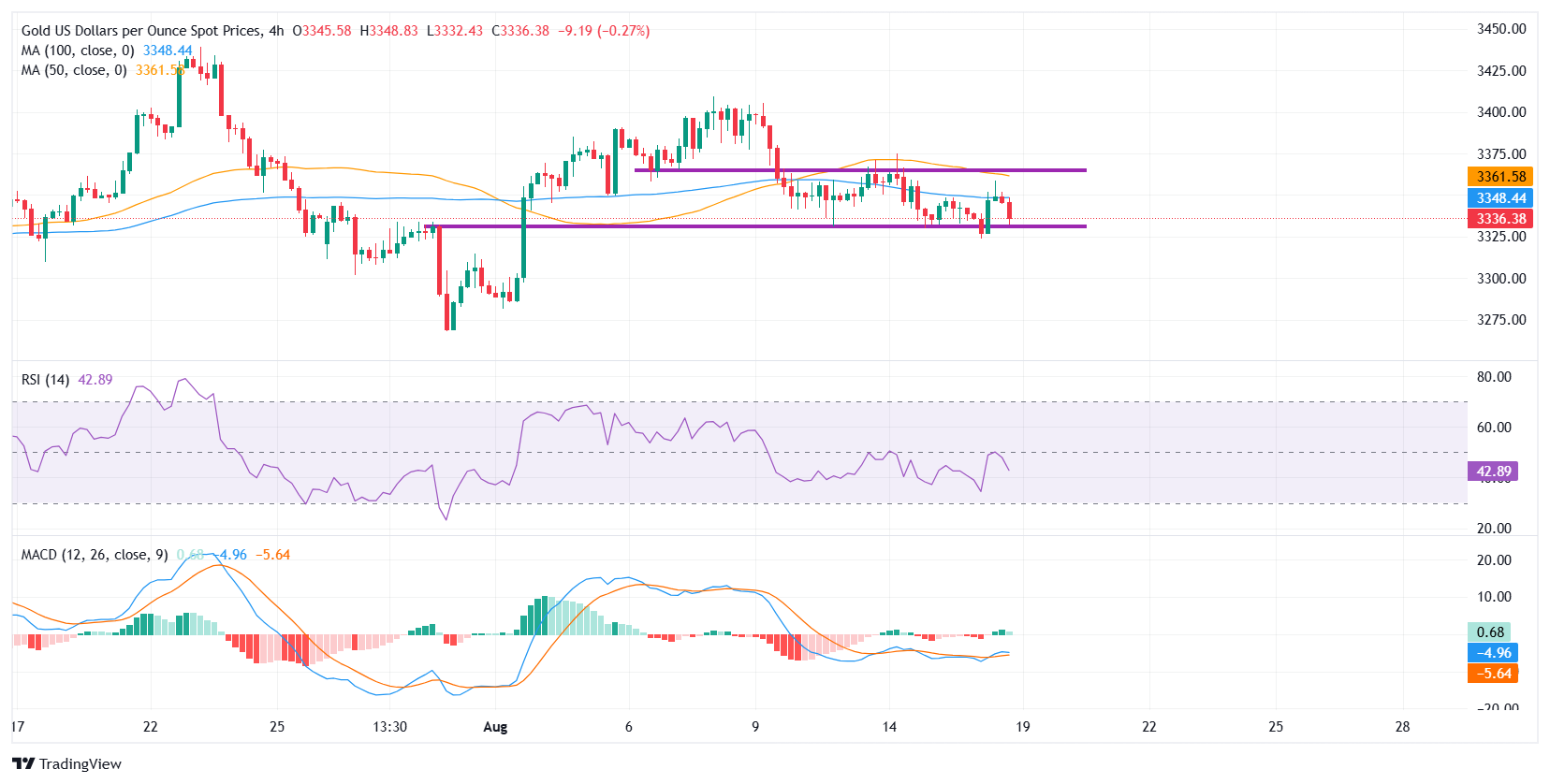
Gold (XAU/USD) continues to trade within a well-defined consolidation range on the 4-hour chart with immediate support at $3,330 and resistance at $3,370. The metal remains caught in consolidation as traders await fresh directional cues from geopolitical developments. Price action shows limited commitment from either bulls or bears, keeping Gold stuck in familiar territory.
Repeated dip-buying interest has emerged near the $3,330 support area, but Gold is struggling to gain traction above $3,350. The 100-period Simple Moving Average (SMA), currently near $3,348, is acting as immediate resistance. Meanwhile, the 50-period SMA around $3,362 reinforces the topside barrier, closely aligning with the upper edge of the consolidation range.
The Relative Strength Index (RSI) is hovering just below the neutral 50 level, having recovered modestly after edging close to oversold territory earlier. The Moving Average Convergence Divergence (MACD) indicator is showing tentative signs of a bullish crossover, but both the MACD and signal lines remain below the zero threshold, and the histogram bars are shallow. This setup suggests fading downside pressure, though the absence of strong momentum keeps the short-term outlook cautious.
A break above $3,370 would be needed to confirm a bullish breakout, potentially opening the door toward the $3,400 psychological level. On the downside, a sustained move below $3,330 could expose the next support at $3,300, with further downside risk if that level gives way.
Economic Indicator
Jackson Hole Symposium
The Jackson Hole Economic Policy Symposium is an annual symposium sponsored by the Federal Reserve Bank of Kansas City since 1978, and held in Jackson Hole, Wyoming, since 1981. It is a forum for central bankers, policy experts and academics to come together to focus on a topic.
Read more.Next release: Thu Aug 21, 2025 00:00
Frequency: Irregular
Consensus: -
Previous: -
Author
Vishal Chaturvedi
FXStreet
I am a macro-focused research analyst with over four years of experience covering forex and commodities market. I enjoy breaking down complex economic trends and turning them into clear, actionable insights that help traders stay ahead of the curve.