Gold range-bound as markets digest delayed US jobs data
- Gold is range-bound despite a stronger-than-expected NFP report.
- Improved risk appetite after Nvidia’s upbeat earnings limits safe-haven demand.
- A firmer US Dollar also weighs on the metal as markets scale back expectations of a December Fed rate cut.

Gold (XAU/USD) trades a little changed on Thursday, moving in a tight range as traders digest the mixed set of delayed September US jobs data. At the time of writing, XAU/USD is trading around $4,080, easing after briefly climbing above the $4,100 psychological mark.
The mood across markets has brightened after Nvidia delivered strong earnings, sparking a rebound in global equities and easing safe-haven flows into Gold. On top of that, a stronger US Dollar (USD) as investors scale back expectations of a December interest rate cut by the Federal Reserve (Fed) is adding pressure and limiting the metal’s upside.
Markets saw a sharp repricing of rate expectations after the Bureau of Labor Statistics confirmed that the October Employment Situation Report will be released together with the November data. In addition, the hawkish-leaning Federal Open Market Committee (FOMC) Meeting Minutes published on Wednesday reinforced expectations that the Fed may leave interest rates unchanged in December.
Market movers: US Dollar steady after upbeat NFP surprise
- The US Dollar Index (DXY), which measures the Greenback against a basket of six major currencies, is trading around 100.18, hovering near its highest levels since August and revisiting the territory last seen on November 5.
- September Nonfarm Payrolls (NFP) rose by 119K, comfortably beating expectations for a 50K increase. August’s reading was revised to a 4K decline instead of the previously reported 22K gain. The Unemployment Rate climbed to 4.4%, modestly above the 4.3% estimate and unchanged from the prior month.
- Average Hourly Earnings rose 0.2% MoM in September, slightly below expectations for 0.3% and softer than the 0.4% increase seen previously. On a yearly basis, wages grew 3.8%, matching the prior reading and coming in just above the 3.7% forecast. Average Weekly Hours held steady at 34.2, in line with expectations.
- The October FOMC Minutes tilted hawkish, with several policymakers observing that inflation had moved up since earlier in the year and remained above the 2% goal, while progress toward disinflation had stalled. Many participants judged that further rate cuts were not necessarily appropriate at the December meeting. The Minutes also noted that although most participants favored October’s 25 bps cut, some of them said they could have supported leaving rates unchanged.
- The US Bureau of Labor Statistics (BLS) confirmed on Wednesday that the October payrolls report has been postponed after the government shutdown prevented officials from collecting key data, including inputs needed to calculate the unemployment rate. The missing October figures will now be released together with the November jobs report on December 16, reducing the data available to the Fed ahead of its December 9-10 FOMC meeting.
- According to the CME FedWatch Tool, markets are assigning a 31.8% probability of a December rate cut, down from about 50% a week ago. Attention now turns to the delayed September NFP report, which could shift expectations again. Economists forecast payrolls to rise by roughly 50K, compared with the 22K increase recorded in August.
Technical analysis: XAU/USD clings to $4,050 support as 100-SMA keeps bears in check
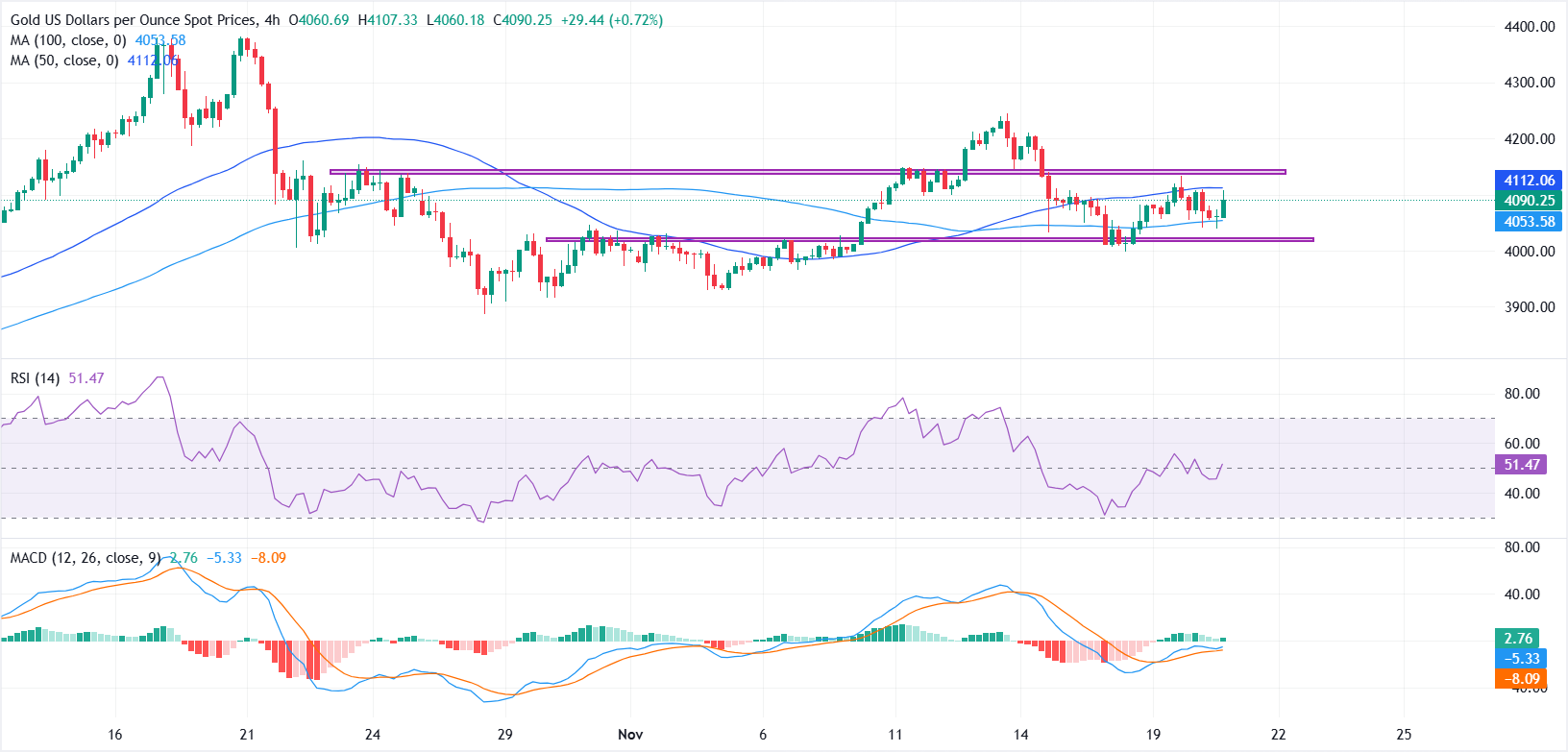
On the 4-hour chart, XAU/USD is consolidating just above a key confluence support zone around $4,050, where the 100-period Simple Moving Average (SMA) is offering immediate technical support. As long as the price holds above the 100 SMA, the short-term outlook remains constructive. However, a clean break below this confluence zone would weaken the technical bias and open the door toward the $4,000 mark.
On the upside, Gold continues to face strong resistance in the $4,100-$4,150 band. A decisive breakout above $4,150 would be needed to revive bullish momentum, paving the way for a move toward $4,200, with further follow-through buying potentially exposing $4,250 next.
The Relative Strength Index (RSI) on the 4-hour timeframe is hovering near 45, reflecting a neutral-to-slightly bearish momentum setup. A recovery in the RSI through the 50 midline would help improve bullish traction.
(This story was corrected on November 20 at 14:31 GMT to say that Gold is trading with little change on Thursday, not Wednesday.)
Nonfarm Payrolls FAQs
Nonfarm Payrolls (NFP) are part of the US Bureau of Labor Statistics monthly jobs report. The Nonfarm Payrolls component specifically measures the change in the number of people employed in the US during the previous month, excluding the farming industry.
The Nonfarm Payrolls figure can influence the decisions of the Federal Reserve by providing a measure of how successfully the Fed is meeting its mandate of fostering full employment and 2% inflation. A relatively high NFP figure means more people are in employment, earning more money and therefore probably spending more. A relatively low Nonfarm Payrolls’ result, on the either hand, could mean people are struggling to find work. The Fed will typically raise interest rates to combat high inflation triggered by low unemployment, and lower them to stimulate a stagnant labor market.
Nonfarm Payrolls generally have a positive correlation with the US Dollar. This means when payrolls’ figures come out higher-than-expected the USD tends to rally and vice versa when they are lower. NFPs influence the US Dollar by virtue of their impact on inflation, monetary policy expectations and interest rates. A higher NFP usually means the Federal Reserve will be more tight in its monetary policy, supporting the USD.
Nonfarm Payrolls are generally negatively-correlated with the price of Gold. This means a higher-than-expected payrolls’ figure will have a depressing effect on the Gold price and vice versa. Higher NFP generally has a positive effect on the value of the USD, and like most major commodities Gold is priced in US Dollars. If the USD gains in value, therefore, it requires less Dollars to buy an ounce of Gold. Also, higher interest rates (typically helped higher NFPs) also lessen the attractiveness of Gold as an investment compared to staying in cash, where the money will at least earn interest.
Nonfarm Payrolls is only one component within a bigger jobs report and it can be overshadowed by the other components. At times, when NFP come out higher-than-forecast, but the Average Weekly Earnings is lower than expected, the market has ignored the potentially inflationary effect of the headline result and interpreted the fall in earnings as deflationary. The Participation Rate and the Average Weekly Hours components can also influence the market reaction, but only in seldom events like the “Great Resignation” or the Global Financial Crisis.
Author

Vishal Chaturvedi
FXStreet
I am a macro-focused research analyst with over four years of experience covering forex and commodities market. I enjoy breaking down complex economic trends and turning them into clear, actionable insights that help traders stay ahead of the curve.