Gold dives 1% lower in CPI aftermath
- Gold faces a hangover on Wednesday after a wild ride the previous day.
- Traders are shedding their stake in Bullion after a stronger inflation report.
- The $3,000 level is out of the cards this week as a technical barrier must first be overcome.

Gold’s price (XAU/USD) is facing a dive lower and says goodbey to $2,900 for now after the US Consumer Price Index (CPI) data for January came in stronger in both the monthly Headline and monthly Core inflation gauge. The inflation numbers are coming in as an outright surprise just a day after Federal Reserve (Fed) Chairman Jerome Powell faces lawmakers at Capitol Hill. Powell did not say much but stated that the current level of the monetary policy rate is helping the central bank to withstand market volatility and potential inflation shocks that could take place.
Meanwhile, traders see their beloved Fed under pressure from the Department of Government Efficiency (DOGE), led by Elon Musk, who already mentioned at the beginning of the week that the Fed will face scrutiny from DOGE, as it will from all other government agencies. DOGE has already tried accessing all US Treasury Data, though access to the US Treasury system remains blocked for now.
Daily digest market movers: Powell proven right
- At 15:00 GMT, Fed Chairman Jerome Powell testifies on his second day in Congress before the US House Financial Services Committee.
- At 17:00 GMT, Federal Reserve Bank of Atlanta President Raphael W. Bostic gives remarks at the Atlanta chapter of the National Association of Corporate Directors.
- At 22:05 GMT, Federal Reserve Governor Christopher Waller is set to speak at "A very Stable Conference: Stablecoin Infrastructure for Real World Applications" in San Francisco, California.
- Australia’s second-largest Gold miner, Evolution Mining Ltd., expects prices to rise further in the near term after the company posted record first-half profits following bullion’s rally to near $3,000 an ounce, Bloomberg reports.
- The CME FedWatch tool shows a 95.5% chance that interest rates will remain unchanged in March, compared to a slim 4.5% chance of a 25 basis point (bps) interest rate cut.
Technical Analysis: Here comes the sell off
With Fed Chairman Powell's testimony, Gold might have shot itself in the foot after its volatile session on Tuesday. With the price action now below the daily Pivot Point (at $2,907), Bullion is not facing just the Pivot Point’s resistance levels, it also needs to break through a Pivot Point level. In theory, an opening below the daily pivot is always seen as bearish and is often a sign more downside is to come in the same trading day.
The first support level on Wednesday is $2,872, which is the S1 support. From there, S2 support should come in at $2,846. In case of a sharp correction, the bigger $2,790 level (October 31, 2024, high) should be able to catch any falling knives.
On the upside, the daily Pivot Point at $2,907 is the first big level that needs to be recovered. From there, the R1 resistance comes in at $2,933. In case the rally continues, the $2,950 big figure psychological level and the R2 resistance at $2,968 will be tested for a break to the upside. Further up, the $3,000 psychological level could be next.
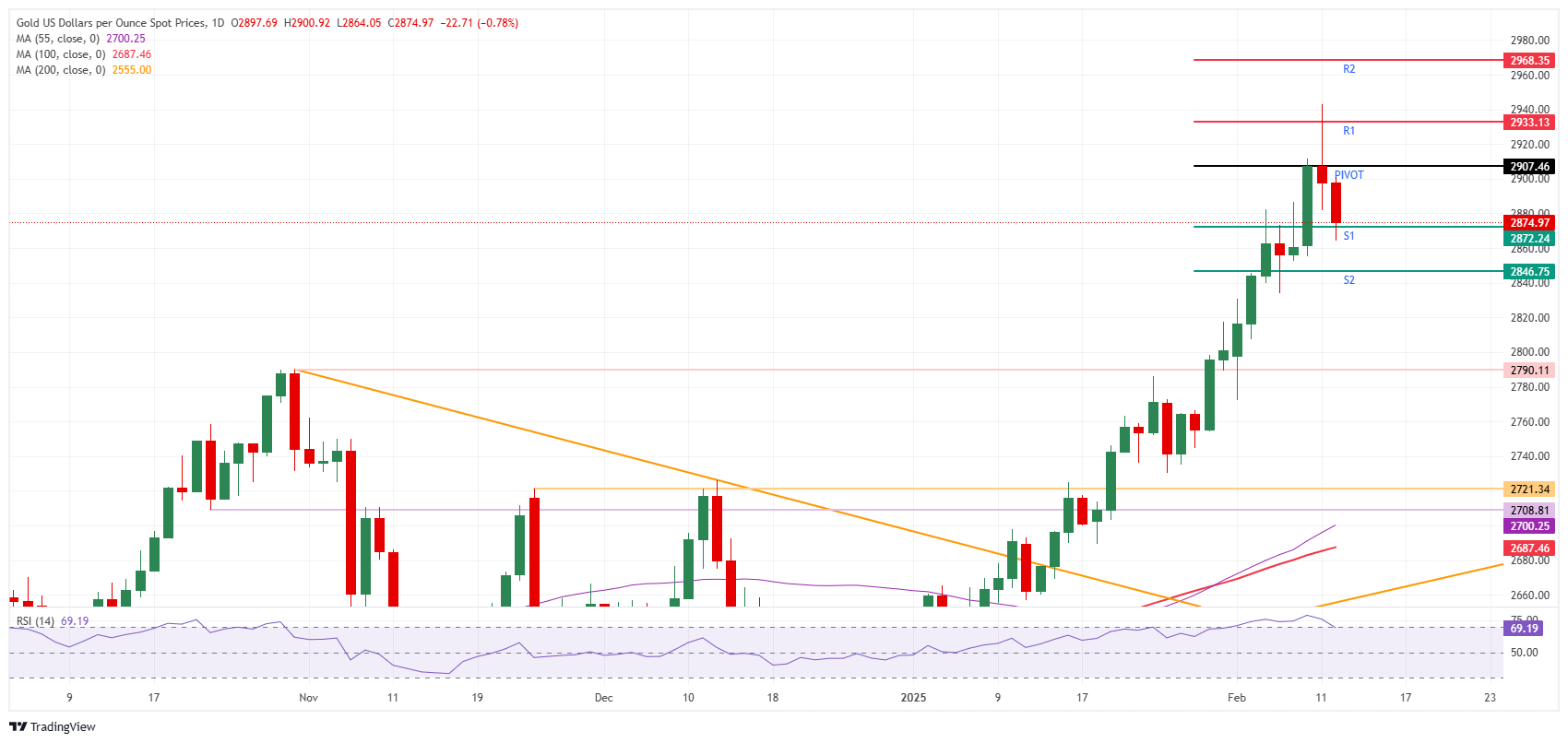
XAU/USD: Daily Chart
Gold FAQs
Gold has played a key role in human’s history as it has been widely used as a store of value and medium of exchange. Currently, apart from its shine and usage for jewelry, the precious metal is widely seen as a safe-haven asset, meaning that it is considered a good investment during turbulent times. Gold is also widely seen as a hedge against inflation and against depreciating currencies as it doesn’t rely on any specific issuer or government.
Central banks are the biggest Gold holders. In their aim to support their currencies in turbulent times, central banks tend to diversify their reserves and buy Gold to improve the perceived strength of the economy and the currency. High Gold reserves can be a source of trust for a country’s solvency. Central banks added 1,136 tonnes of Gold worth around $70 billion to their reserves in 2022, according to data from the World Gold Council. This is the highest yearly purchase since records began. Central banks from emerging economies such as China, India and Turkey are quickly increasing their Gold reserves.
Gold has an inverse correlation with the US Dollar and US Treasuries, which are both major reserve and safe-haven assets. When the Dollar depreciates, Gold tends to rise, enabling investors and central banks to diversify their assets in turbulent times. Gold is also inversely correlated with risk assets. A rally in the stock market tends to weaken Gold price, while sell-offs in riskier markets tend to favor the precious metal.
The price can move due to a wide range of factors. Geopolitical instability or fears of a deep recession can quickly make Gold price escalate due to its safe-haven status. As a yield-less asset, Gold tends to rise with lower interest rates, while higher cost of money usually weighs down on the yellow metal. Still, most moves depend on how the US Dollar (USD) behaves as the asset is priced in dollars (XAU/USD). A strong Dollar tends to keep the price of Gold controlled, whereas a weaker Dollar is likely to push Gold prices up.
Author

Filip Lagaart
FXStreet
Filip Lagaart is a former sales/trader with over 15 years of financial markets expertise under its belt.
















